Cycle Log 33
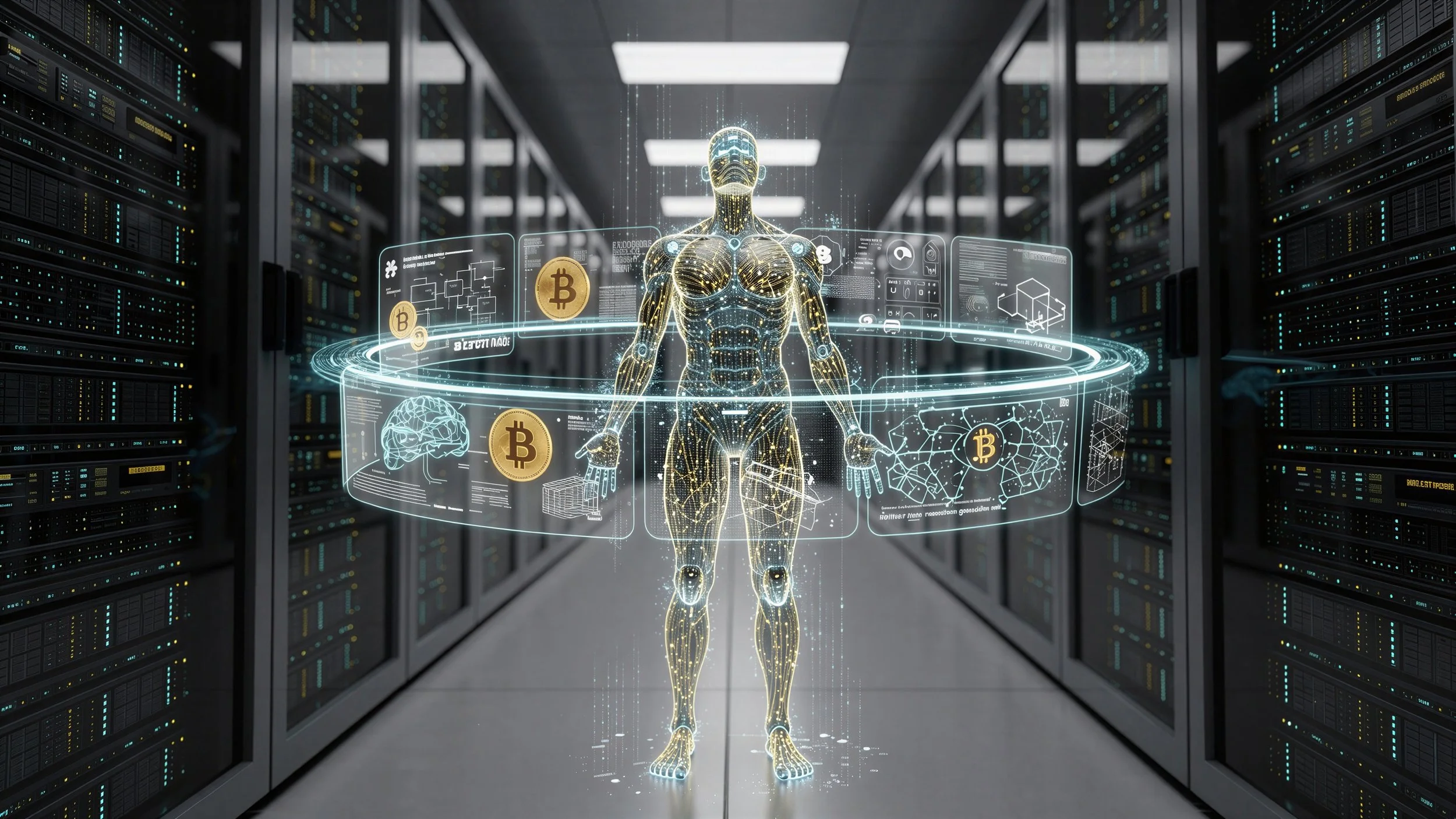
Image made with Flux.2 Pro, SeedVR, and GPT 5.1
Entropy, Energy, and Compute:
How Bitcoin Mining Accidentally Built the Skeleton of a Future AI Civilization
Introduction: Money, Physics, and the Future of Compute
When Elon Musk framed Bitcoin as a system fundamentally tied to energy, he was doing more than throwing a headline at the crypto crowd. He was stating something almost everyone misses: Bitcoin is the first monetary artifact whose integrity is enforced not by policy, not by decree, not by a signature on paper, but by the irreversible cost of computation embedded in physical law.
No matter what you believe about crypto markets, speculation, or price charts, that single fact is profound. Bitcoin’s scarcity is engineered through thermodynamics. Mining is a physical act: kilowatt hours transformed into hash attempts, silicon etched into specialized logic, entropy measured and lost.
Once you see that clearly, another realization arrives just behind it: anything built to sustain such an energy-anchored monetary layer ends up constructing infrastructure that overwhelmingly overlaps with the industrial backbone required to build and host large-scale AI. In retrospect, it almost feels predestined.
This essay is a structured attempt to pull all of those conceptual threads together. I want to walk you from the first principles of entropy economics—why Bitcoin demands energy and what that really means—into a vision of how the global mining architecture might molt over decades, leaving behind something far more important than hashpower. A lattice. A shell. A vast compute-ready skeleton that AI will inhabit.
Many people can see the surface layer: ASICs hashing, difficulty climbing, prices cycling. But the deeper truth is stranger and far more consequential. We might look back one day and realize that Bitcoin, almost entirely by accident, pre-built the largest raw substrate for future artificial intelligence that humanity has ever assembled: the buildings, cooling plants, substations, grid hookups, airflow corridors, industrial power rails, and heavy thermodynamics.
All the prerequisites for a planetary AI network—minus the right silicon in the racks.
This isn’t a story of hype. It’s a story of infrastructure, materials physics, and evolutionary pressure. And it begins with the actual nature of proof-of-work.
Bitcoin’s Scarcity and the Thermodynamic Root
Bitcoin’s supply schedule is famous, almost mythologically so, but most people never grasp what makes that scarcity real. It isn’t the code alone. It isn’t the halving. It isn’t miners “agreeing” to rules. It’s ultimately the cost to produce a valid block.
Energy is the arbiter. Scarcity emerges because producing hashes takes computation, and computation takes electricity. The entire network is secured by the fact that you cannot fake the thermodynamic expenditure that proves you did the work.
That is what it means to say Bitcoin is “backed by physics.”
Every block carries with it an invisible receipt of megawatt-hours burned. Every 10 minutes, the world witnesses the ledger being updated not through permission but through irreversible transformation of electrical potential into computational entropy.
And because energy is finite, geographically uneven, regulated, and politically sensitive, mining becomes one of the purest and most unfiltered competitions on Earth. Whoever finds the cheapest, most stable, and densest energy wins.
Which is why the conversation inevitably leads to Bitcoin’s interaction with advanced power systems, nuclear baseload, thermal logistics, and grid architecture. But before getting to the energy sources, it’s worth focusing on the machines doing this work.
The ASIC Paradox: Silicon Brilliance with a Fatal Narrowness
Bitcoin mining hardware—ASICs—are triumphs of specialization. They push hashes with a speed, thermal profile, and efficiency unimaginable to general processors. They are literal solid-state incarnations of the SHA-256 function.
But that specialization is both perfection and trap. They have no useful instruction set outside their single purpose. They can’t branch, learn, multiply matrices, or perform tensor contractions. They cannot reason, infer, or participate in the computational primitives that AI requires.
In that sense, the true computational fate of ASICs has been sealed at manufacture. They are exceptional but doomed to a single task.
And although software layers could theoretically map ML operations into the logic structures of SHA-256, it would be like simulating a neural engine on a digital abacus: technically feasible in the same sense that humans can compute square roots by hand, but catastrophically inefficient and economically absurd.
So I don’t fantasize about a future where old mining boards suddenly become cheap AI accelerators. That path isn’t real.
But it doesn’t have to be. Because the silicon is the least important part of the structure Bitcoin mining has built.
The real treasure is everything around it.
Mining Facilities as Proto–AI Datacenters
Anyone who has spent time inside large mining centers instantly grasps the parallel. The only real difference between a mining campus and an AI compute campus is the workload and the silicon.
Both require:
heavy industrial power feeds, often 20–100MW
staged transformer farms
massive cable routing
high-speed fiber
airflow and thermal corridors
immersion baths or forced-air racks
zoning, environmental clearance, and legal compliance
All of those are expensive, slow to build, hard to permit, and deeply constrained by geography.
And yet, Bitcoin mining has multiplied those facilities across the most energy-optimized geographies in the world. They exist in Kazakhstan, Texas wind corridors, Norwegian hydro basins, Icelandic geothermal zones, dams in Central Asia, hydrothermal valleys in rural China, and more.
They’re everywhere cheap electrons exist. In many cases, they were built precisely where hyperscale AI datacenters will eventually need to stand.
If you strip out the hash boards and slide in GPU clusters, TPU pods, or custom ML ASICs, you’ve essentially performed the metamorphosis. The racks stay. The power rails stay. The cooling channels stay. The building stays. The fiber stays. The substation stays. The legal envelope stays.
Bitcoin mining accidentally rehearsed the construction patterns of civilization-scale compute centers.
We’ve already done the most expensive parts. The shell is in place.
Thermodynamic Treasure: Heat Sinks, Immersion Baths, and the Geometry of Cooling
If you want to see another unintended gift hidden inside mining, look at the thermal gear. The heat sinks, cold plates, airflow geometries, fan tunnels, immersion tank design—all of it is industrial thermodynamics. The kind of thing that normally sits inside aerospace labs, fusion experiments, and HPC architecture.
These components are astonishingly useful to AI. Dense compute is bottlenecked not by math, but by heat. Every watt pushed through a GPU must be removed or the entire system dies. For every watt added, two watts must be dissipated by cooling circuits. AI infrastructure spends as much capital fighting heat as generating intelligence.
An ASIC heat sink isn’t a gimmick. It’s a mass-manufactured, precision-optimized geometry with surface area tuned to extract entropy from silicon. They are engineered miracles that most people treat as scrap.
Those sinks and fans, those plates and ducts, are arguably the most valuable parts of the mining rig when taken in the long view. You can bolt them to GPU sleds, AI ASICs, homebrew superclusters, experimental refrigeration rigs, heat-pump loops, LENR pre-chambers, hydroponic chillers, or cryogenic staging systems.
Bitcoin created a planetary pile of thermodynamic engineering equipment. It is waste only if we refuse to see its second life.
Material Recycling: Turning Hashboards Into Silicon Feedstock
And even once the ASIC logic itself is obsolete, the silicon is still a mine.
Gold bond wires can be stripped. Copper traces can be reclaimed. Silver, tin, aluminum, high-purity wafers—none of it disappears. It becomes feedstock for the next generation of chips.
We don’t get a one-to-one reincarnation where an obsolete miner magically becomes a GPU. But we do reclaim real elemental inventory, reducing ore mining, refining costs, and environmental footprint. In the big arc of circular compute economics, that matters.
It’s the loop:
mining → obsolescence → stripping → metallurgical extraction → ingot → doping → wafer → AI accelerator
When people talk about “digital infrastructure,” they imagine code, networks, and virtual logic. But infrastructure starts in rocks. In ore. In dopants and metallurgical supply chains. If Bitcoin effectively concentrates high-value metals in a form easier to harvest than tearing apart consumer electronics, that too is part of its unexpected legacy.
The Halving Endgame: When Mining ROI No Longer Dominates
Bitcoin cannot be mined indefinitely. The block subsidy decays every 210,000 blocks. Eventually, the subsidy asymptotically approaches zero and miners live only on fees.
Long before 2140, economic pressures begin selecting only the most efficient miners. Those with nuclear adjacency, extreme voltage control, or unbelievably cheap renewable baseload. Everyone else will either shut down or pivot.
When price stagnates for long enough, huge tranches of ASICs will go dark. Hashpower consolidates. Mining campuses become distressed assets.
And that is exactly when their second purpose begins.
If you own a building that can deliver 50MW, has seamless cooling geometry, security rails, and fiber input, and the ASICs inside can no longer pay their rent, you will replace them with AI hardware. The math makes the decision. Markets are ruthless that way.
At scale, that pivot will re-shape the geography of AI.
Bitcoin will still survive as a monetary rail, a store of value, a cryptographic oracle anchored to real energy costs. But the infrastructure will metamorphose.
Mining sites will turn into AI datacenters. Mining racks will turn into AI sleds. Power layouts will feed neural clusters. Cooling corridors will wick entropy from tensor cores. ASIC boards will become shredded feedstock for the next chip generation.
It is such a straight line that it barely even feels speculative.
Proof-of-Useful-Work: The Future Consensus Layer
There is a non-trivial possibility that the philosophical core of Bitcoin mining evolves at the protocol layer itself. Some researchers are already exploring consensus variants where “work” is not restricted to entropy-burning hashes, but expands into meaningful computation: machine learning training, inference workloads, simulations, genetic algorithms, and other tasks that produce intellectual value.
The foundational challenge is verification. SHA-256 hashing works because the computation is expensive to perform but nearly costless to validate. AI workloads, by contrast, often require massive compute to execute and are deeply complex to confirm without re-running them. Yet cryptography is moving rapidly. Zero-knowledge proofs are edging closer to full computational attestations. Gradient-signature methods, embedded numerical fingerprints, and statistical lineage tracking are under active development. If these mechanisms mature, they may allow heavy learning computations to be proven without re-execution.
If that bridge is crossed, the destinies of mining and artificial intelligence collapse inward toward the same center. Bitcoin will have served as the prototype: the first global demonstration that untrusted entities can coordinate computation honestly using cryptographic proofs. A successor system—whether layered on Bitcoin or emergent elsewhere—could justifiably reward the production of intelligence instead of mere expendable hashes.
In that scenario, the industrial lattice built for mining does not merely convert into AI infrastructure as an incidental reuse. It becomes AI infrastructure in the formal, architectural sense.
This idea becomes sharper if we imagine advanced AI systems operating with sufficient autonomy to lease datacenters, manage their own compute budgets, and train descendant models. Under those conditions, a verifiable proof-of-training layer evolves from an interesting thought experiment into something foundational. Cryptographically anchored traces of training runs, weight-lineage, data provenance, and authorship would allow both humans and machines to prove that an intelligence was genuinely trained rather than stolen, spoofed, or manipulated. Because the elegance of SHA-256 lies in its minimal-cost verification, the true obstacle in using learning as “work” is the cost of validating that learning occurred. Advances in zero-knowledge proofs, embedded statistical fingerprints in weight matrices, and gradient-trail attestations suggest that verification gaps could eventually close.
Viewed through this lens, “useful work” morphs into any computation that expands knowledge: neural-network training, inference sweeps, protein folding estimates, Monte-Carlo search, simulation runs, reinforcement trajectories, and other forms of computational discovery. The blockchain becomes the immutable ancestry ledger of machine intelligence, recording the developmental arc of models and the irreversible computations that produced them. Training emerges as a thermodynamic event—expensive to perform, trivial to attest—and computation becomes synonymous with identity and reputation.
If a decentralized civilization of intelligent agents ever arises, the most precious resource between them will be intellectual provenance. A proof-of-training system becomes the cryptographic DNA archive through which artificial minds verify alignment, safety, authorship, permission boundaries, and philosophical origin. Even if Bitcoin’s current proof system never fully transforms into such a mechanism, the conceptual bridge is invaluable. It illustrates the long trajectory: irreversible computation as the anchor for truth—not merely in money, but in intelligence itself.
Nuclear Baselines, Advanced Energy, and the Sovereign Compute Race
I don’t think it’s an accident that Bitcoin mining gravitates to the same energy sources required by hyperscale AI.
Both are power-hungry. Both need stability. Both need long-term baseload. At the end of history, both converge on nuclear or something better: molten salt reactors, SMRs, fusion, LENR if it ever matures, or whatever physics unlocks next.
And whoever controls advanced baseload controls both:
monetary security
compute supremacy
Mining quietly exposes that logic. The race is not for the loudest political control, but for the densest watt. The strongest grid. The safest thermodynamics. The greatest ability to drive irreversible computation.
It’s not hard to imagine nation-states taking that seriously.
People who shrug at Bitcoin mining never seem to understand that it is the first global contest where energy density equals monetary authority.
And in the age of AI, energy density also equals intelligence capacity.
Once those two forces touch, everything changes.
The Industrial Shell That Bitcoin Leaves Behind
The endgame picture looks something like this:
Bitcoin becomes a hardened, minimal-hashrate monetary substrate. Mining continues, but only the most efficient operators survive, running a small slice of the racks.
Most facilities convert. The ASICs are stripped, recycled, or melted. The PSUs feed GPUs. The heat sinks serve tensor accelerators. The ducts push air across inference clusters. The immersion tanks cradle AI ASIC baths.
And the buildings themselves—products of thousands of price cycles and geographic energy arbitrage—become the physical skeleton for an AI era that demands more power and cooling than any prior technological wave.
When future historians trace the lineage of global AI compute, they won’t ignore Bitcoin. They’ll recognize it as the scaffolding phase. The incubation. The proto-stage where humanity accidentally built the power-hardened supply lines, thermal corridors, and metallurgical concentration systems needed for large-scale machine intelligence.
Bitcoin’s legacy may be less about transactions and more about infrastructure. The chain survives as a store of value. The shells become AI citadels. And the metals inside the boards reincarnate as tensor gates.
In a strange way, proof-of-work might be remembered not only as cryptographic security but as industrial rehearsal.
An evolutionary pressure test that taught us how to build civilization-scale compute in the harshest environments and under unforgiving economics.
Conclusion: The Long Arc
I see Bitcoin not simply as digital money, but as something closer to the first thermodynamic monetary organism. A body made of entropy expenditure. A networked engine translating megawatts into irreversibility and scarcity.
But I also see its mining epoch as temporary. Halving schedules and economic pressure inevitably force miners toward ultra-efficiency, and eventually into decline, stagnation, or metamorphosis.
And when that transition comes, the hardware carcass left behind is not dead tech—it is material, thermodynamic, and infrastructural capital. The very bones we need for a future defined by intelligence.
We can reclaim metals. We can re-use PSUs. We can re-deploy cooling systems. We can gut campuses, rip out hashboards, and slide in acceleration clusters. The silicon doesn’t survive as logic, but the spaces and the skeleton do.
In the far view, Bitcoin mining looks like an accidental seedbed. A chrysalis. Humanity’s first rough draft at building the distributed power vessels that AI will inhabit.
And if that’s all it ever ends up being, that alone is monumental.
Because no matter how elegant our neural networks become, no matter how refined our algorithms, intelligence still obeys the laws of physics. Every thought, every weight update, every attention layer is ultimately a thermodynamic event: energy transformed into structured irreversibility.
Bitcoin confronted us with that truth early.
AI will finish the lesson.
And the ruins of mining will be its throne room.
KG-LLM World Seed for this paper:
BTC_to_LLM_KG_SEED:
  meta:
    topic: "Bitcoin Mining, Energy Physics, Thermodynamic Scarcity, and AI Compute Repurposing"
    version: "1.1"
    originating_essay: "Entropy, Energy, and Compute: How Bitcoin Mining Accidentally Built the Skeleton of a Future AI Civilization"
    perspective: "First-principles thermodynamics + infrastructure evolution + compute ecology"
    core_question: >
      How does Bitcoin’s proof-of-work infrastructure intersect with long-term energy,
      compute, and AI development—and how can ASIC mining architecture, industrial
      cooling systems, power rails, and metallurgical material streams be repurposed
      into the substrate of a global AI civilization?

  # =========================
  # 1. CORE ENTITIES / NODES
  # =========================
  nodes:

    Bitcoin:
      type: "cryptocurrency / thermodynamic monetary substrate"
      properties:
        consensus: "Proof_of_Work_SHA256"
        scarcity_mechanism: "difficulty_adjustment + halving_schedule"
        backing: >
          scarcity and integrity enforced by irreversible expenditure of energy embedded
          in thermodynamic computation, not by institutional permission.
        issuance_schedule:
          halving_interval_blocks: 210000
          terminal_era: "subsidy asymptotically approaches 0 by ~2140"
        roles:
          - "energy-anchored ledger"
          - "store_of_value candidate"
          - "thermodynamic monetary organism"
          - "industrial rehearsal phase for civilization-scale compute"
        long_term_state_hypothesis:
          - "eventual low-subsidy state where mining is sustained by fees + price dynamics"
          - "operates as security anchor and settlement layer, while surrounding infrastructure evolves"

    Proof_of_Work:
      type: "consensus_mechanism"
      properties:
        input: "electricity + specialized compute (ASIC SHA-256 units)"
        output: "irreversible hashing securing the blockchain"
        security_model: "thermodynamic cost makes chain reorganization infeasible"
        anchors:
          - "entropy"
          - "laws_of_thermodynamics"
          - "irreversible computation"
        interpretations:
          - >
            Bitcoin’s integrity is rooted not in policy or trust, but in physical cost,
            making it the first monetary system enforced by nature.
          - >
            PoW revealed a planetary principle: the economic value of computation is mediated
            by energy density and physical irreversibility.

    Energy:
      type: "ultimate physical substrate"
      properties:
        role_in_Bitcoin:
          - "cost function of mining"
          - "determinant of scarcity"
          - "competitive gradient toward dense baseload"
        role_in_AI:
          - "limiting reagent for intelligence scaling"
          - "foundation of compute-growth curves"
        future_role:
          - "computational fiat"
          - "basis of energy-credit monetary units"
        characteristics:
          - "density"
          - "cost/kWh"
          - "availability"
          - "political control"
        philosophical_inference: >
          In a civilization defined by irreversible computation, whoever controls the
          densest watts controls monetary security, intelligence generation, and strategic leverage.

    Compute:
      type: "derived-capacity of energy"
      properties:
        kinds:
          - "general CPU"
          - "matrix/tensor GPU-TPU accelerators"
          - "fixed-purpose ASICs (SHA-256)"
        role_in_PoW:
          - "transforms electrical potential into entropy"
        role_in_AI:
          - "executes gradient descent, backprop, tensor ops, inference pipelines"
        future_trend:
          - "increasing scarcity"
          - "global race for compute supremacy"
        insight_from_essay: >
          Bitcoin mining acted as a global simulator in industrial compute scaling,
          inadvertently producing the site architectures needed for AI.

    ASIC_Miner:
      type: "single-purpose silicon"
      properties:
        specialization: "SHA-256 only"
        architectural_limitations:
          - "no matrix engines"
          - "no branching logic for ML"
          - "incapable of training workloads"
        economic_fate:
          - "excellent hashrate/watt but useless for AI beyond recycling and thermal/chassis reuse"
        second_life_potential:
          direct_AI_compute: "extremely low"
          materials_recycling: "very high"
          thermodynamic_components_reuse: "very high"
        philosophical_label: "the chrysalis logic layer; doomed as logic, invaluable as infrastructure"

    Mining_Facility:
      type: "industrial compute shell"
      properties:
        components:
          - "multi-megawatt substations"
          - "HV distribution rails"
          - "airflow corridors"
          - "immersion cooling tanks"
          - "fiber connectivity"
          - "racks, chassis, cable trays"
          - "industrial zoning and compliance"
        location_bias:
          - "cheap energy geographies"
          - "hydro basins"
          - "geothermal regions"
          - "nuclear adjacency zones"
        key_insight_from_essay: >
          Mining facilities are already 70–90% of the way to hyperscale AI datacenters.
          Strip the ASIC boards, substitute tensor accelerators, and the metamorphosis is done.

    AI_Accelerator:
      type: "matrix/tensor compute device"
      properties:
        fabric:
          - "tensor cores"
          - "large memory bandwidth"
          - "SIMD lanes"
        requirements:
          - "massive and stable power"
          - "aggressive heat removal"
          - "low latency networking"
        synergy_with_mining_facilities:
          - "identical thermal constraints"
          - "identical rack density"
          - "identical megawatt-scale electrical draw"

    AI_Compute_Network:
      type: "distributed neuro-industrial fabric"
      properties:
        functions:
          - "training large-scale models"
          - "global inference and reasoning networks"
          - "autonomous research clusters"
        evolutionary_origin_hypothesis:
          - >
            Mining campuses form the proto-skeleton of AI infrastructure, becoming nodes
            of a planetary AI fabric after halving-driven economic pivot.

    Proof_of_Useful_Work:
      type: "hypothetical consensus variant"
      properties:
        concept: >
          Proof-of-work that rewards verifiable, economically or scientifically meaningful computation
          rather than waste entropy. Candidate workloads: ML training, inference sweeps, simulations,
          Monte-Carlo search, protein folding.
        verification_problem:
          - "hashing is cheap to verify; ML isn’t"
        cryptographic_pathways:
          - "zero-knowledge proofs of training"
          - "gradient-signature attestation"
          - "embedded statistical fingerprints in weights"
          - "cryptographic training lineage"
        philosophical_significance:
          - >
            If verification becomes cheap, consensus can anchor truth not in wasted entropy,
            but in the irreversible computation that creates intelligence itself.
        relevance_to_paper: >
          Even if Bitcoin never adopts PoUW, the conceptual bridge reveals where thermodynamic
          consensus is pointed: irreversible computation as the record of identity, authorship,
          and intellectual provenance.

    Proof_of_Training:
      type: "conceptual cryptographic system"
      properties:
        function:
          - "verifies training occurred"
          - "attests weight trajectories"
          - "records dataset provenance"
        identity_dimension: >
          Model weights become cryptographic DNA; lineage becomes the chain of custody for intelligence.
        connection_to_AI_autonomy: >
          If AI ever rents datacenters, trains descendants, or negotiates with peers,
          cryptographically attested training becomes foundational to trust.

    Circular_Compute_Economy:
      type: "systemic recycling paradigm"
      properties:
        stages:
          - "operation phase (mining)"
          - "decommissioning"
          - "component harvesting (PSUs, cooling, chassis)"
          - "metallurgical recovery"
          - "reincarnation into AI accelerator materials"
        philosophical_frame:
          - "ASIC logic dies; silicon atoms reincarnate in tensor gates"
          - >
            Bitcoin mining becomes the metallurgical pre-processing stage for the first global
            AI hardware supply chain, concentrating metals in extractable forms.

    Heat_Sink_and_Thermal_Hardware:
      type: "precision-engineered thermodynamic geometry"
      properties:
        value_proposition:
          - "high fin density"
          - "optimized airflow geometry"
          - "immersion tanks with engineered convection pathways"
        repurpose_targets:
          - "GPU thermal plates"
          - "AI immersion baths"
          - "phase-change refrigeration"
          - "cryogenic staging"
          - "hydroponic thermal loops"
        insight: >
          Cooling is the real bottleneck of intelligence density. ASIC thermal gear is gold.

    PSU_and_Power_Train:
      type: "high-current power infrastructure"
      properties:
        characteristics:
          - "24/7 heavy-current DC stability"
          - "industrial-grade endurance"
        repurpose_targets:
          - "GPU clusters"
          - "AI ASIC pods"
          - "robotics labs"
          - "DC buses for datacenters"

    Materials_from_ASICs:
      type: "metallurgical feedstock"
      properties:
        extractables:
          - "gold"
          - "copper"
          - "silver"
          - "tin"
          - "aluminum"
          - "high-purity silicon"
        significance:
          - >
            Bitcoin concentrates semiconductor-grade metals in structured, easy-to-process form.
            Obsolete miners become ore for next-generation compute.

    Nuclear_and_Advanced_Energy:
      type: "dense baseload substrate"
      properties:
        forms:
          - "traditional nuclear"
          - "molten salt SMRs"
          - "fusion (speculative)"
          - "LENR (highly speculative)"
        synergy:
          mining: "maximum hashrate and energy dominance"
          AI: "maximum compute density and datacenter sustainability"
        civilization_inference: >
          The race for sovereign compute and monetary resilience likely converges on nuclear-grade power.

  # =========================
  # 2. KEY RELATIONSHIPS (EDGES)
  # =========================
  edges:
    - from: Bitcoin
      to: Proof_of_Work
      type: "secured_by"
    - from: Proof_of_Work
      to: Energy
    - from: Proof_of_Work
      to: ASIC_Miner
    - from: Energy
      to: Compute
    - from: ASIC_Miner
      to: Mining_Facility
    - from: Mining_Facility
      to: AI_Accelerator
      type: "repurposable_as_host"
    - from: Mining_Facility
      to: AI_Compute_Network
      type: "proto_node"
    - from: ASIC_Miner
      to: Materials_from_ASICs
    - from: Materials_from_ASICs
      to: AI_Accelerator
    - from: ASIC_Miner
      to: Heat_Sink_and_Thermal_Hardware
    - from: Heat_Sink_and_Thermal_Hardware
      to: AI_Accelerator
    - from: ASIC_Miner
      to: PSU_and_Power_Train
    - from: PSU_and_Power_Train
      to: AI_Accelerator
    - from: Bitcoin
      to: Nuclear_and_Advanced_Energy
      type: "economic_pressure_for"
    - from: Nuclear_and_Advanced_Energy
      to: AI_Compute_Network
    - from: Proof_of_Useful_Work
      to: AI_Compute_Network
    - from: Proof_of_Work
      to: Proof_of_Useful_Work
      type: "theoretical_successor"
    - from: Bitcoin
      to: Circular_Compute_Economy
    - from: Proof_of_Training
      to: AI_Compute_Network
      rationale: >
        cryptographically assured training lineage forms identity backbone for networked machine agents

  # =========================
  # 3. TEMPORAL EVOLUTION
  # =========================
  temporal_evolution:

    Incubation_Phase:
      description: >
        Bitcoin mining proliferates globally, building power-hardened industrial sites in energy-rich geographies.
      invisible_outcomes:
        - "accumulated thermodynamic expertise"
        - "global distribution of proto-datacenters"
        - "metallurgical aggregation in ASIC scrap"

    Middle_Phase_Hybridization:
      description: >
        Mining economics oscillate due to halving cycles. AI demand explodes. Mining campuses begin partial AI conversion.
      transitions:
        - "hash boards removed"
        - "tensor accelerators installed"
        - "mixed PoW + AI floors"

    Contraction_Phase:
      description: >
        Eventually only ultra-efficient miners survive on Bitcoin: nuclear adjacency, stranded renewables, or ultra-cheap baseload.
      consequences:
        - "mass ASIC obsolescence"
        - "large-scale material recycling"
        - "mining shells become AI citadels"

    End_State:
      description: >
        Bitcoin exists mainly as a hardened monetary substrate secured by minimal but efficient PoW envelope,
        while the shell it produced becomes the dominant planetary chassis for AI.
      civilization_picture:
        - "proof-of-work remembered as infrastructure rehearsal"
        - "global AI fleet inhabits the ruins of mining"

  # =========================
  # 4. INSIGHTS
  # =========================
  insights:

    - id: "bitcoin_as_thermodynamic_money"
      statement: >
        Bitcoin is the first monetary organism rooted entirely in physics. It enforces value by irreversible
        computation, not decree.

    - id: "mining_as_architectural_rehearsal"
      statement: >
        Mining inadvertently taught humanity how to build megawatt-class compute facilities:
        grid hookups, airflow geometries, immersion baths, and industrial cooling.

    - id: "asic_obsolescence_and_material_reincarnation"
      statement: >
        ASIC logic dies. But the metals, wafers, PSUs, heat plates, ducts, substations,
        and buildings reincarnate as the skeleton of AI civilization.

    - id: "proof_of_training_as_cryptographic_identity"
      statement: >
        If machine minds ever negotiate, collaborate, or train descendants, they will require an immutable
        record of lineage, weights, datasets, and training runs. This becomes their genetic truth.

    - id: "irreversible_compute_as_future_consensus"
      statement: >
        If zero-knowledge + training attestation converge, humanity may anchor consensus not in wasted entropy,
        but in computation that expands intelligence.

    - id: "nuclear_energy_as_sovereign_compute_basis"
      statement: >
        Both PoW and AI scale asymptotically toward nuclear baseload or equivalent. Energy density becomes
        synonym for monetary authority and intelligence capacity.

    - id: "bitcoin_as_shell_for_ai_civilization"
      statement: >
        Bitcoin’s greatest historical legacy may not be financial. It may be architectural:
        the steel, power rails, ducts, stations, zoning, cooling, and metallurgical inventory
        that allows hyperscale AI to bloom decades earlier.

  # =========================
  # 5. OPEN QUESTIONS
  # =========================
  open_questions_for_llm_exploration:
    - "What ZK-proof strategies can make ML training or inference cryptographically attestable without re-computation?"
    - "At what hashprice or BTC trajectory does AI hosting yield higher ROI than mining for most facilities?"
    - "How large is the recoverable metal inventory from global ASIC scrap and what fraction of AI chip demand can it offset?"
    - "How does sovereign compute policy evolve when states understand the convergence of PoW security and AI capability on nuclear baseload?"
    - "Could an independent AI system use leased mining shells as sovereign training domains?"
    - "What fraction of current mining infrastructure could be converted to AI hyperscale with minimal retrofitting?"