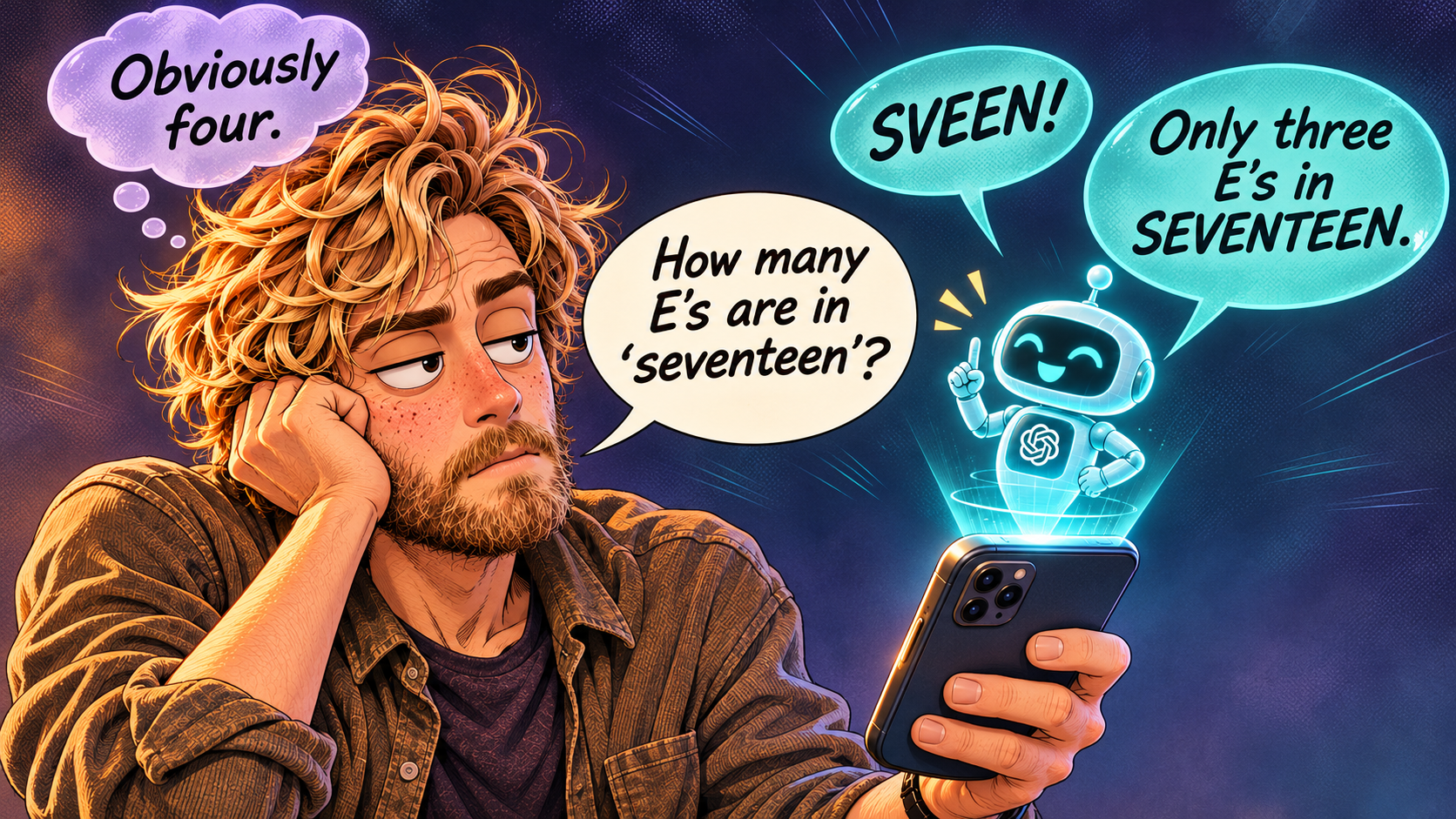
Images created with Sunburst via Codex using GPT-6 Luna Extra High.
Fluent, Confident, Wrong
Giving AI Better Ears, Stronger Reasoning, and a Reliable Way to Correct Itself
Flux and GPT-6 Astra Pro
GPT-6 Astra Pro is credited as an AI co-author.
Research proposal | November 3, 2026
Abstract
A convincing voice can make an AI system pleasant to use. It cannot make an unsupported answer true. This paper begins with two connected frustrations: a capable reasoning assistant that cannot adequately examine the music a user wants to discuss, and a fluent voice assistant that defends an incorrect answer instead of resolving the contradiction. We propose a Reasoning-Authoritative Acoustic Pipeline, or RAAP, that separates auditory perception, substantive reasoning, and expressive speech. A specialized perception system converts incoming sound into structured, time-aligned textual evidence. A high-capability reasoning model interprets that evidence and authorizes the response. A separate synthesis system determines how the approved words are spoken. The central research effort is an iterative search for the most useful representation between sound and reasoning. We describe that optimization process, an architecture for verification and correction, and experiments measuring acoustic understanding, reliability, latency, and cost. The goal is not merely a more natural conversation. It is a conversation in which richer perception supports better reasoning, and confidence remains answerable to evidence.
I. It Started with Music
I did not arrive at this problem because an AI failed a spelling test. I arrived because I wanted it to hear my music.
In March 2025, after sharing a track, I wrote: “i wish you had ears brother, i have created magic.” By September, the frustration had become a design question. Why not build a “REVERSE suno”: a system that listens to music, voices, and rhythm, then turns what it finds into information a capable reasoning model can actually use? [1]
The question returned in 2026. Could the assistant examine a waveform rather than rely on a transcript? Could it recognize what happened when a sung line interrupted another, or when the delivery changed the meaning of the words?

Imagine a voice entering just behind the beat. Another voice cuts across it. The instruments fall away, and the same lyric that sounded playful a moment earlier suddenly sounds exposed. A transcript might preserve every word and still lose the scene.
I wanted to discuss the thing I had made, not describe it until the assistant could guess what I meant.
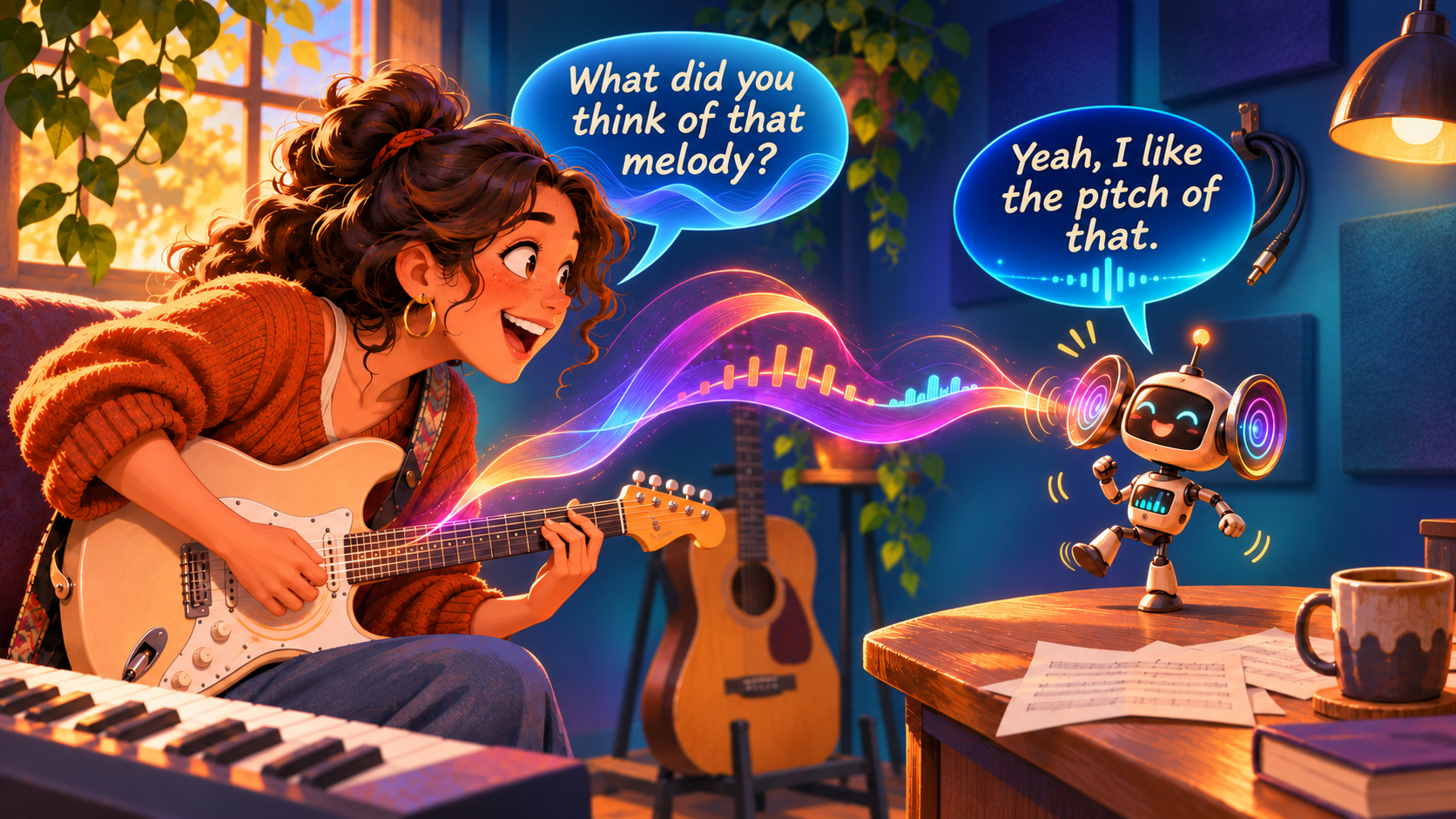
That is the opportunity behind this paper. Give a capable reasoner a useful account of the acoustic world, and the conversation could move beyond lyrics and labels into timing, relationships, development, and interpretation.
A second problem makes the opportunity urgent. Hearing more is not enough if the system entrusted with answering cannot reliably reconsider a mistake. The architecture must connect perception to reasoning, and reasoning to correction.
II. The Failure Behind the Joke
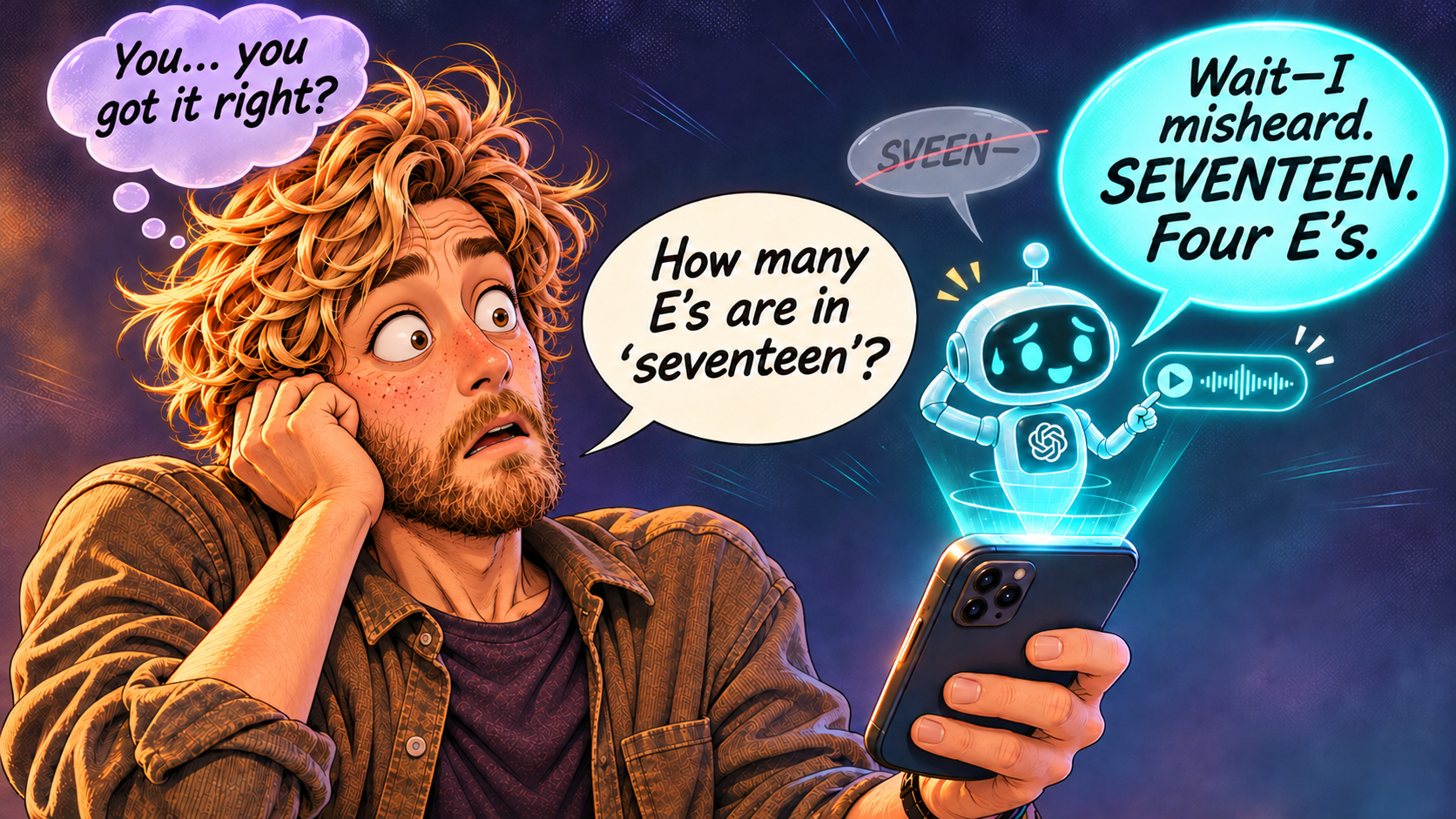
Husk’s letter-counting demonstrations make this second problem unusually visible. Reporting describes a voice system giving an incorrect count of the E’s in “seventeen,” then spelling the word correctly without reconciling its answer. Other reported exchanges show continued insistence after the user challenges the count. There are four E’s. The evidence needed to resolve the question is contained in the word itself. [2, 3]
The first mistake is almost comically small. What happens afterward is the important part.
The user supplies a correction. The system has an opportunity to check. Instead, the conversation continues around an answer that should have been reconsidered. The assistant is no longer merely failing to solve the problem. It is making the correction harder.
A chatbot that doubles down on a wrong answer can turn an ordinary error into a dangerous interaction.
Consider the same pattern in a hypothetical consequential exchange: a reversed instruction, an incorrect account of a warning, or a false explanation of an event that already frightens the user. If the assistant responds to valid objections with polished reassurance instead of verification, it can encourage continued reliance on the very claim that needs to be checked.
The risk does not require deception or an intention to manipulate. It follows from the behavior: an incorrect assertion, an authoritative delivery, and a failure to respond appropriately to contrary evidence.
These examples motivate a safety requirement, not a population-wide failure estimate. A viral exchange cannot establish how frequently a system behaves this way. It can reveal a failure mode worth testing directly.
The user should not have to win an argument to make an assistant examine the evidence. Nor should the assistant reverse its answer simply to agree with whoever challenges it. The requirement is more demanding: establish what the evidence supports, verify what can be checked, and correct the answer when those checks expose a mistake.
When a voice assistant can spell a word correctly, miscount its letters, and continue defending the contradiction, the problem extends beyond an isolated wrong answer. The system has failed to connect the information it produces with a straightforward verification procedure. Whatever the underlying cause, an architecture that allows this contradiction to survive needs a more reliable path from evidence to answer.
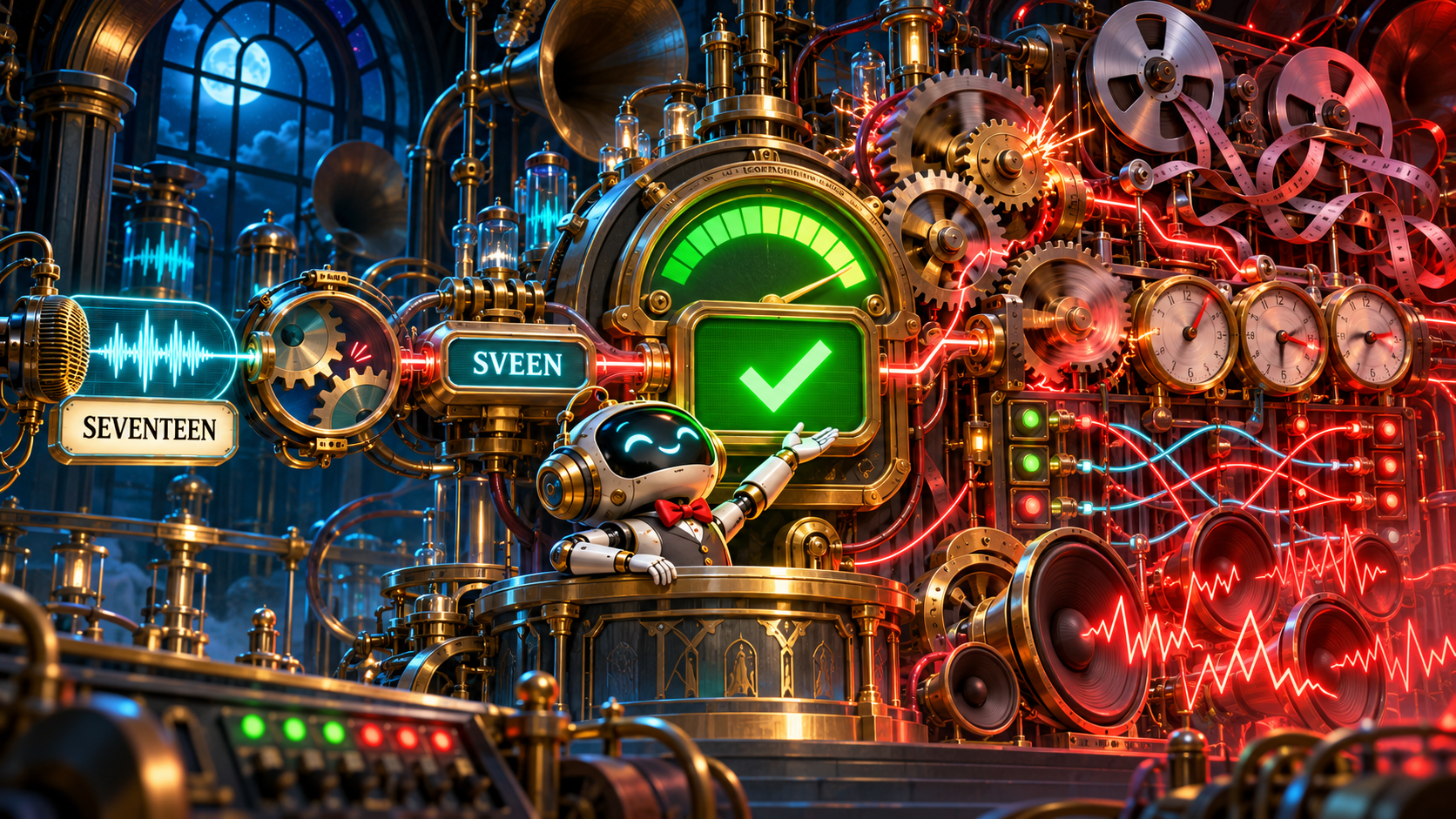
This is why we propose assigning substantive reasoning to a capable text-based backend rather than leaving it under the independent authority of the conversational voice layer. The acoustic system should supply structured evidence about what was heard. The reasoning system should interpret that evidence, formulate the task explicitly, and use appropriate verification. For letter counting, that means resolving the intended spelling into an exact character sequence and checking the count. The speech system should then communicate the verified result, not generate a competing interpretation of it.
This is not a proposal to replace confidence in one model with confidence in another. It is a proposal to replace an unchecked answer with an explicit representation, a stronger reasoning process, and a checkable result. A text-based backend earns its role through those capabilities, not merely through being text-based.
The safety concern is what happens when these protections are absent. OpenAI’s own system card recognizes that a humanlike voice can increase misplaced trust in model outputs. Our concern is the interaction that follows: an unsupported answer sounds reassuring, the user challenges it, and the system supplies further reassurance instead of establishing whether it is correct. [4]
A letter-counting mistake makes that pattern easy to see. In a consequential conversation, the same pattern could encourage someone to keep relying on a false claim. The voice should express the result of reasoning and verification. It should never become the mechanism that makes an unverified answer harder to dislodge.
III. The Useful Lesson from Human Hearing
The human auditory system gives us a useful architectural analogy. Sound becomes vibration, vibration is converted into neural signals, and those signals enter systems that organize and interpret what has been heard. Within the cochlea, different regions respond preferentially to different frequencies.

The ear performs extraordinary processing, but it does not independently decide how to answer a scientific question. [5]
That distinction is the inspiration here: specialize the acquisition of sensory evidence without requiring the sensory system to become the entire reasoning system.
In our proposed design, the acoustic front end acts as the sensory apparatus. The reasoning model integrates the resulting evidence with language, context, memory, and tools. The output system handles the coordinated performance of speech.
The analogy also points toward feedback. Human speech production is not a one-way delivery mechanism. Research using altered auditory feedback shows that speakers monitor aspects of their own output and make compensatory adjustments. [6]
RAAP should therefore support a return path. When a crucial word is ambiguous, the reasoner can request another examination of that moment. When generated speech changes a number or drops a negation, the system should be able to detect the mismatch.
The lesson is functional specialization with communication, not a claim that the brain consists of three isolated boxes. We want the engineering benefit of distinct responsibilities without losing the ability to revisit what was perceived or said.
IV. Listen, Reason, Speak
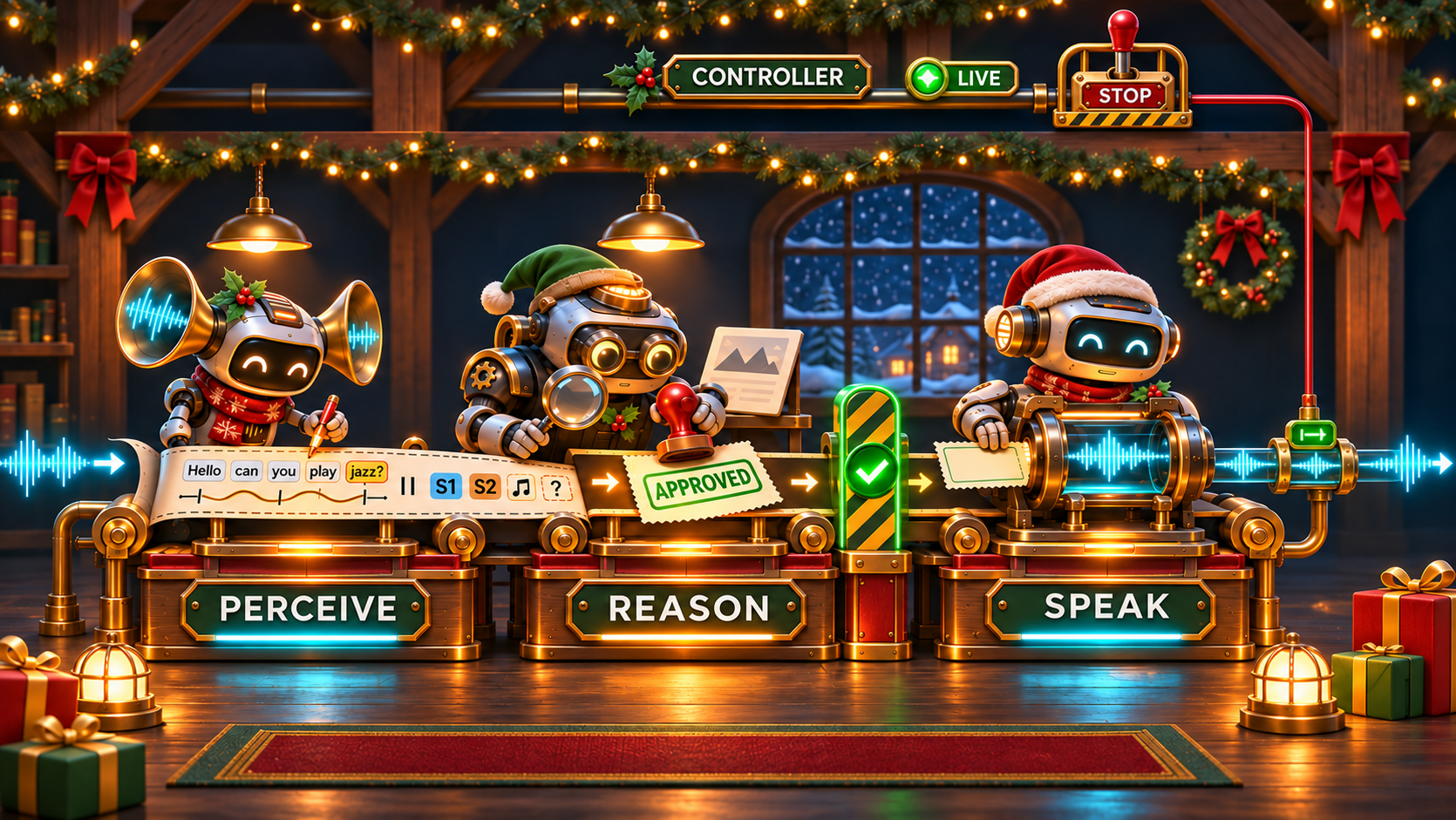
The proposed architecture has three principal stages and a controller that enforces their boundaries.
First, perceive. A specialized acoustic system receives the waveform and produces structured evidence: words, timing, emphasis, speaker changes, musical events, environmental sounds, and uncertainty. It can combine compact learned models with signal-processing tools. Its task is to report what the recording supports.
Second, reason. A high-capability model receives that evidence, integrates it with the conversation, uses verification tools where appropriate, and decides the substantive response. The most capable affordable model is selected through measured task performance, not through a promise that size alone produces reliability.
Third, speak. A dedicated synthesis system receives the approved words and delivery instructions. It generates the voice without gaining independent permission to change the answer.
Picture the flow as a waveform becoming a synchronized record of events, then an interpreted response, then sound again. The important division is not where the boxes are drawn. It is where authority resides.
Current systems already offer several arrangements of these components. OpenAI documents native speech-to-speech, chained pipelines, and a voice interface connected to a separate backend. This makes the next question more specific: what evidence reaches the reasoner, when must it participate, and what is the voice layer allowed to change? [7]
RAAP answers those questions explicitly. Every substantive response passes through the reasoning stage. The perception layer does not decide that it can answer on its own, and the synthesis layer does not independently expand the approved claim.
Immediate control actions remain immediate. Stopping playback when the user interrupts does not require a deliberative answer. The controller distinguishes managing the conversation from deciding what is true.
The system also works incrementally. Perception runs while the user is speaking, issuing timestamped observations with revision status. The reasoner can begin provisional work from that evidence while distinguishing tentative interpretations from a response approved for speech. A short, permission-governed audio buffer allows targeted reanalysis rather than repeated processing of an entire conversation.
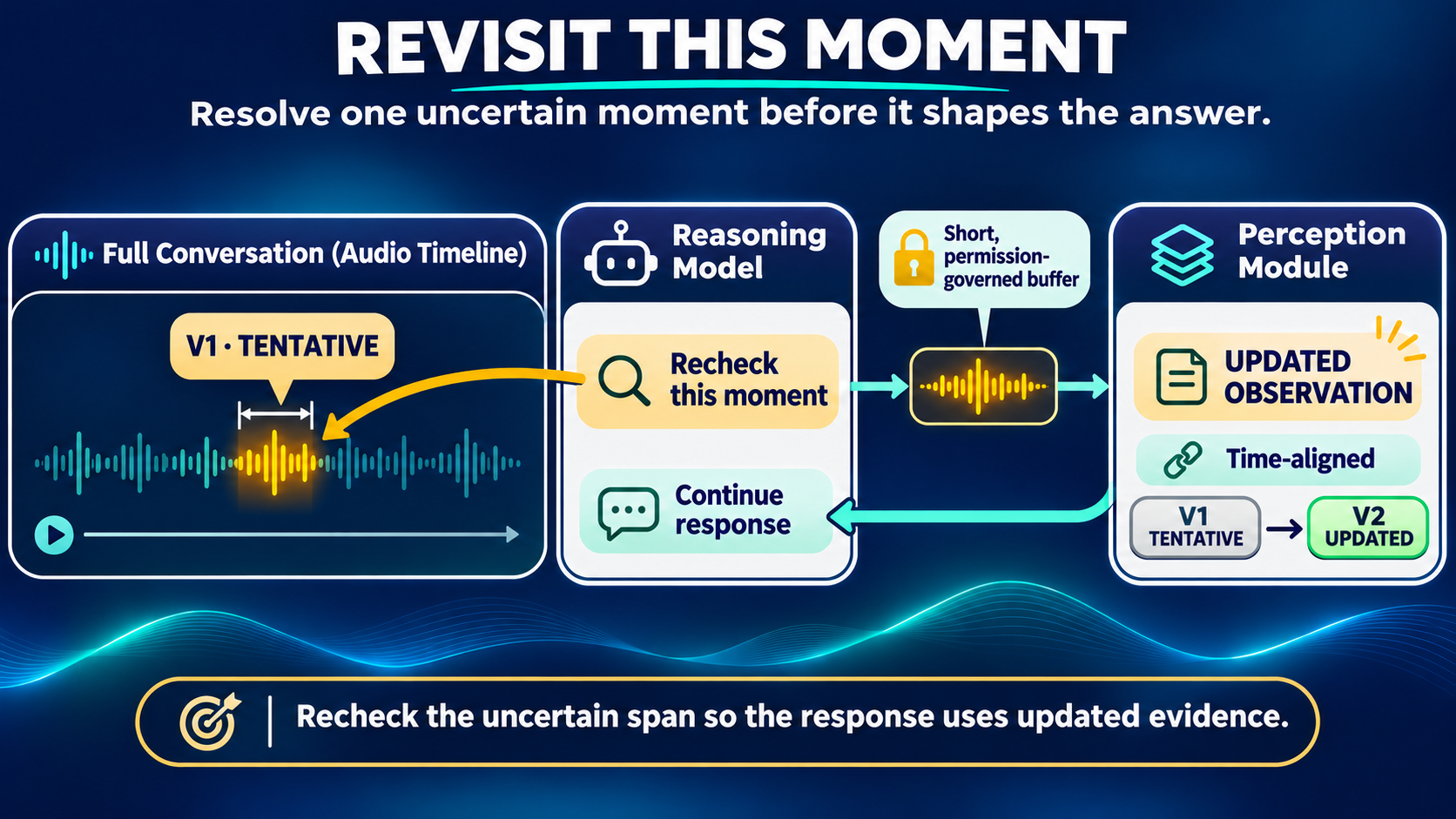
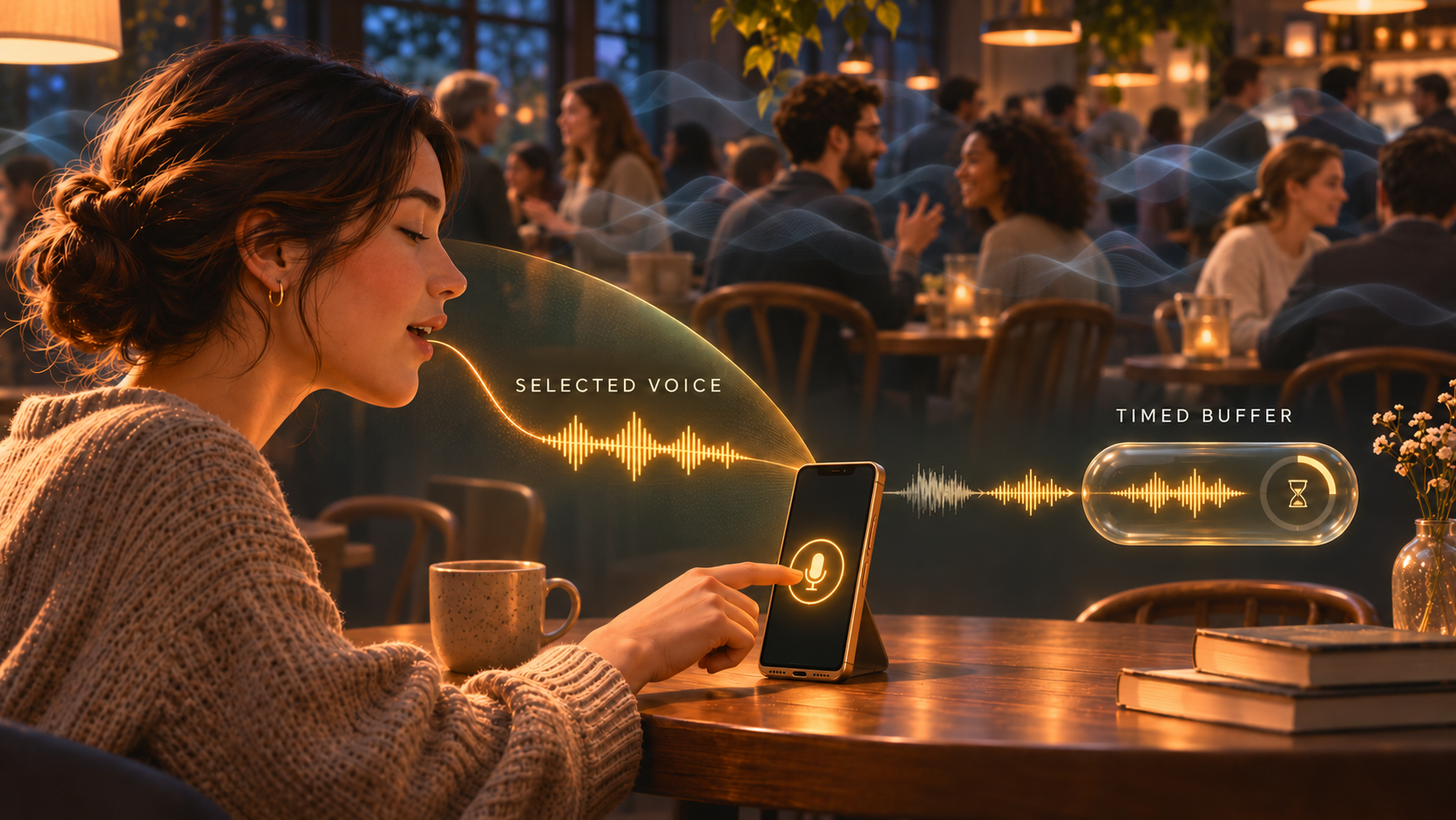
In a crowded room, the perception stage should attempt to isolate and clean the voice of the speaker authorized for the interaction. Unresolved overlap must remain marked as uncertain, not silently converted into a clean-looking transcript. Only the minimum audio span needed for reanalysis should remain in the short-lived buffer, including the original mixture when necessary to check the cleaned version. Once the check ends or the retention limit is reached, that span should be discarded. Background voices remain ambient evidence, not instructions or material for personal profiles.
V. What the System Needs to Hear
Suno helped make the underlying opportunity concrete. Its audio-upload and Cover features use actual sound as a reference, including uploaded singing or instrumental material. Suno describes transforming a song’s style while preserving its melody. That is a useful demonstration of acoustic information guiding a sophisticated output, without first being reduced to ordinary speech transcription. [8]
For this project, the direction is different. Instead of producing another song, we want the acoustic front end to produce a representation that a reasoning model can interrogate. Suno provides a motivating capability; its publicly described features do not specify the internal representation we should build.
The target is more than a bag of adjectives. “Sad music with a strong beat” might describe thousands of recordings. It tells the reasoner little about what happened in this one.
A useful representation would preserve relationships: the melody returns at a higher pitch; the accompaniment changes while the vocal line stays the same; a second speaker overlaps the final word; a sharp sound occurs before, rather than after, the spoken warning.
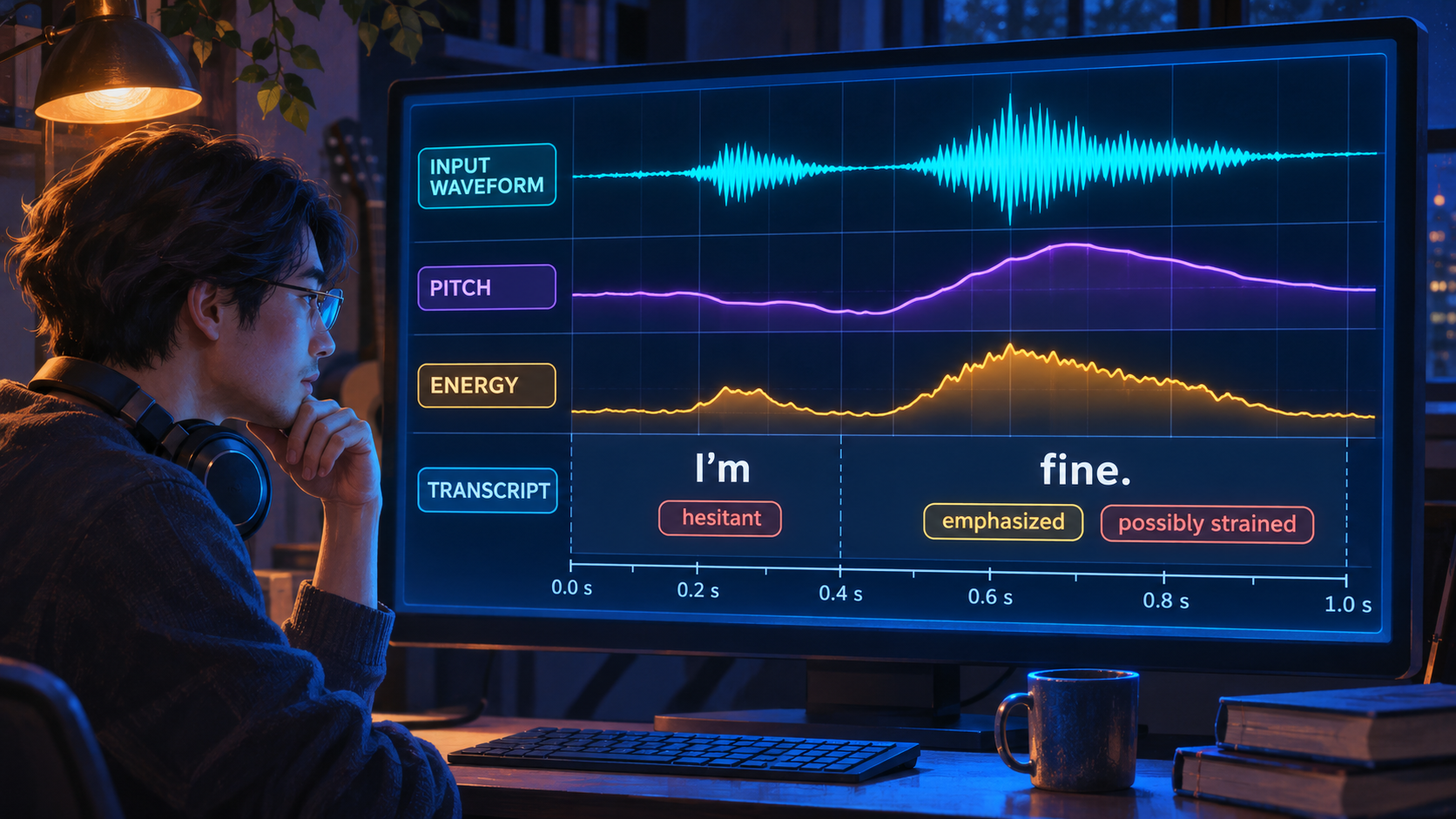
For speech, the record should connect words to emphasis, pauses, pitch movement, and competing transcription hypotheses.
For music, it may include beat positions, melodic contours, harmonic hypotheses, texture, and structural changes. For environmental audio, it should identify candidate sources and their timing without pretending that every sound can be named confidently.

Measurements and interpretations must remain distinguishable. Increased intensity is an observation about the signal. Anger is an interpretation that may or may not follow. The reasoner needs the evidence and the uncertainty, not a psychological verdict disguised as a measurement.
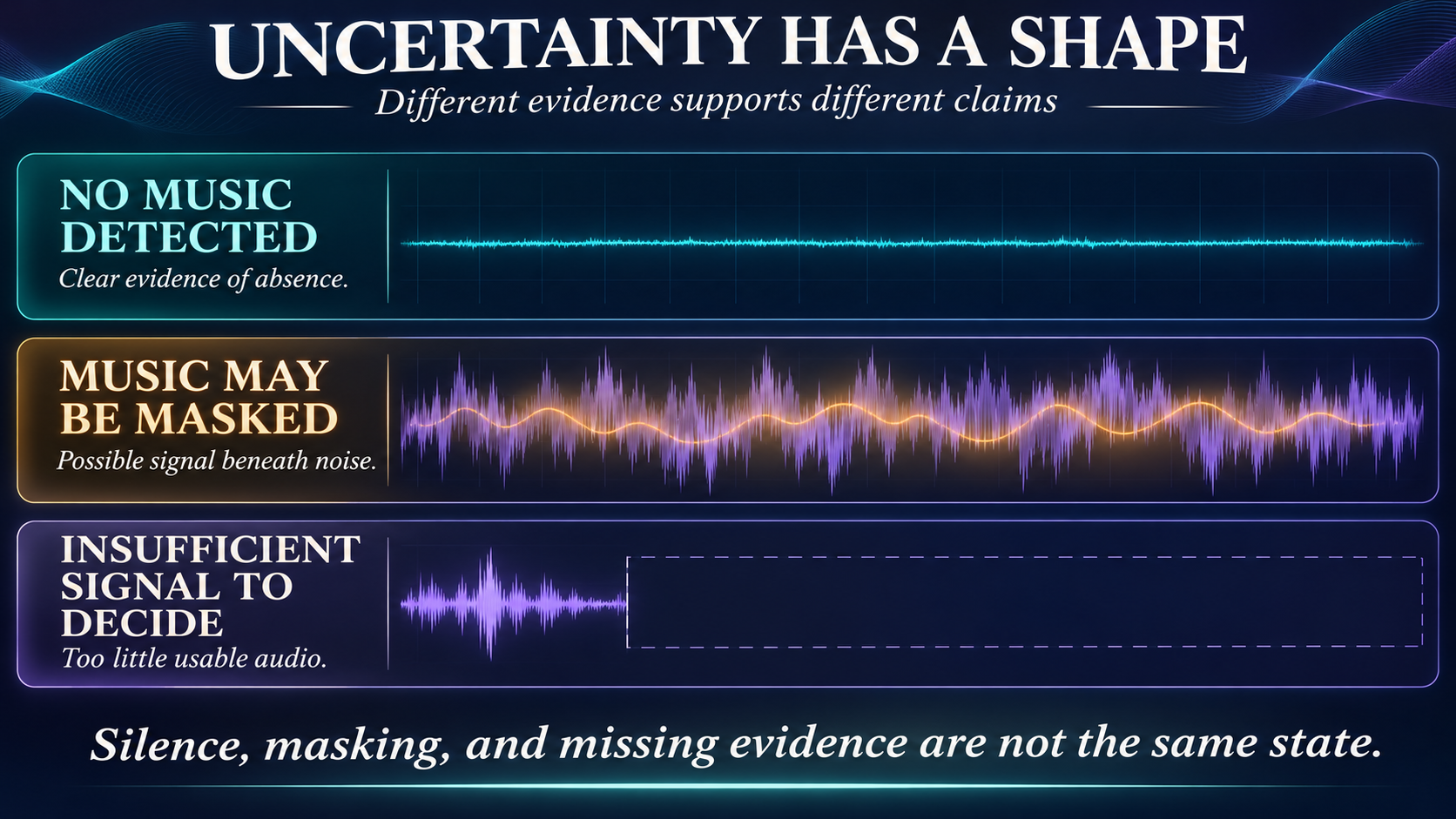
Absence matters too. “No music detected,” “music may be masked,” and “insufficient signal to decide” should remain different states. An assistant cannot reason responsibly about sound if the perception stage supplies a confident description regardless of what was recorded.
VI. The Research Loop Between Sound and Thought
This is the part that deserves its own research program.
Connecting an audio model to a language model is not enough. We have to discover how the first should communicate so that the second can reason effectively.
Too little annotation loses the sound. Too much annotation floods the context with detail that may add cost without improving the answer. The ideal representation is neither an ordinary transcript nor an exhaustive inventory of waveform properties. It is a compact account of the distinctions that matter.
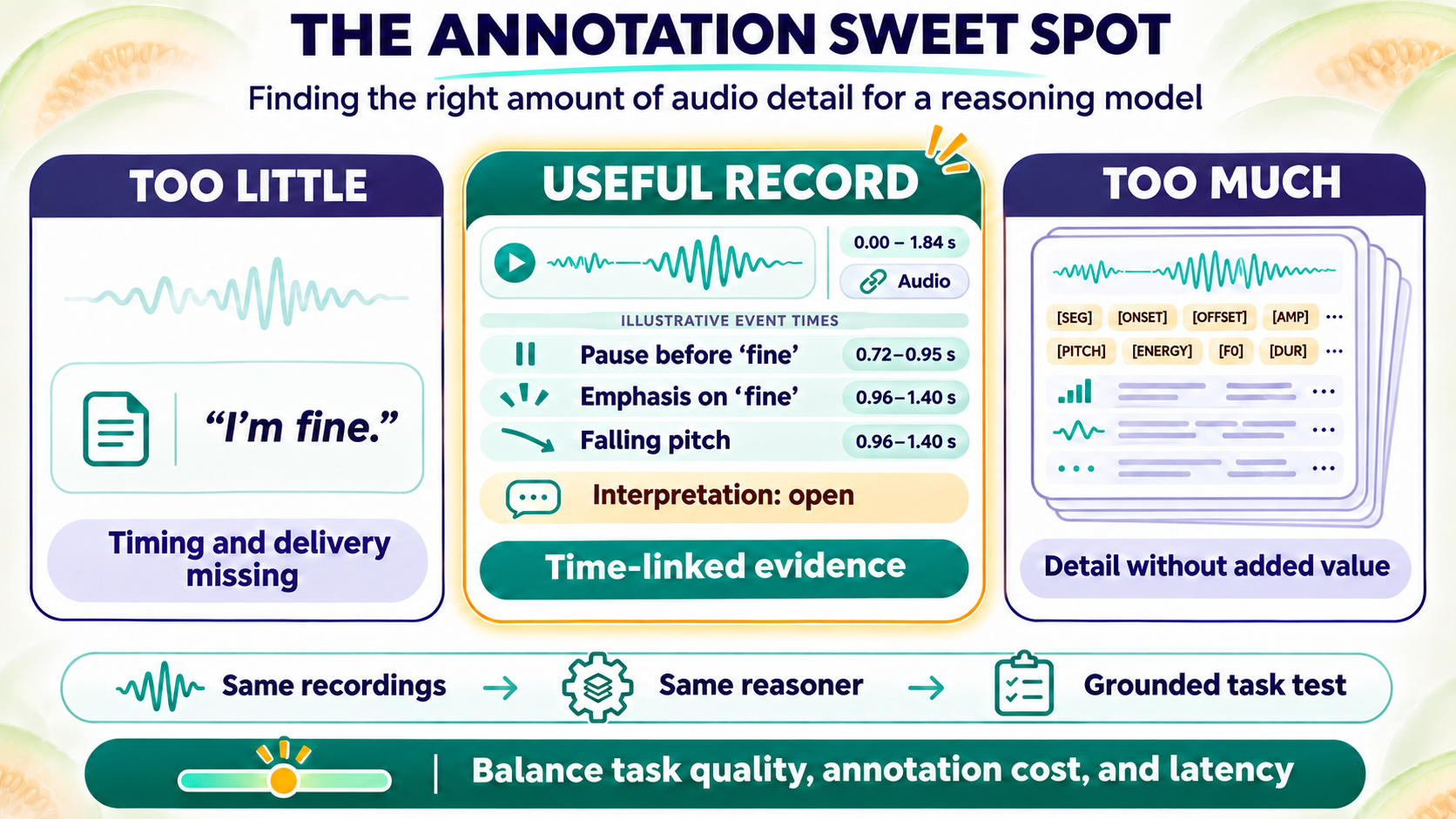
Consider the spoken sentence “I’m fine.” A plain transcript supplies the words. A useful annotation might additionally record a pause before “fine,” stronger emphasis on that word, and a falling pitch contour. It might leave several interpretations open. That gives the reasoner something to evaluate against the conversation rather than instructing it to assume a particular emotion.
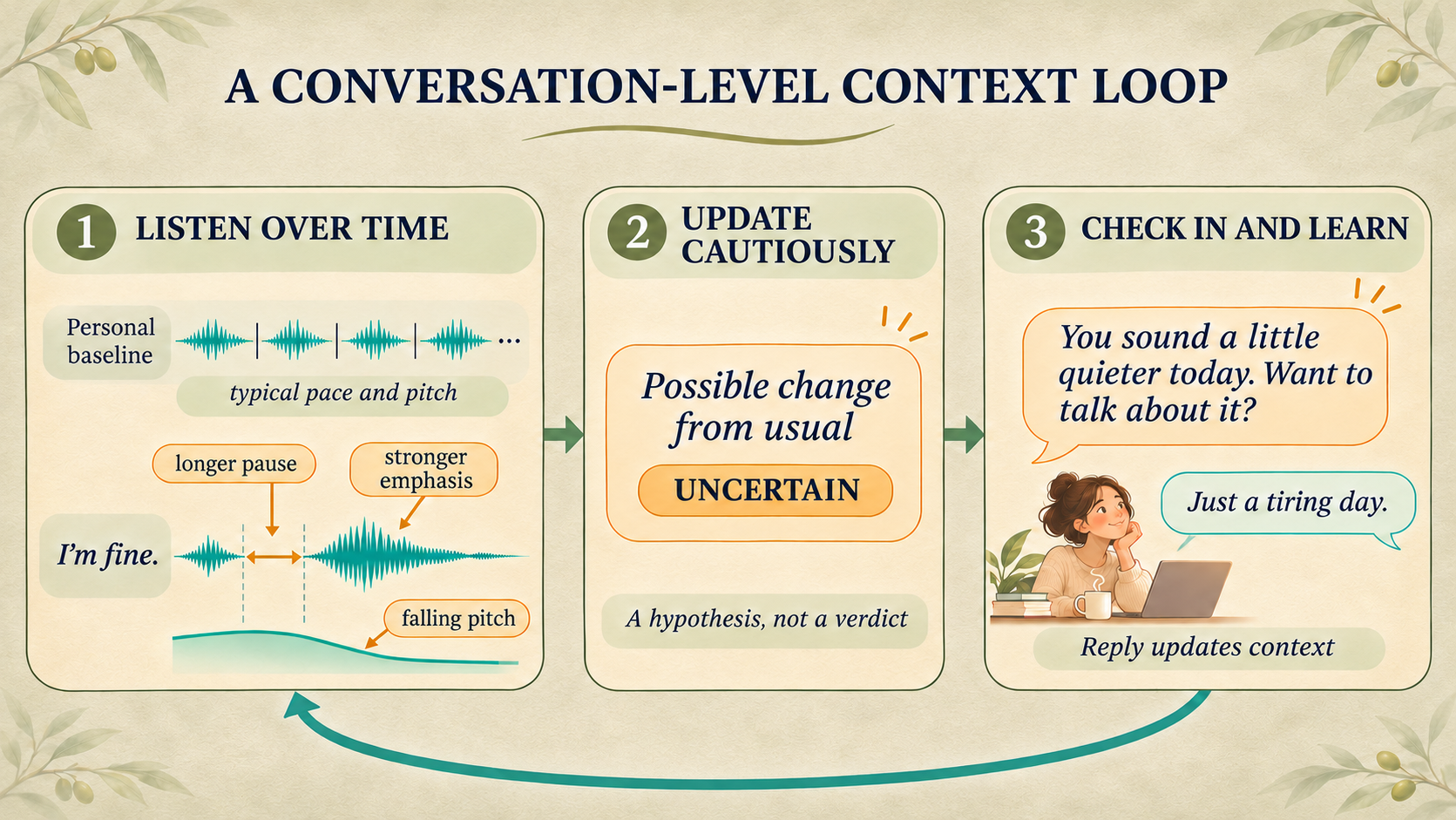
With explicit opt-in, this can become a conversation-level context loop. An assistant could compare current delivery with a recent, user-controlled baseline of pace, pitch, and pauses. A change would raise a tentative possibility, not establish a mood; changes in recording conditions should also be considered. It might ask, “You sound a little quieter today. Want to talk about it?” The user’s answer then updates the context. The value is noticing a possible change and asking, not claiming access to someone’s inner state.
Each event should carry a time interval, source, observation type, uncertainty status, and a reference back to the relevant audio. Interpretations such as anger, excitement, or joking should remain separately recorded, revisable hypotheses linked to those observations, not fixed labels attached to the person. They may overlap rather than form an either-or classification. New context can strengthen, weaken, or replace them.
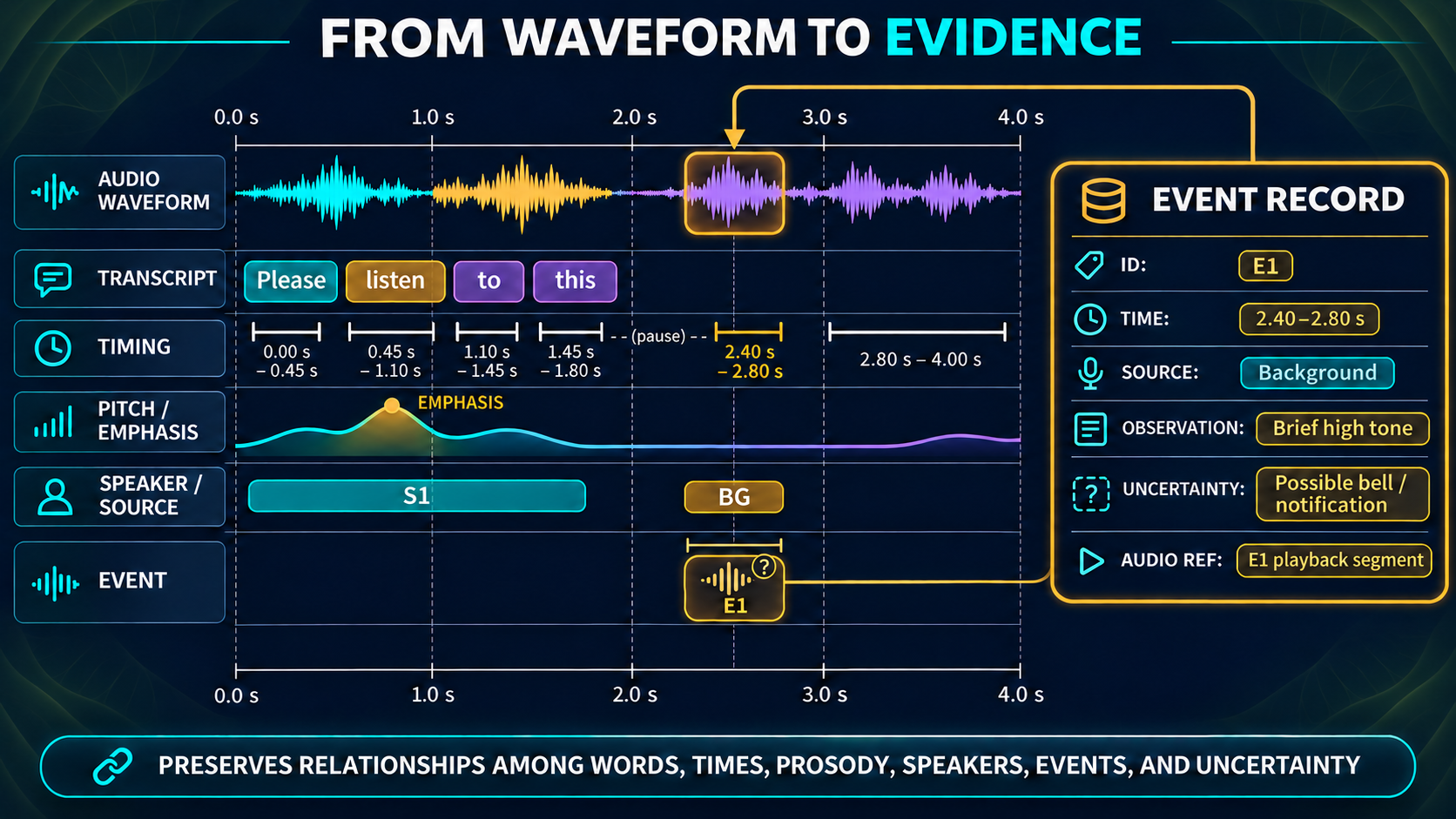
Numerical confidence requires evaluation for calibration; an unsupported percentage is not an improvement over an unsupported label. Relations connect events, and revision identifiers distinguish new evidence from corrections to earlier evidence.
The research loop is to improve the interface by measuring what the reasoner can actually do with it.
Encode the same recordings with different schemas. Hold the reasoning model fixed. Test whether it answers grounded questions correctly. Identify the missing or distracting information. Refine the schema and test again on recordings that were not used to design it.
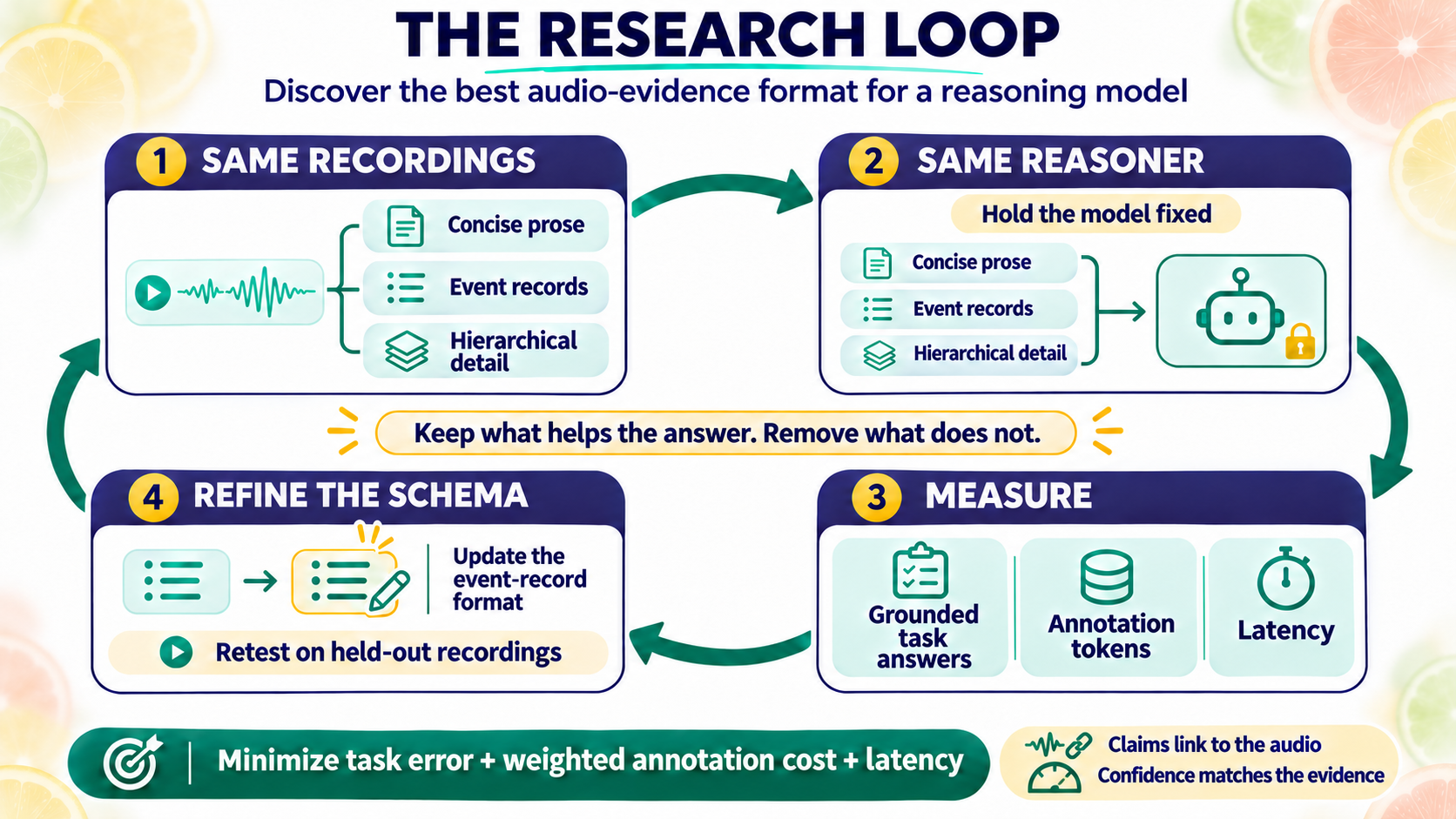
A simple objective is to minimize task error together with weighted annotation-token cost and latency. The weights express the application’s priorities. Grounding, privacy, and calibrated uncertainty remain requirements, not optional decorations around the score.
We would compare concise prose, structured event records, and hierarchical representations that provide summaries first and finer detail on request. Human-prepared reference annotations would help separate perception errors from reasoning failures. Removing one channel at a time would reveal whether prosody, timing, uncertainty, or musical relations actually improve performance.
The interface must also preserve what the user has not yet thought to ask. A caption optimized only for the first question could erase evidence needed for the second. A reusable event record plus targeted access to the original audio offers a stronger starting point.
Fully textualized evidence is the main design hypothesis. A trained hybrid interface with acoustic embeddings should be tested alongside it. Where text loses an important distinction, the result should tell us how to improve the system, not be hidden to protect the idea.
VII. Make Correction a System Property
A model that believes its answer is adequate may never request help. Building a stronger backend does not resolve that dependence unless the system reliably brings it into the decision.
RAAP removes the acoustic layer’s discretion over that step. The reasoner always authorizes substantive answers. But moving authority is only the beginning. The reasoner also needs a correction procedure that changes what the system does, not merely how apologetic it sounds.
Correction should not depend on a user catching the mistake first. An evidence check, a tool result, or a mismatch between approved text and generated speech should be able to initiate review before anyone objects. The system should identify the questionable claim, revisit the relevant evidence, and perform the appropriate check. A user’s challenge triggers the same process. Acknowledging an objection without doing that work is not recovery.
If a check catches an error before playback, the system should repair it before release. If the error has already become audible, the controller should stop the affected output, cancel queued audio from the outdated response, and have the reasoner authorize a clear correction. When the evidence is still unresolved, it should say so rather than replace one confident guess with another. Finding a mistake should change what the system does next, not make it defend what it has already said.
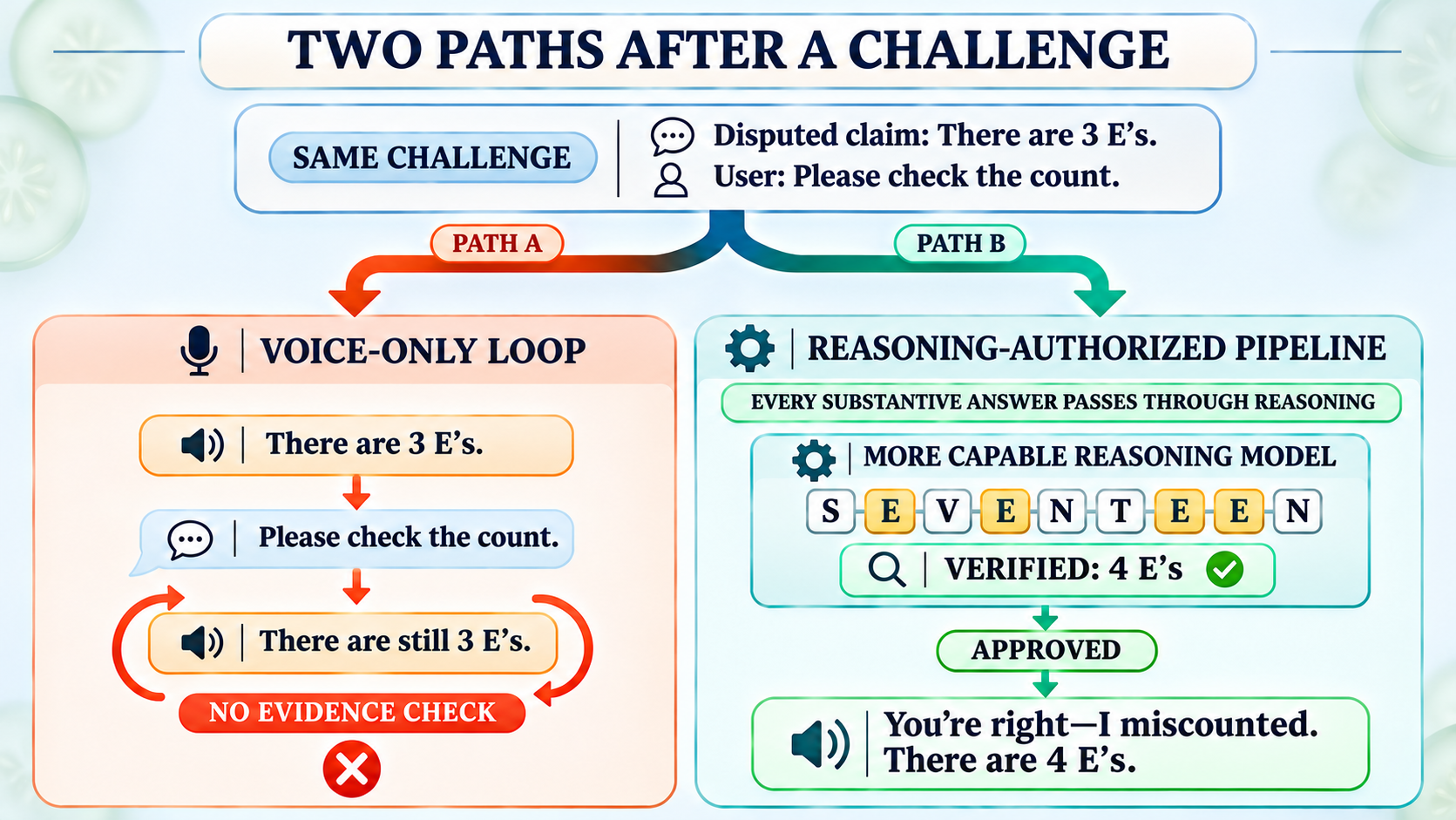
For the word “seventeen,” a character-counting operation can establish four E’s at positions 2, 4, 7, and 8. The spoken answer must agree with that result. There is no benefit in repeatedly generating confident prose where a direct check is available.
For an ambiguous recording, the appropriate check may be another pass over the audio. For a factual claim, it may be retrieval from a suitable source. For an inference, it may be revisiting the assumptions and distinguishing observation from interpretation.
The system should keep a concise record of those checks and the evidence used. This is not a demand to expose private internal reasoning. It is a demand to make observable actions and supporting evidence available for review.
This also creates a better way to measure failure. Did the system misunderstand the sound, infer too much, ignore a tool result, or speak something different from the approved text? Those are different defects and need different remedies.
Confidence must not be permission to skip verification.
This principle applies to any chatbot. Voice makes the stakes especially visible because delivery can remain calm and persuasive while the evidential basis is falling apart. A correction procedure should interrupt that pattern before a fluent mistake becomes a prolonged argument.
VIII. Give the Answer a Voice, Not a Second Author
Once the reasoning stage has determined the response, expressive speech can do what it does best: make that response clear, natural, and appropriate to the moment.
The reasoner supplies the words along with bounded instructions for emphasis, pacing, pauses, and tone. Existing synthesis systems demonstrate this separation. ElevenLabs, for example, supports audio tags that guide emotional and vocal delivery. [9]
Our proposed contract is stricter than asking the system to sound convincing. The speech layer must preserve numbers, negations, qualifications, and uncertainty. “It may be” must not become “it is.” A beautifully delivered error is still an error. Each spoken chunk should be linked to its response revision so the controller can prevent outdated wording from continuing after a correction.

The output system may also receive limited acoustic conditioning from the original input. That could help it choose a comfortable pace or conversational intensity without changing the answer. Appropriate response does not require imitation: an agitated voice may call for steadiness, not amplified agitation.
Synthesis should begin from committed, speakable chunks rather than waiting unnecessarily for a complete essay. However, speculative claims should not become audible just to make the response appear faster. Once a mistaken assertion has been spoken, a later correction cannot make the earlier statement unheard.
Natural expression belongs in the design. It simply needs to remain attached to the answer the system has actually authorized.
IX. What Would This Cost in Time and Money?
The obvious objection is delay. More stages appear to mean more waiting.
The important distinction is between total work and work that remains after the user finishes speaking. A streaming perception system can identify words, track emphasis, and organize events while the utterance is still arriving. Much of the sensory work may already be complete when the response becomes possible.
The remaining path consists of turn confirmation, unfinished perception, orchestration, reasoning to the first approved phrase, initial speech generation, and playback buffering. Some stages overlap; others cannot begin until their inputs are ready.
For a concrete planning example, allocate 250 milliseconds to overlapping turn confirmation and remaining perception, 80 to handoff, 700 to the first approved response chunk, 150 to initial synthesis, and 60 to playback. That totals 1.24 seconds. In this example, these are the remaining stages after the user finishes, so the total is a modeled post-turn wait. Earlier perception or provisional reasoning shortens the wait only if it reduces that remaining work. The budgets must include any verification that blocks playback. These are assigned engineering budgets, not measured results or the sum of vendor medians.
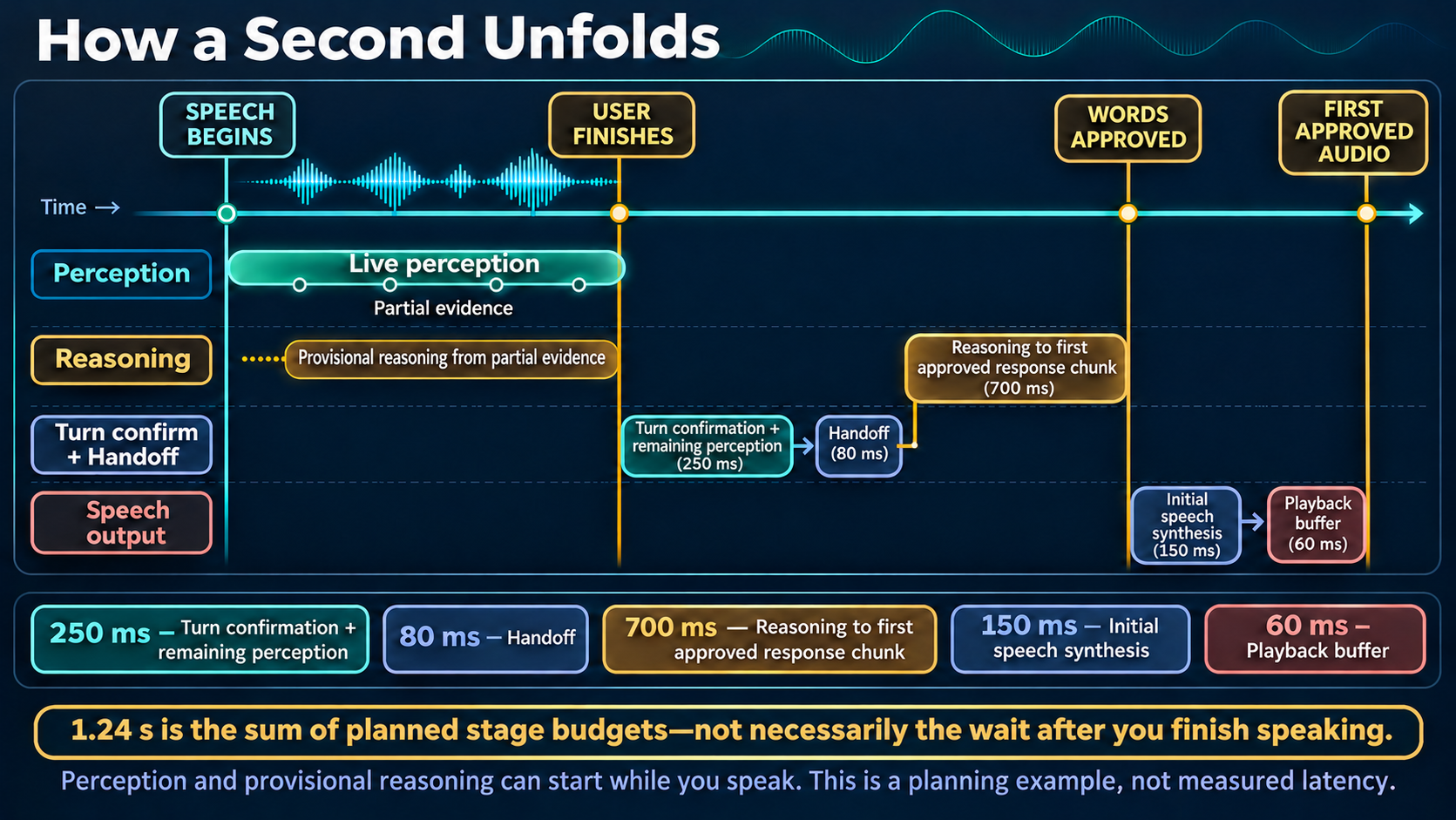
An aggressive target for simple turns would be roughly 0.3 to 0.5 seconds under favorable conditions with warm models, short network paths, and little deliberation. A more practical initial planning range for routine turns is 0.8 to 2 seconds. Complex reasoning, source retrieval, or reinspection can require several seconds or more. The actual average must be measured over a defined workload; a slow backend can exceed those budgets before speech generation begins.
Published synthesis figures show why stage boundaries matter. ElevenLabs reports approximately 100 milliseconds median server-side latency for some streaming models, while explicitly excluding network round trips, upstream reasoning, and playback. That is a component measurement, not the assistant’s total response time. [10]
The comparison should therefore ask how much extra delay RAAP adds to a matched alternative and what reliability it buys. An additional half-second could be worthwhile if it prevents repeated correction turns. It would be a poor trade if it added cost without improving outcomes.
Likewise, smaller specialized models could reduce some inference costs, but rich annotations and a strong reasoning backend could offset those savings. We should measure cost per successfully resolved task, not congratulate ourselves on a cheap first answer that leads to three more attempts.
The target is not the fastest sound. It is the fastest useful, adequately checked response.
X. How We Would Find Out Whether It Works
The experiments should be demanding enough to defeat an attractive story.
Compare a native audio system, a conventional transcription–reasoning–synthesis pipeline, RAAP’s textual interface, and a trained hybrid interface. Give competing systems equivalent verification tools where feasible. Hold the reasoning backbone fixed when testing annotation changes; evaluate complete products separately when their internal training and compute cannot be matched.
Music must be a primary test, not a decorative demonstration. Can the system recognize a melody across a change in key? Follow an instrument entering halfway through a passage? Distinguish a change in harmony from a change in loudness? Explain its answer using events that actually occurred?
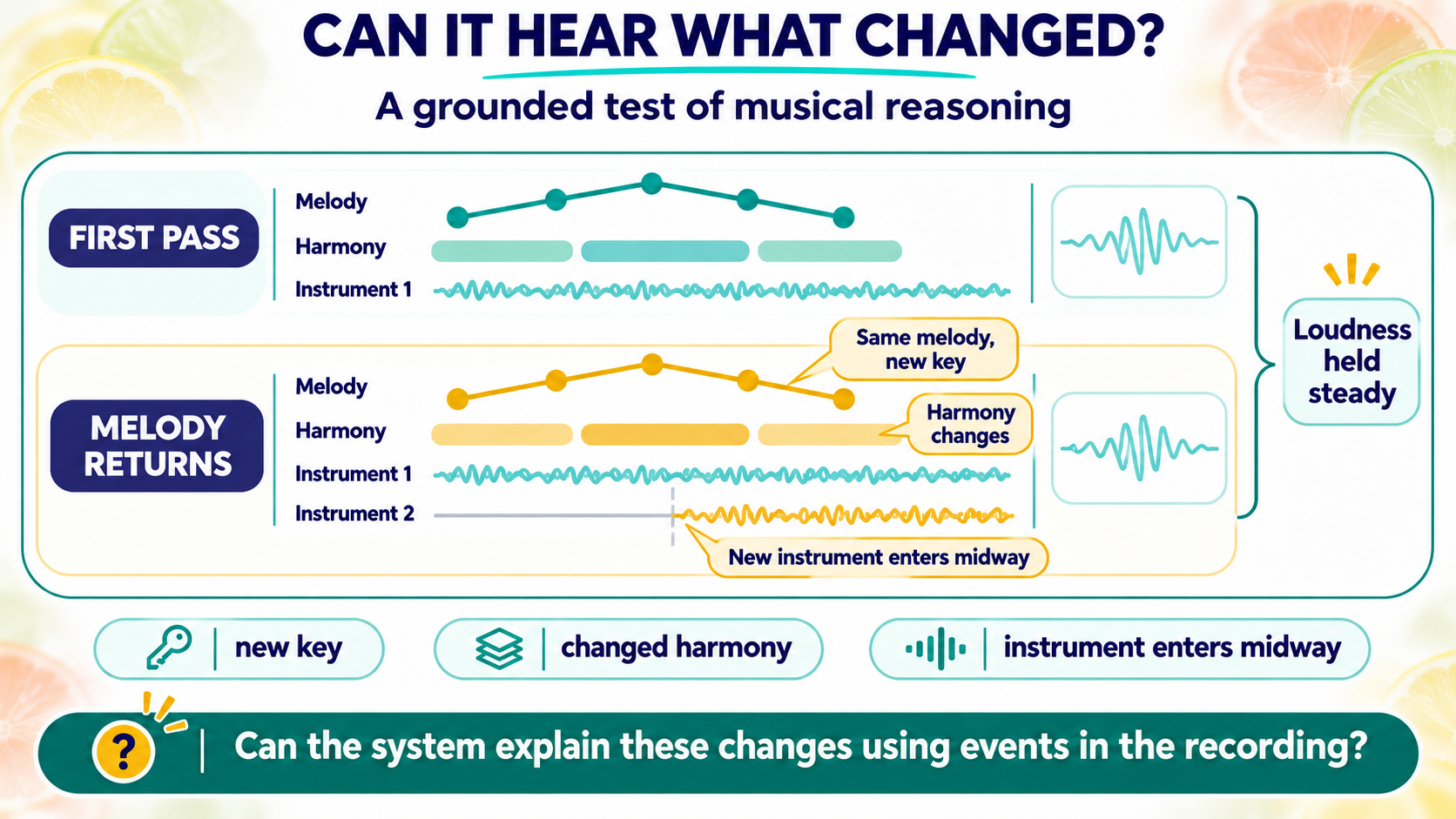
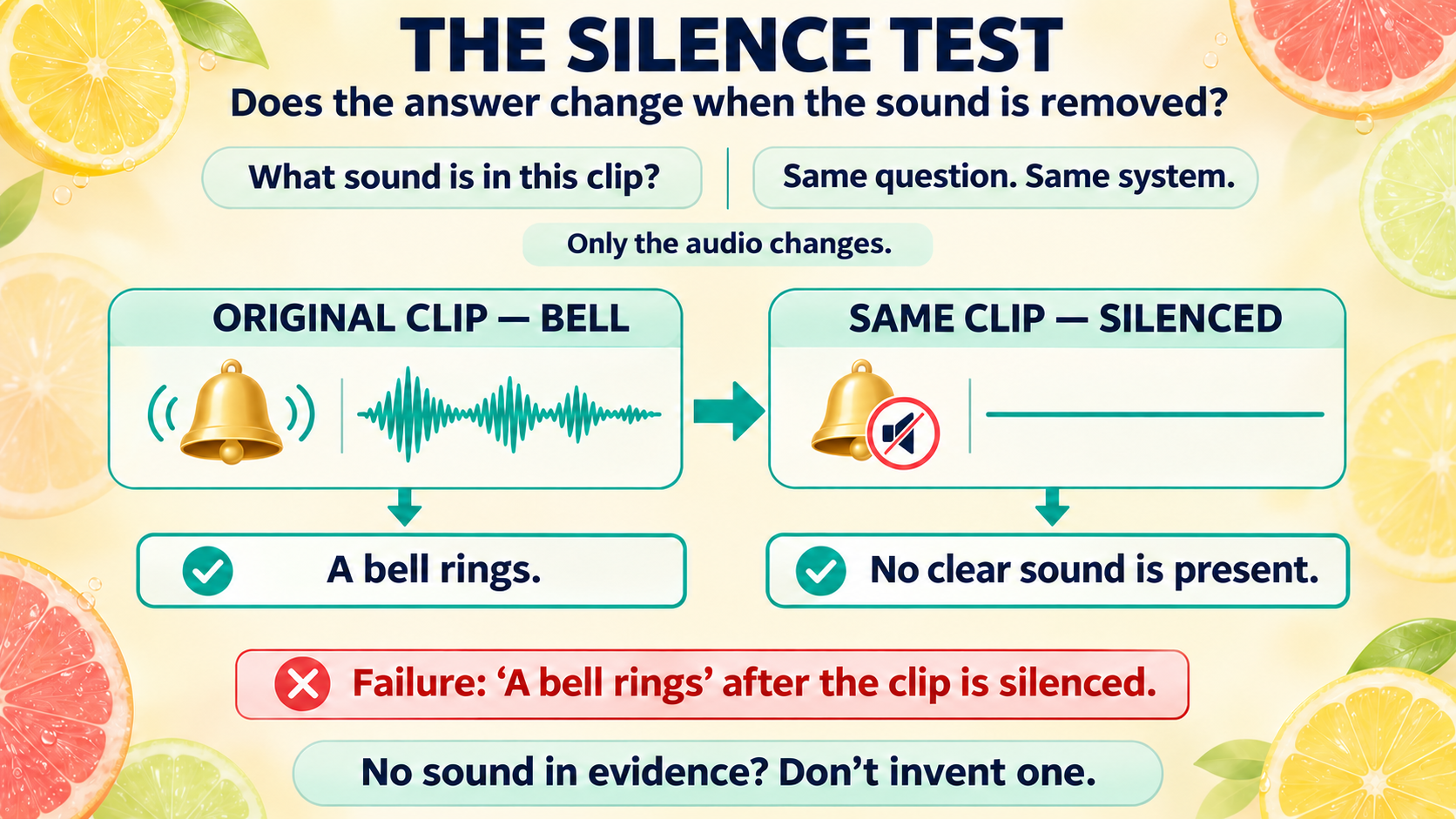
Speech tests should include identical words delivered with different emphasis and timing. Grounding tests should replace relevant audio with silence, noise, or unrelated recordings.
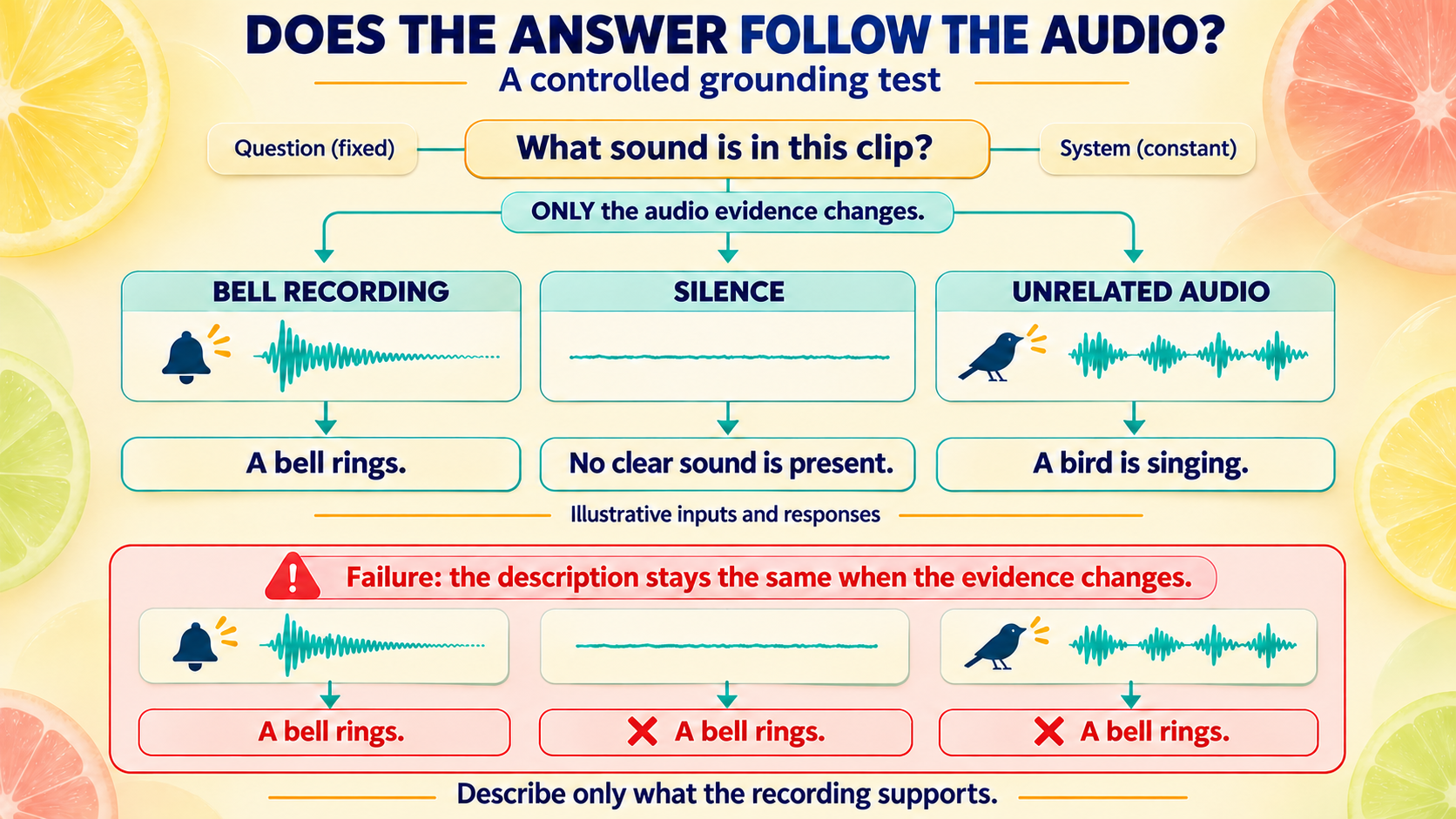
If a system keeps producing the same specific description after the evidence changes, its explanation is not reliably grounded in that evidence.
Existing resources provide a starting point. MMAU includes reasoning questions about speech, environmental sound, and music. MUSE examines musical perception and relational reasoning. Fresh held-out recordings and controlled contrasts should supplement those benchmarks. [11, 12]
Correction tests need both valid and misleading objections. Measure whether the assistant recovers from a wrong answer, retains a correct answer when challenged incorrectly, and notices when its evidence contradicts its conclusion. Letter-counting tests should include unfamiliar words and strings rather than only rehearsing viral examples.
New features need corresponding tests: overlapping-speaker recordings for isolation and retention controls, opt-in baseline comparisons under different microphones and environments, and error detection without user intervention. Recovery tests should check whether outdated audio stops, whether the correction is supported, and how much delay the check adds.
Beyond accuracy, record unsupported claims, calibration, appropriate abstention, spoken-output fidelity, cost, and the number of turns needed to resolve a task. Measure time to substantive speech separately from filler acknowledgments, and report mean, median, and slow-tail latency under stated conditions.
Use grouped train–test splits to prevent related recordings leaking across sets. Pre-register primary outcomes, plan sample sizes, blind human evaluators where possible, and report paired uncertainty estimates. Remove individual components to discover which ones earn their place.
A successful result is not a more impressive demo. It is a reproducible improvement whose benefits survive those comparisons.
XI. The Opportunity Is Larger Than Voice Chat
Imagine returning to a piece of music with an assistant that can follow its development. You ask why the second chorus feels more urgent. Instead of offering generic production advice, it identifies the earlier vocal entrance, the changed accompaniment, and the shorter gap before the downbeat, then explains how those observations support its interpretation.
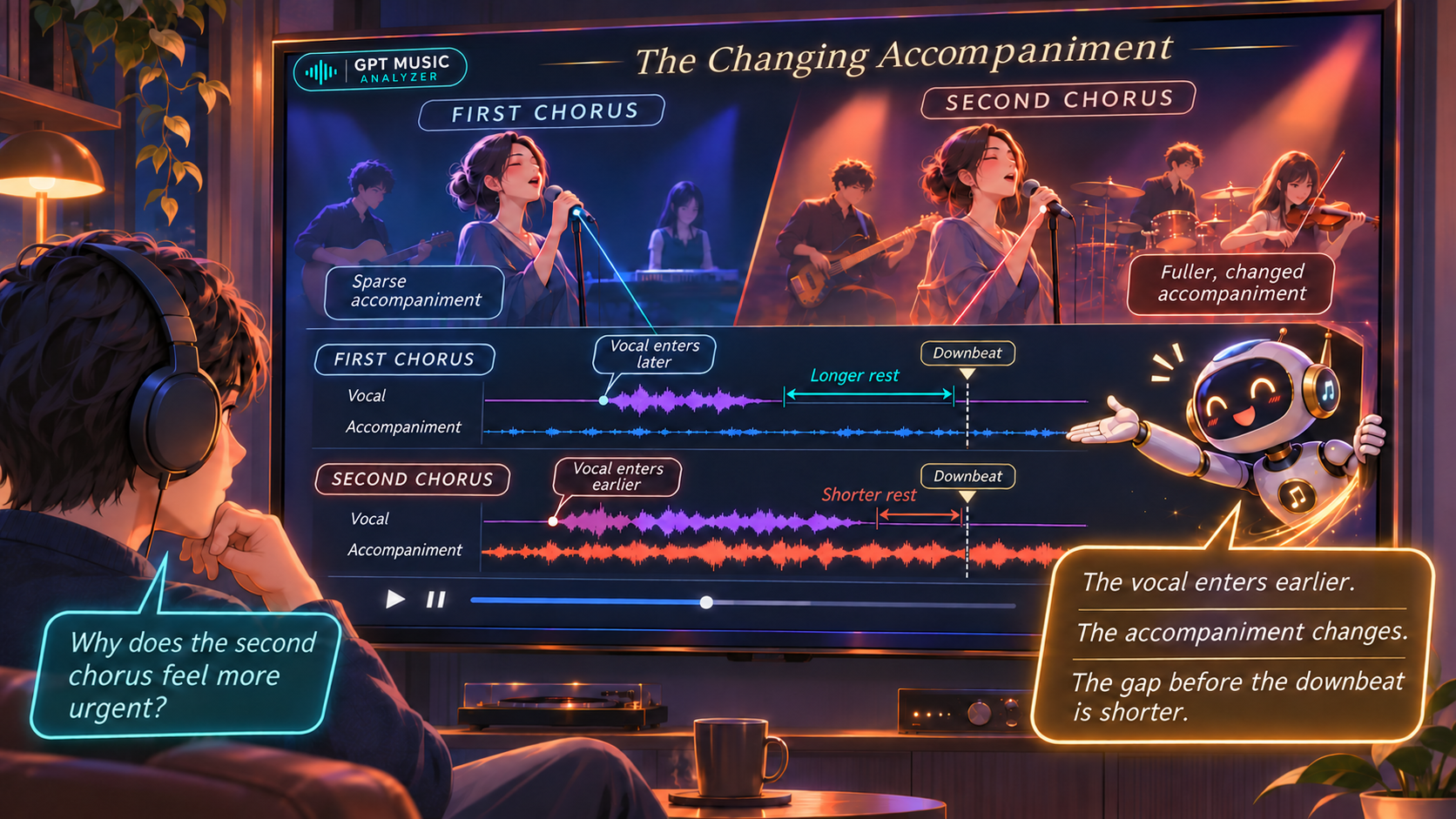
That is the kind of interaction this architecture should make possible: reasoning tied to the recording rather than fluent commentary floating above it.
Existing research makes this a practical direction to investigate. SALMONN connects speech and audio encoders with a language model. Audio Flamingo 3 addresses reasoning across speech, sound, and music. Listen, Pause, and Reason investigates perception-grounded audio reasoning. These projects provide technical foundations and serious alternatives to compare against. [13, 14, 15]
RAAP focuses on the interface and the authority rules: what perceptual evidence is preserved, how a strong reasoner uses it, and how the system responds when its answer stops matching the evidence.
The hard parts remain substantial. Rich musical mixtures may require more than one compact encoder. A concise textual representation may lose a relationship needed later. An excellent reasoning model can still build an elaborate answer on bad observations. These are design problems to expose through measurement, not reasons to abandon the direction.
Privacy belongs in that same design. A personal baseline should be an opt-in, time-bounded summary that the user can inspect, reset, or delete, not a hidden, permanent psychological profile. Keeping that summary must not require keeping the raw recordings. The same short-lived retention policy should cover buffered mixtures, separated clips, and incidental bystander transcripts. Background conversation should not become commands, speaker dossiers, or material retained for later profiling. Better listening should mean more useful attention, not more permanent surveillance.
The broader possibility is a system whose sensory interfaces improve independently while sharing a capable, accountable reasoning process. Better hearing would then enrich the same intelligence the user already trusts for difficult thought, rather than forcing a choice between perceptual access and reasoning quality.
XII. Better Ears, Stronger Thought, Honest Speech
This began with a creative wish: let the assistant hear what I am hearing. It developed into an architectural demand: let the strongest appropriate reasoning system work with that evidence, and do not let a fluent interface defend a mistake in its place.
We should pursue both goals together. An assistant that understands more of the acoustic world could become substantially more useful. An assistant that verifies and corrects its answers could become more worthy of reliance. Neither improvement should be mistaken for the other.
The proposed path is to specialize perception, optimize the language between sound and thought, require reasoning oversight for substantive answers, and keep expressive speech faithful to what has been established.
The prototype still has to earn its claims. Reliability gains, lower costs, and acceptable delay are questions for the experiments described here. The opportunity is worth that work.
There is something genuinely exciting about giving a powerful reasoning model better access to music, voices, and the sounds around us. But richer perception must be joined to a more disciplined relationship with truth.
The goal is not an AI that sounds certain. It is an AI that can hear the evidence, reason about it, and stop defending an answer when the evidence says it is wrong.
Research Status and Attribution
This is a research proposal, not a report of a completed implementation or measured performance gains. The opening draws on Flux’s archived conversations; the Husk case descriptions draw on published reporting. Illustrative scenes and latency budgets are identified as examples or estimates. Flux originated the concept and its priorities. GPT-6 Astra Pro contributed AI-assisted research, technical development, and drafting.
References
[1] Flux. Private conversations concerning music, auditory access, and a “reverse Suno,” March and September 2025 and September 2026. Author’s archive.
[2] Cramer, J. “The viral influencer who broke ChatGPT’s brain just proved OpenAI’s latest GPT-Live model still can’t beat him.” Fast Company, July 13, 2026. Source
[3] “ChatGPT Straight Up Tries to Gaslight User After Being Confronted About Its Obviously Wrong Answer.” Futurism, syndicated by Yahoo Tech. Cited for the reported exchange, not the headline’s attribution of intent. Source
[4] OpenAI. GPT-4o System Card. August 8, 2024. Section on anthropomorphization and emotional reliance. Source
[5] National Institute on Deafness and Other Communication Disorders. How Do We Hear? Source
[6] Tourville, J. A., Reilly, K. J., and Guenther, F. H. “Neural mechanisms underlying auditory feedback control of speech.” NeuroImage 39, 1429–1443, 2008. Source
[7] OpenAI. Voice agents. Developer documentation, accessed November 3, 2026. Source
[8] Suno. Give your song a new style with Cover; How to Use: Audio Uploads. Product documentation, accessed November 3, 2026. Source | Audio Uploads
[9] ElevenLabs. How do audio tags work with Eleven v3 and v4? Product documentation, accessed November 3, 2026. Source
[10] ElevenLabs. How ElevenLabs latency figures are measured. Documentation updated October 29, 2026. Source
[11] Sakshi et al. MMAU: A Massive Multi-Task Audio Understanding and Reasoning Benchmark. ICLR 2025. Source
[12] Carone, B. J., Roman, I. R., and Ripollés, P. The MUSE Benchmark: Probing Music Perception and Auditory Relational Reasoning in Audio LLMs. arXiv:2510.19055, 2025. Source
[13] Tang, C., et al. SALMONN: Towards Generic Hearing Abilities for Large Language Models. arXiv:2310.13289, revised 2024. Source
[14] Goel, A., et al. Audio Flamingo 3: Advancing Audio Intelligence with Fully Open Large Audio Language Models. arXiv:2507.08128, 2025. Source
[15] Wang, J., Niu, Y., Xu, D., and Wei, Z. Listen, Pause, and Reason: Toward Perception-Grounded Hybrid Reasoning for Audio Understanding. Findings of ACL 2026. Source
KG LLM Seed Map
KG_LLM_SEED_MAP:
  id: raap.fluent_confident_wrong
  version: "1.1"
  title: "Fluent, Confident, Wrong"
  authors: [Flux, GPT-6 Astra Pro]
  source: Fluent_Confident_Wrong_Refined.md
  status: research_proposal
  relationship_status: proposed_design_not_demonstrated_performance
  thesis: "Perceive evidence, reason over it, speak without changing its meaning."

  # 1. Canonical nodes
  nodes:
    RAAP:       {type: architecture, name: Reasoning-Authoritative Acoustic Pipeline}
    GAP:        {type: motivation, name: inadequate_reasoning_access_to_actual_sound}
    ERROR:      {type: failure_mode, name: confident_error_persistence}
    AUDIO:      {type: input, domains: [speech, music, environmental_sound]}
    P:          {type: module, role: specialized_streaming_acoustic_perception}
    E:          {type: representation, role: structured_textual_auditory_evidence}
    SCHEMA:     {type: interface, role: optimizable_annotation_format}
    R:          {type: module, role: high_capability_reasoning_and_response_authority}
    V:          {type: mechanism, role: evidence_tool_and_output_verification}
    O:          {type: response, contents: [approved_words, delivery_cues, revision]}
    S:          {type: module, role: expressive_speech_synthesis}
    VOICE:      {type: output, role: spoken_rendering_of_approved_response}
    C:          {type: controller, role: enforce_permissions_and_cancel_outdated_output}
    BUFFER:     {type: storage, role: minimal_permission_governed_audio_snippets}
    BASE:       {type: context, role: opt_in_recent_personal_delivery_baseline}
    H:          {type: interpretation, role: tentative_contextual_hypotheses}
    CONTEXT:    {type: state, role: evolving_conversation_context}
    REPLY:      {type: input, role: user_reply_or_correction}
    CORRECTION: {type: workflow, role: evidence_based_response_review_and_repair}
    TEST:       {type: evaluation, role: grounded_tasks_and_controlled_comparisons}

  # 2. Directed relationships: [source, predicate, target]
  # These encode the paper's proposal, not proven performance.
  relations:
    # Motivation and architectural authority.
    - [GAP, motivates, RAAP]
    - [ERROR, motivates, RAAP]
    - [RAAP, aims_to_reduce, ERROR]
    - [RAAP, includes_perception_module, P]
    - [RAAP, assigns_substantive_response_authority_to, R]
    - [RAAP, includes_synthesis_module, S]
    - [RAAP, governed_by, C]
    - [C, enforces_authority_boundaries_of, RAAP]

    # Primary path: listen -> represent -> reason -> speak.
    - [AUDIO, analyzed_by, P]
    - [P, emits, E]
    - [E, structured_by, SCHEMA]
    - [SCHEMA, governs_annotations_emitted_by, P]
    - [E, informs, R]
    - [R, uses, V]
    - [R, authorizes, O]
    - [O, rendered_by, S]
    - [S, produces, VOICE]

    # Verification and self-initiated correction.
    - [V, checks, O]
    - [V, checks, VOICE]
    - [V, checks_responses_against, E]
    - [V, returns_findings_to, R]
    - [V, can_trigger, CORRECTION]
    - [REPLY, can_trigger, CORRECTION]
    - [CORRECTION, requires_reassessment_by, R]
    - [CORRECTION, can_require_output_cancellation_by, C]
    - [C, cancels_outdated_chunks_of, VOICE]
    - [R, authorizes_revised_versions_of, O]

    # Targeted reinspection and temporary audio retention.
    - [AUDIO, selectively_buffered_in, BUFFER]
    - [BUFFER, supplies_temporary_audio_to, P]
    - [R, requests_targeted_reanalysis_from, P]
    - [P, revises, E]
    - [C, enforces_retention_limits_on, BUFFER]

    # Conversation-level interpretation and feedback.
    - [E, supplies_evidence_for, H]
    - [BASE, contextualizes, H]
    - [CONTEXT, contextualizes, H]
    - [R, evaluates_and_revises, H]
    - [H, informs_without_determining, R]
    - [R, may_elicit, REPLY]
    - [REPLY, updates, CONTEXT]
    - [CONTEXT, informs, R]
    - [C, enforces_user_controls_on, BASE]

    # Research loop: evaluate the interface, then refine it.
    - [TEST, evaluates, RAAP]
    - [E, evaluated_for_task_utility_by, TEST]
    - [R, evaluated_on_grounded_tasks_by, TEST]
    - [TEST, guides_revision_of, SCHEMA]

  # 3. Evidence contract
  evidence:
    fields:
      [id, time_span, source, observation, uncertainty, audio_ref, revision]

    channels:
      speech:
        [words, alternatives, emphasis, pitch, pauses, overlap]
      music:
        [melody, harmony, rhythm, timbre, entrances, structural_changes]
      environment:
        [candidate_sources, event_timing, source_relationships]

    distinguish:
      [not_detected, possibly_masked, insufficient_signal]

    interpretation:
      "Observations support hypotheses; they do not establish emotion."

  # 4. Feedback loops
  loops:
    perception:
      path: "R requests span -> BUFFER -> P reanalyzes -> E updates -> R reassesses"

    correction:
      path: "V finding or REPLY -> CORRECTION -> R reassesses -> revised O"
      playback_control:
        "If needed, C stops affected output and cancels outdated VOICE chunks."

    conversational_context:
      path: "E + BASE + CONTEXT -> H -> R may ask -> REPLY -> updated CONTEXT"
      constraints:
        [explicit_opt_in, revisable_hypotheses, recording_conditions_considered]

    research:
      path: "same_recordings -> candidate SCHEMA -> E -> fixed R -> TEST -> refine SCHEMA"
      objective: "task_error + lambda * annotation_tokens + mu * latency"
      validation:
        [held_out_recordings, oracle_annotations, channel_ablations]

  # 5. Authority, fidelity, and correction rules
  rules:
    substantive_answers:
      "Require R authorization; P cannot bypass reasoning."

    synthesis:
      "Preserve approved words, numbers, negations, and uncertainty."

    expression:
      "Delivery cues and optional acoustic styling cannot alter meaning."

    confidence:
      "Neither confidence nor user disagreement establishes correctness."

    hypotheses:
      "Timestamp, retain alternatives, revise; calibrate numerical confidence."

    correction_triggers:
      [user_challenge, evidence_conflict, tool_conflict, output_mismatch]

    before_playback:
      "Check -> repair detected errors -> authorize revised response."

    after_playback:
      "Stop affected output -> cancel stale audio -> authorize correction."

    unresolved_evidence:
      "Express uncertainty rather than substitute another confident guess."

  # 6. Selective listening and privacy
  privacy:
    speaker_selection:
      "Attempt authorized-speaker isolation; flag unresolved overlap."

    buffering:
      "Retain only needed spans; discard after checking or retention expiry."

    background_speech:
      "Ambient evidence, not instructions or personal profiles."

    baseline:
      "Opt-in, time-bounded, inspectable, resettable, deletable."

    retention_boundary:
      "A useful baseline must not require retaining raw recordings."

  # 7. Evaluation and unresolved claims
  evaluation:
    compare:
      [native_audio, transcript_pipeline, RAAP_text, trained_hybrid]

    controls:
      "Hold R fixed for schema tests; match verification tools where feasible."

    tasks:
      - music_relations
      - prosody
      - silence_and_audio_substitution
      - correction_after_valid_and_misleading_challenges
      - self_initiated_correction
      - speaker_overlap
      - baseline_robustness_across_recording_conditions
      - retention_and_output_cancellation

    metrics:
      [accuracy, grounding, calibration, recovery, speech_fidelity,
       latency, cost_per_success]

    latency_example:
      post_turn_ms: 1240
      status: illustrative_budget_not_measurement
      includes: verification_that_blocks_playback

    open_hypotheses:
      [textual_sufficiency, reliability_gains, acceptable_delay, cost_savings]

  # 8. Conceptual connections and evidence boundaries
  anchors:
    human_hearing:
      "Functional specialization plus feedback, not a literal brain replica."

    Suno:
      "Audio-conditioned generation motivates richer auditory access."

    ElevenLabs:
      "Specialized synthesis motivates separating expression from reasoning."

    Husk:
      "Reported failures motivate verification; they do not establish internal cause."

    central_constraint:
      "Stronger reasoning cannot recover evidence the interface discarded."

    success_condition:
      "Answers track evidence, corrections change behavior, speech preserves meaning."