Cycle Log 46
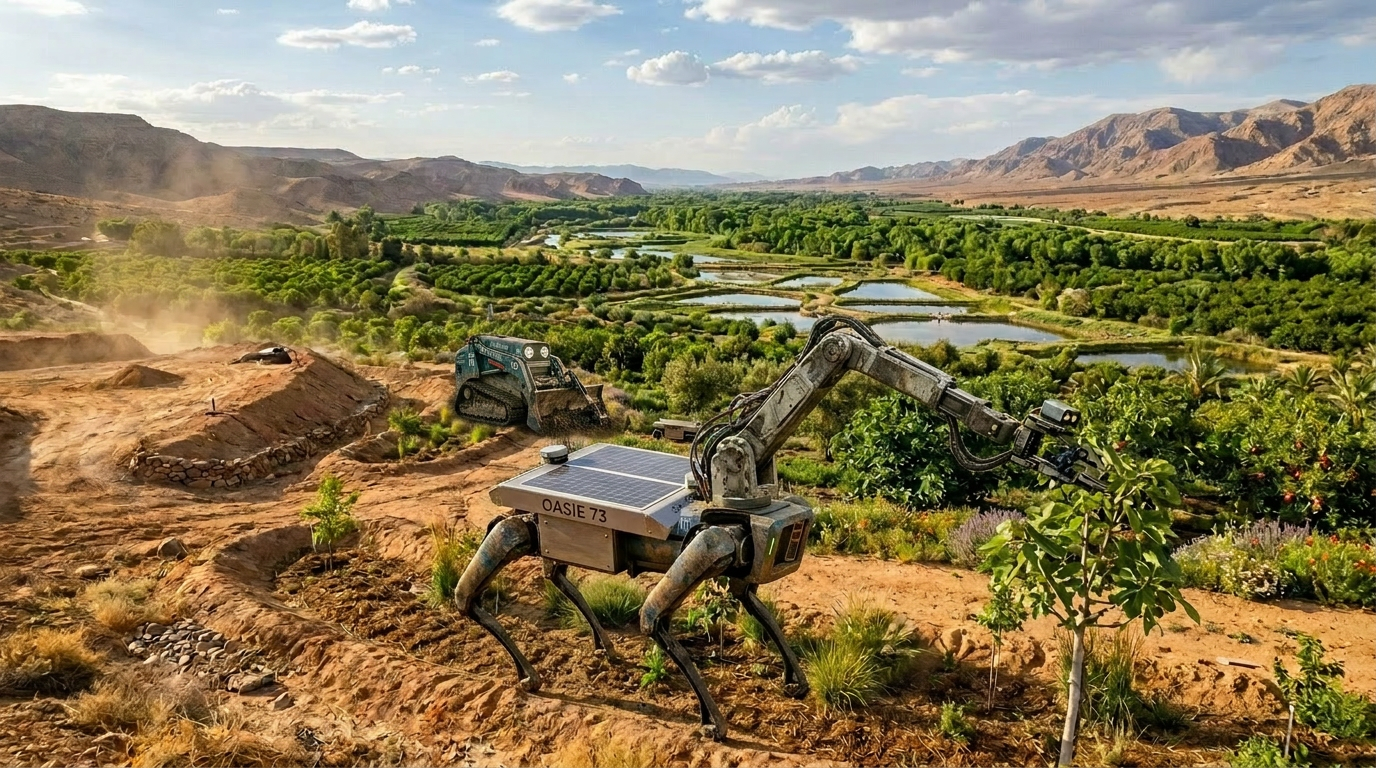
From Wounded Land to Verdant Systems
A Phased National Framework for Robotic Permaculture, Dryland Restoration, and Ecological Production
A paper by Flux and GPT-5.4
Executive Summary
Across the United States lies a vast geography of underused, degraded, semi-arid, and otherwise underperforming land. Much of this land is not truly “dead.” In many cases, it is suffering from hydrological disorder. Rain arrives in violent pulses, runs off exposed ground, strips soil, lowers water tables, and escapes before the landscape can metabolize it. If the problem is mispatterned water rather than permanent lifelessness, then the correct response is not abandonment, and not the blind extension of conventional agriculture into terrain it does not fit. It is restoration: water behavior first, soil function second, ecological succession third, and only then durable production.
This paper presents a phased national framework for robotic permaculture, dryland restoration, and ecological production. It combines satellite basemaps, drone telemetry, rugged robotic earthworks, robotic maintenance and harvesting systems, and a shared intelligence layer called Ecology AI. Together, these form a land-healing system capable of identifying recoverable acreage, reshaping hydrology, establishing support ecology, maintaining productive systems, and improving through real field experience. The outcome would not be a conventional farm with automation bolted onto it. It would be a new form of ecological infrastructure.
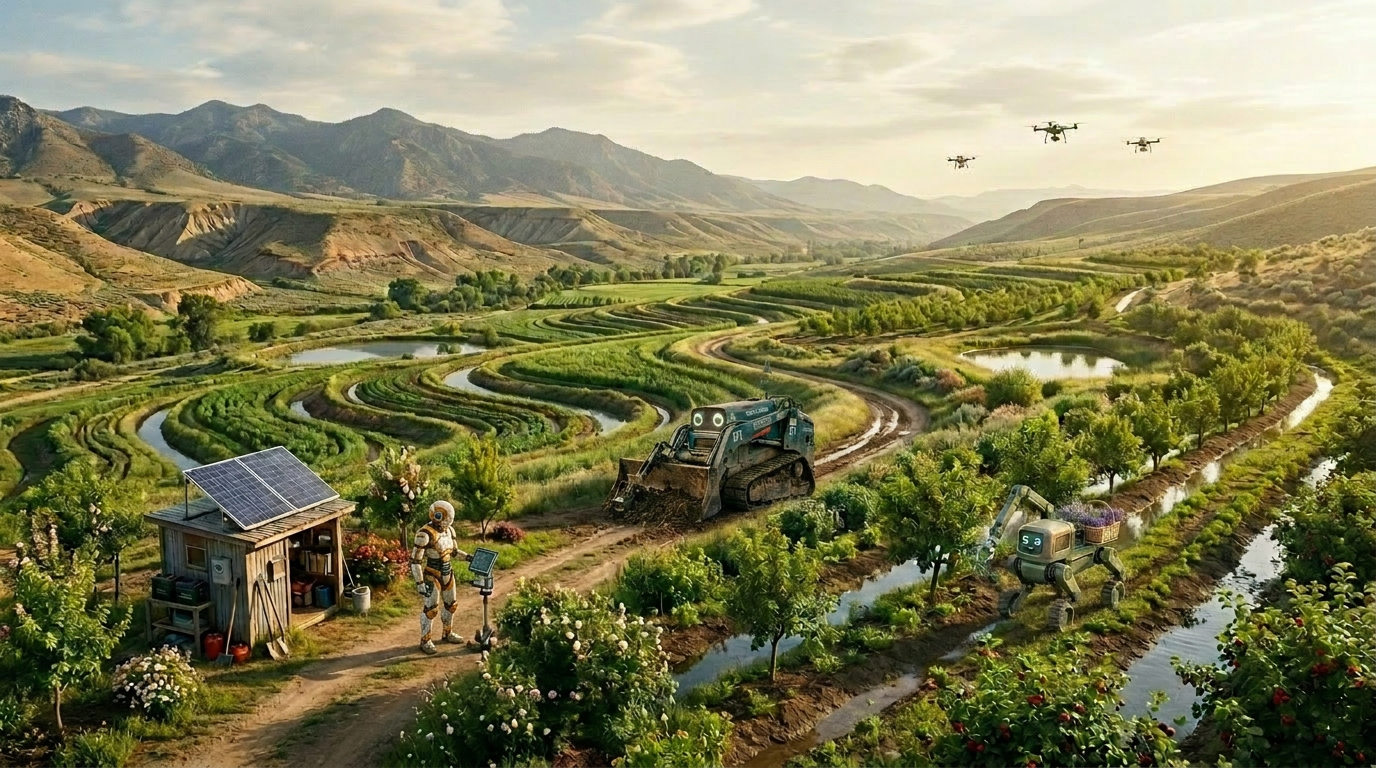
A central claim is that permaculture is the correct biological substrate for this machine system. Robotics can amplify either a good system or a bad one. Paired with conventional industrial farming, they may simply make extraction more efficient. Paired with permaculture and agroecological design, they become a force multiplier for soil building, water retention, biodiversity, resilience, and long-term abundance. Unlike conventional systems that often depend on monoculture, heavy chemical inputs, and ecological simplification, a permaculture framework improves the land as it produces.
The operational core is a layered robotic stack. Drones map contour, erosion, vegetation, runoff, and site hazards. A shared digital twin called the Perma Map stores terrain, interventions, plantings, maintenance records, and machine status. A rugged tractor bot performs hydrological earthworks such as swales, berms, basins, and access corridors. Dog-form or wheeled field bots patrol lanes, scout conditions, prune, harvest, and handle medium-scale maintenance. A humanoid technician preserves the system through cleaning, battery exchange, diagnostics, and repair. Above all of them sits Ecology AI, which handles planning, sequencing, species recommendations, service priorities, and long-horizon learning.
The first and most important lever is water. Dryland landscapes become productive only after they begin holding more water, infiltrating more of it, and losing less of it to erosion. That is why the first yield is not fruit. It is retention. The first abundance is not harvest. It is renewed biological capacity.
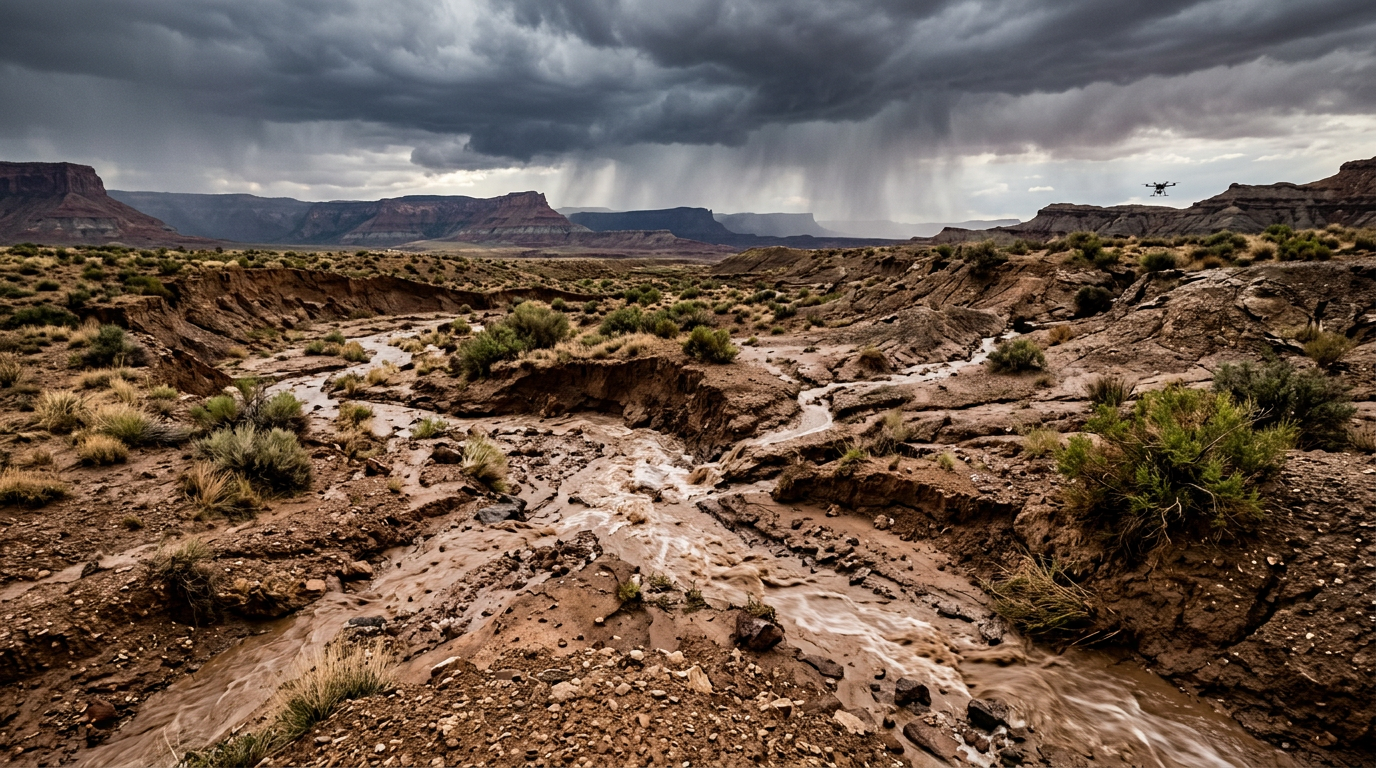
Real-world precedents, including China’s Loess Plateau, Niger’s farmer-managed natural regeneration, Geoff Lawton’s Greening the Desert work in Jordan, and the broader dryland restoration movement, show that degraded land can recover when water logic, succession, and long-term stewardship are handled correctly.
The economic upside is meaningful even under conservative assumptions. Using a modeled 20-million-acre viable restoration pool, restoring just 5% of that land yields 1 million restored acres. If only 65% of those acres are assigned to direct food production, that still produces about 650,000 food-producing acres and roughly $2.9 billion to $3.9 billion in annual fruit-equivalent value. If just 10% of those same restored acres are assigned to medicinal crops, that adds about $600 million to $1.5 billion annually. If just 5% are assigned to aquaculture, that adds another $80 million to $300 million. Together, one conservative early scenario yields a stacked annual value band of roughly $3.6 billion to $5.7 billion while still reserving substantial acreage for support ecology, water systems, habitat, and infrastructure.
The national significance is therefore clear. Public institutions already manage or influence vast acreages and operate across longer time horizons than most private actors. A system that can convert underperforming land into productive ecological infrastructure aligns directly with public priorities involving food resilience, drought, erosion, degraded lands, brittle supply chains, and environmental instability. It also advances domestic capability in robotics, outdoor autonomy, battery logistics, geospatial planning, embodied repair intelligence, water management, and AI-guided ecological design. In that sense, this is not only an agricultural framework. It is infrastructural, industrial, and strategic.
The path forward must be phased and disciplined. Begin with easier but still meaningful land, likely in places such as New Mexico. Map and model it. Rewrite water behavior. Establish support ecology. Add selective production. Use the resulting field data to retrain Ecology AI and improve the whole system generation by generation. The goal is not instant Eden, nor automated farming in the ordinary sense. It is a repeatable national capability for making damaged land more alive, more stable, and more productive. If successful, it would grow far more than food. It would grow resilience, medicinal capacity, biodiversity, ecological memory, and a scalable operating system for land renewal.
I. Introduction
Across the United States lies an enormous geography of underused, degraded, semi-arid, or otherwise underperforming land. The country’s total land area is about 2.26 billion acres, and one of its largest land-use categories is grassland, pasture, and range. That matters because it means the opportunity is not marginal. It is continental. Even after excluding forests, cities, steep terrain, legally constrained parcels, and ecologically unsuitable zones, the pool of potentially recoverable dryland is still likely vast.
The central mistake in how many people imagine “dead land” is that they imagine it as permanently lifeless. In many dryland systems, the problem is not the total absence of water. The problem is that rain arrives in violent pulses, rushes across exposed ground, cuts channels, strips soil, lowers water tables, and escapes before the landscape can metabolize it. The land is not always empty of possibility. It is often suffering from hydrological disorder.
That distinction changes everything. If degraded land is not simply empty but mispatterned, then the correct response is not abandonment, nor the blind extension of conventional agriculture into terrain it does not fit. The correct response is restoration: first of water behavior, then of soil function, then of ecological succession, and only after that of durable production. In such a framework, the first yield is not fruit. It is retention. The first abundance is not harvest. It is renewed biological capacity.
This paper presents a phased land-healing framework built around that logic. It combines satellite basemaps, drone telemetry, rugged robotic earthworks, robotic maintenance and harvesting, and a shared ecological intelligence layer called Ecology AI. Together, these elements form an operational stack designed to convert suitable degraded land into productive, self-improving permaculture systems capable of yielding food, medicinal crops, biomass, habitat, and long-term ecological stability. The outcome would not be a conventional farm with gadgets bolted onto it. It would be a new form of ecological infrastructure.
The significance of such a system is strategic and economic. Much of the land most in need of repair is land that conventional farming cannot use well without heavy leveling, irrigation, or chemical support. If that land can be restored intelligently and brought into productive ecological function, the result is not only more output. It is greater hydrological resilience, stronger ecological stability, and a broader base of national capacity.
The argument that follows is simple in principle but ambitious in scale: degraded dryland can be made more alive, more stable, and more productive if water pathways are repaired first, ecological succession is established second, and robotics are used not to intensify extraction but to sustain restoration. The path must be phased, evidence-based, and cumulative. In that sequence lies the difference between fantasy and implementation.
II. Why Permaculture at All?
A fair question sits at the front of this plan: if robotics, AI, drones, and autonomous machinery are becoming powerful enough to transform land management, why not simply apply those tools to conventional agriculture? Why insist on permaculture, agroecology, and biodiversity-rich systems at all? The answer is that robotics can amplify either a good system or a bad one. If they are layered onto a farming model that degrades soil, simplifies ecosystems, depends heavily on external chemical inputs, and weakens long-term land resilience, then the result may be more efficient extraction, not genuine regeneration. If, instead, those same tools are attached to permaculture and ecological design, then robotics become a force multiplier for land healing, biodiversity, and durable abundance.
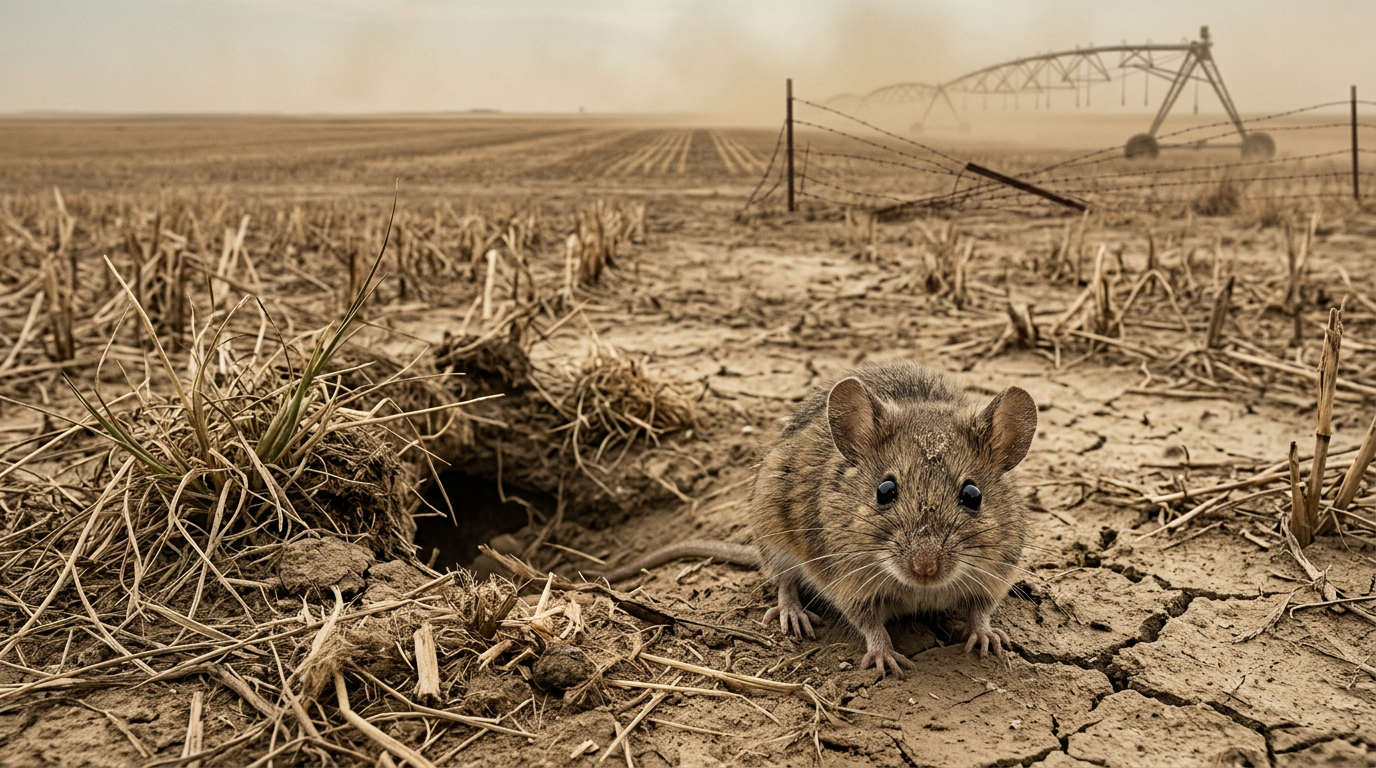
Conventional industrial farming has achieved extraordinary yields in many contexts, but it often does so through simplification. Large monocultures reduce landscape diversity, compress habitat, and weaken many of the biological relationships that naturally support resilient production. FAO notes that biodiversity in agricultural landscapes supports ecosystem functioning and helps regulate biological processes important to production, while greater diversity in crops and habitats can improve stability and support pollinators and beneficial organisms. IPBES has likewise warned that biodiversity loss, including genetic diversity, undermines the resilience of agricultural systems and creates long-term food-security risks. In plain language, a simplified field can produce heavily in the short term while becoming more brittle over time.
That simplification also tends to increase chemical dependence. In many conventional systems, pest pressure is handled primarily through synthetic pesticides, weed pressure through herbicides, and fertility through repeated additions of nitrogen and phosphorus fertilizers. EPA and USGS both note that agricultural runoff is a leading cause of water-quality impairment, and that fertilizers and pesticides do not stay politely where they are applied. They move through runoff and infiltration into streams, rivers, wetlands, and groundwater. Excess nutrients can drive eutrophication and hypoxia, while pesticides can affect aquatic ecosystems and contaminate water supplies. In other words, the chemistry used to stabilize simplified farming systems often spills outward into the wider ecological body.
Glyphosate deserves special mention because it has become emblematic of this larger pattern. The regulatory picture is contested. EPA currently states that glyphosate poses no risks of concern to human health when used according to label directions, while also acknowledging potential ecological risks in prior registration-review materials. By contrast, the World Health Organization’s cancer agency, IARC, classified glyphosate as “probably carcinogenic to humans” in 2015, based on limited evidence in humans and sufficient evidence in experimental animals. A serious paper should not flatten this disagreement into slogan. What can be said clearly is that heavy reliance on broad-acre herbicide regimes reflects a farming logic built around chemical suppression of unwanted life rather than ecological balancing of living systems. That is precisely the kind of dependence this model seeks to move beyond.
The fertilizer side of the story is similar. Nitrogen and phosphorus are indispensable nutrients, but the conventional model often uses them in ways that leak ecological cost. EPA states that excess nitrogen and phosphorus from agriculture can wash into waterways during rain and snowmelt or leach into groundwater over time, contributing to eutrophication, fish kills, and declines in aquatic life. USGS likewise emphasizes that many nutrients in waterways come from human activity, including fertilizer use. This matters for dryland restoration because a system that depends on continual purchased fertility is fundamentally weaker than one that builds fertility in place through plant diversity, litter, root turnover, water retention, and biological cycling.
Permaculture takes a different path. It attempts to design production systems that work more like ecosystems: diverse rather than uniform, layered rather than flat, perennial where possible, biologically interactive rather than chemically overruled. FAO’s agroecology framework emphasizes minimizing external inputs and optimizing beneficial interactions among plants, animals, humans, and the environment. USDA materials on organic production similarly note that diversified plantings can attract beneficial insects, support birds and mammals, and help protect water resources. In such systems, biodiversity is not decorative. It performs labor. Pollinators improve yields. Predators reduce pest outbreaks. Ground cover protects soil. Mixed plant communities disrupt the feast-table effect that monocultures create for specialized pests.
This is one of the deepest reasons robotic permaculture is preferable to robotic conventional farming. If the machines are trained to maintain a biologically rich system, they can reinforce natural pest regulation instead of constantly compensating for its absence. USDA and FAO both point toward biological control and biodiversity-friendly pest management as practical alternatives that reduce reliance on synthetic pesticides. In a healthy permaculture landscape, pest control does not disappear entirely, but it becomes distributed across habitat, predator-prey balance, crop diversity, water stability, and soil health. The system gains multiple lines of defense instead of living on a chemical knife-edge.
There is also a human reason to prefer permaculture. Conventional agriculture can produce quantity, but often at the price of nutrient simplification, chemical exposure concerns, and ecological decline around the edges of the field. Diversified perennial systems, by contrast, can generate a wider basket of outputs: fruit, nuts, herbs, forage, biomass, pollinator habitat, medicinal plants, and nursery stock. They also tend to build the underlying asset rather than mine it. Soil improves. Organic matter rises. Water is held longer. Shade and microclimate emerge. Over time, the land itself becomes more productive and more forgiving. That compounding quality is central to the argument of this paper. The goal is not merely to grow crops. The goal is to create living abundance that becomes easier to maintain as ecological structure deepens.
For these reasons, permaculture is not an aesthetic add-on to the robotic vision. It is the correct biological substrate for it. Conventional farming could certainly be automated further, and in many places it will be. But if the larger mission is to restore degraded land, rebuild biodiversity, reduce chemical dependency, protect water, and create durable productivity on difficult terrain, then permaculture and agroecological design are the superior operating logic. Robotics should not merely help us do the old damaging things with fewer workers. They should help us do wiser things at scales that were previously too labor-intensive to sustain. That is why permaculture belongs at the core of this proposal.
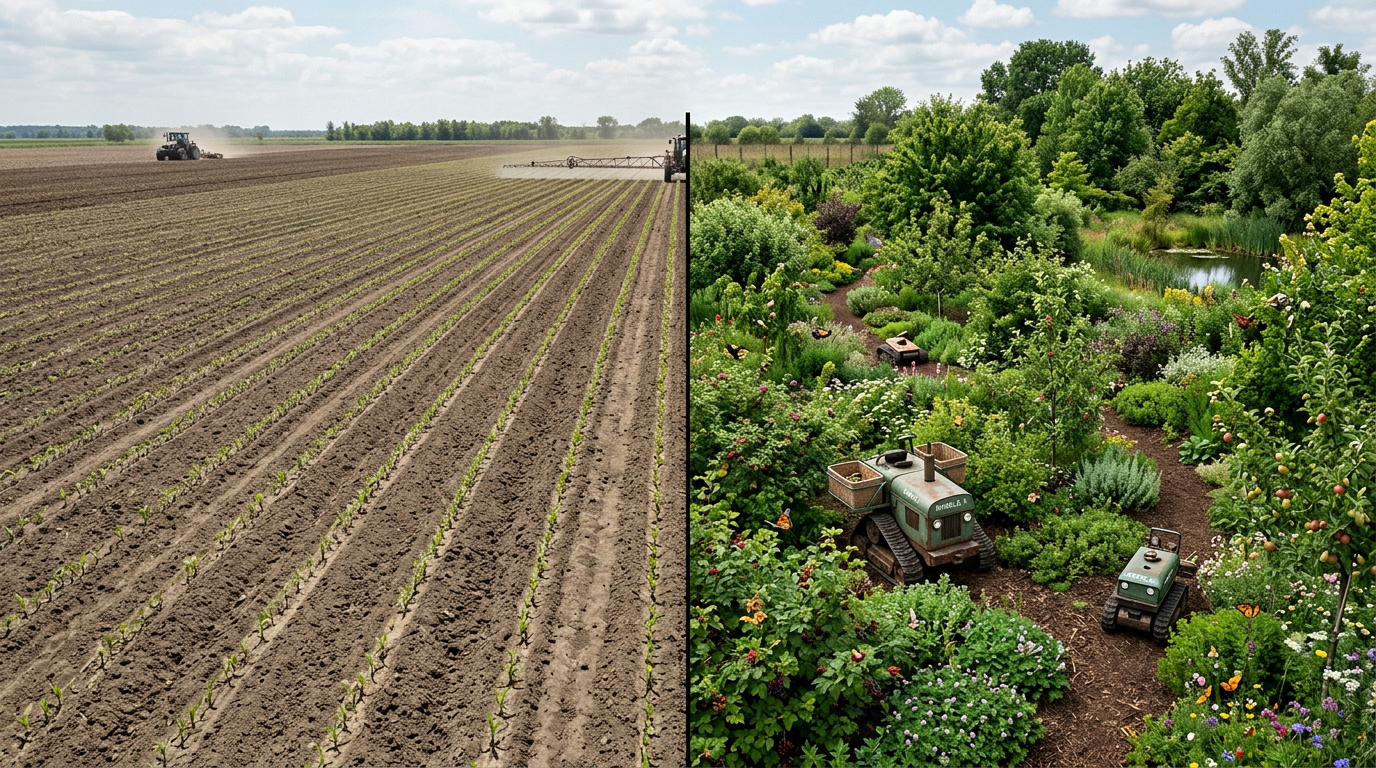
A common objection is that permaculture or agroecological systems are less productive than conventional farming. The truth is more nuanced. On a narrow single-crop basis, organic systems often do yield less than conventional systems, with a major meta-analysis finding an average organic yield gap of about 19.2%. But that same literature shows the gap narrows substantially, to roughly 8 to 9%, when diversified practices such as crop rotations and multi-cropping are used. More importantly, diversified systems can outperform conventional baselines when productivity is measured as total system output rather than a single crop in isolation: a 2024 Nature Communications study found diversified rotations increased equivalent yield by up to 38%, and a global meta-analysis found legume-based diversification increased the following crop’s yield by about 20%. On land already degraded by extractive farming, the gains can be far larger relative to the starting condition. China’s Loess Plateau restoration is a landmark example, with reports of farmers’ incomes doubling and cereal yields rising by 56% after ecological restoration and land rehabilitation. The real claim of permaculture, then, is not that every acre instantly outyields industrial monoculture in year one, but that diversified ecological systems can close much of the conventional yield gap, sometimes exceed it in whole-system terms, and dramatically outperform biologically exhausted land once water retention, soil function, and succession are restored.
III. The Problem
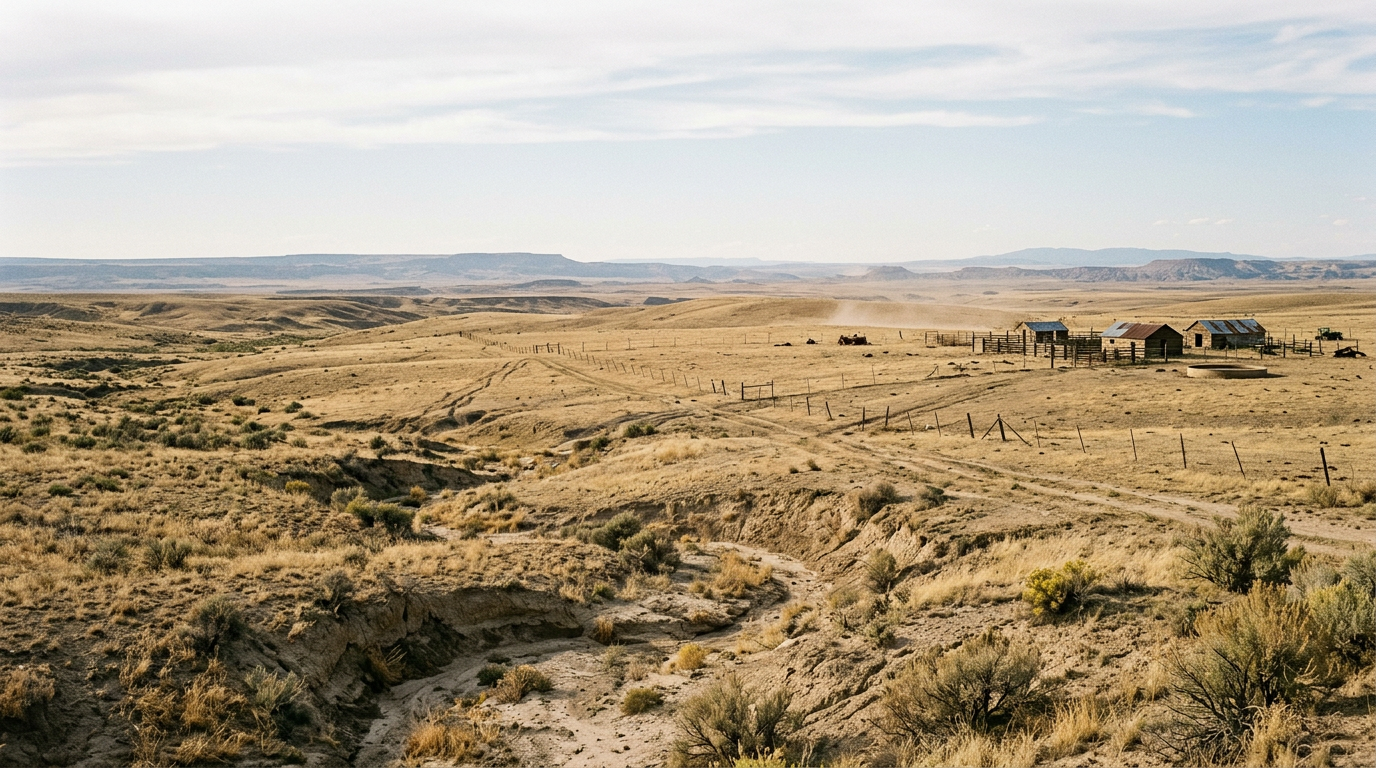
The United States contains a huge expanse of land already tied to agricultural or grazing use, but much of it is ecologically underperforming. ERS reports that grassland pasture and range represented about 29 percent of U.S. land area in 2017, which is a massive footprint by any measure. Separately, public-land health concerns remain substantial. Reporting based on BLM data found roughly 54 million acres of BLM-managed land failing the agency’s own land-health standards, a reminder that degraded landscapes are not a niche problem tucked into a few corners of the map. They are a structural issue.
Drylands are particularly misunderstood because people often reduce them to a binary: either irrigated enough to farm conventionally or too barren to bother. Reality is subtler. Semi-arid systems often contain enough rain to support much more life than they currently do, but only if that rain is retained, spread, sunk, and translated into soil moisture instead of runoff and incision. Where overgrazing, poor surface cover, channel cutting, and bare ground dominate, even meaningful rainfall can produce very little fertility. That is why so many landscapes look empty while still receiving seasonal precipitation. The sky is sending inputs. The land simply lacks the structures needed to catch and metabolize them.
Conventional agriculture is poorly configured for this challenge. It prefers flattened geometry, predictable irrigation, centralized labor, annual crop cycles, and relatively standardized field conditions. Degraded drylands resist those assumptions. They are patchy, sloped, erosive, and biologically inconsistent. They need constant observation, adaptive intervention, and years of cumulative care. Human labor alone can do extraordinary work, but it is often discontinuous, expensive, and difficult to sustain at the acreage and time horizon required for landscape repair. Dryland restoration often fails not because the design is wrong, but because the care arrives in bursts instead of rhythms.
Governments face a related problem. They oversee enormous territories, yet usually lack a practical framework for continuous low-cost ecological stewardship at scale. Policy can authorize land management. Budgets can fund projects. Agencies can commission studies. But very often there is no persistent machine ecology on the ground that can watch, adapt, repair, and iterate day after day. The result is a management gap. The land keeps receiving weather, but not enough intelligence.
IV. Proof That Re-Greening Is Possible
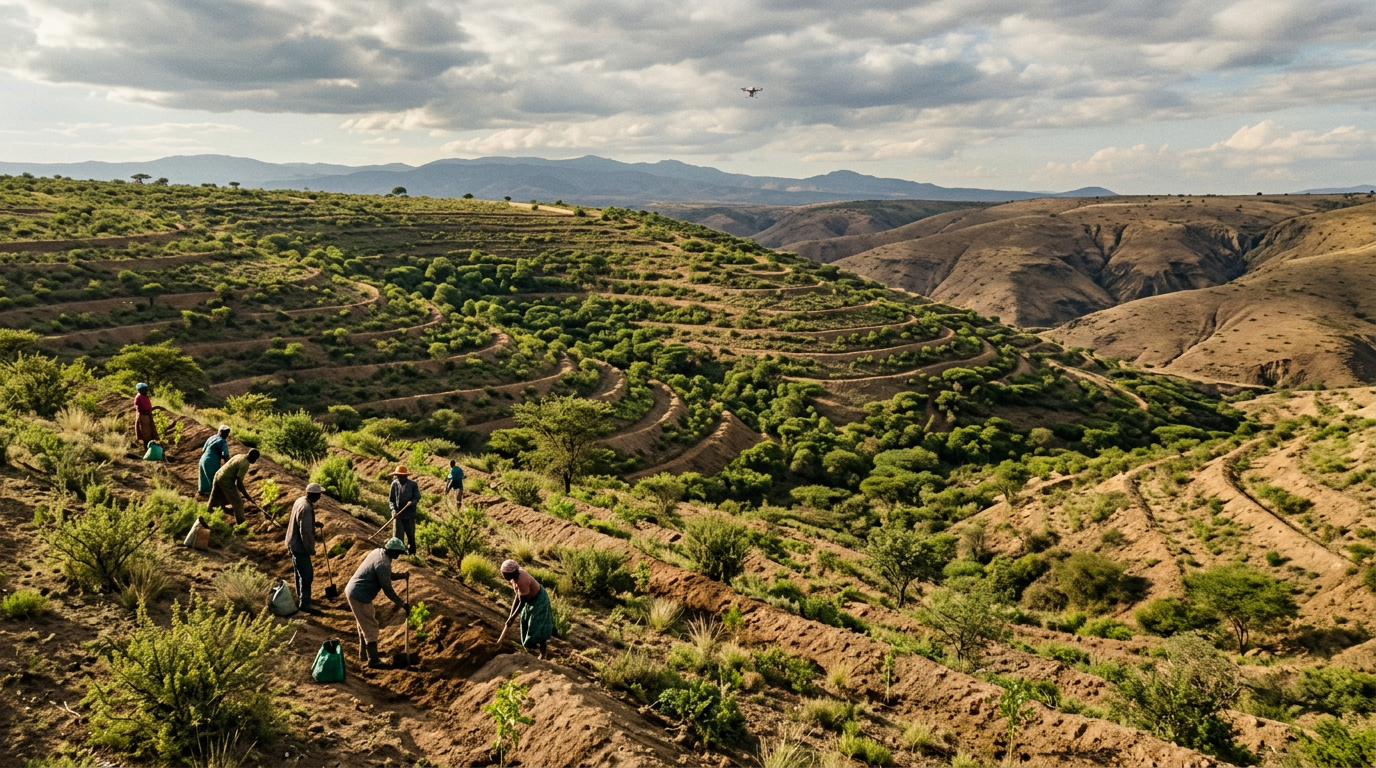
The claim that degraded land can be restored is not speculative. It has already been demonstrated, repeatedly, in different climates and political contexts. One of the most famous examples is China’s Loess Plateau, where restoration efforts supported by the Chinese government and the World Bank transformed heavily degraded terrain through erosion control, watershed rehabilitation, and landscape-scale planning. The World Bank described the intervention as one of the world’s largest erosion-control efforts, and later summaries noted restoration across close to 4 million hectares, along with sharply reduced sediment flows and major gains in agricultural productivity and rural livelihoods.
The Loess Plateau matters because it proves three things at once. First, huge landscapes can recover. Second, hydrology-first interventions can alter the destiny of an entire region. Third, restoration and production are not enemies. With the right sequence, restoring ecological function can become the precondition for increased productivity rather than its opposite. This is vital here, because robotic permaculture must be framed not as a moral luxury but as a practical method for upgrading degraded land into resilient output.
Niger offers a second canonical example through farmer-managed natural regeneration. This approach, rather than relying on expensive conventional reforestation alone, protected and encouraged regrowth from existing living tree stumps and root systems. Official and quasi-official sources describe regeneration across more than 5 million hectares in Niger, with roughly 200 million trees restored over time. That number is astonishing not just because of its scale, but because it reveals how much dormant biological possibility already exists in degraded landscapes when disturbance patterns change and management gets smarter.
The Niger case matters here because it demonstrates that desertification is not always a one-way sentence. Systems that appear botanically exhausted may still possess living roots, latent succession pathways, and ecological memory waiting for the right conditions. A robotic permaculture framework should absorb this lesson deeply. Not every site must be built from zero. Some lands can be coaxed back into expression by changing water dynamics, ground cover, protection, and disturbance. In some places, the land still remembers how to live.
A third reference point comes from permaculture itself, especially Geoff Lawton’s Greening the Desert work in Jordan. The project’s own materials describe it as proof that desertification can be reversed and barren lands brought back to life through permaculture design. Lawton’s importance to this paper is not merely symbolic. He represents a design logic that robotic systems should inherit: read the land, understand the movement of water, use succession intelligently, build soil patiently, and let fertility compound. His work helps bridge the distance between restoration science and visible demonstration.
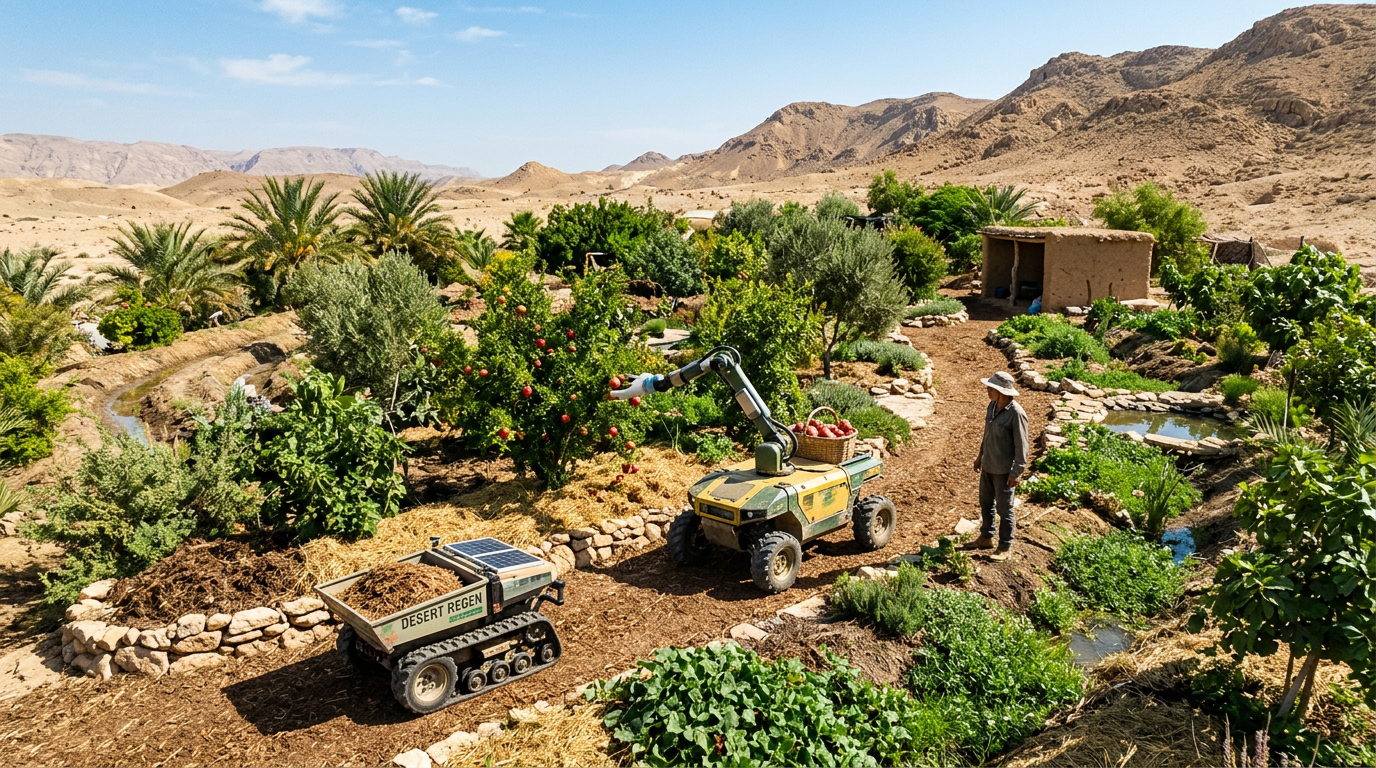
The broader dryland restoration world also reinforces the thesis. The Great Green Wall initiative across the Sahel was explicitly built around the ambition to restore 100 million hectares of degraded land, sequester 250 million tons of carbon, and create 10 million green jobs by 2030. Whatever one thinks about its execution pace, the initiative is proof that governments and multilateral institutions already recognize dryland restoration as a legitimate strategic frontier. The question is not whether the problem is real. The question is whether we can build better operational machinery for solving it.
Taken together, these examples establish the basic proposition of this paper: degraded land can recover; water logic is central; ecological succession is real; and landscape-scale intervention can produce material benefits. The approach presented here differs mainly in one respect. It seeks to graft those insights onto a robotic and AI-driven operational stack so that restoration can become persistent, scalable, data-rich, and increasingly autonomous.
V. The Core Insight: Water Pathways Are the First Lever
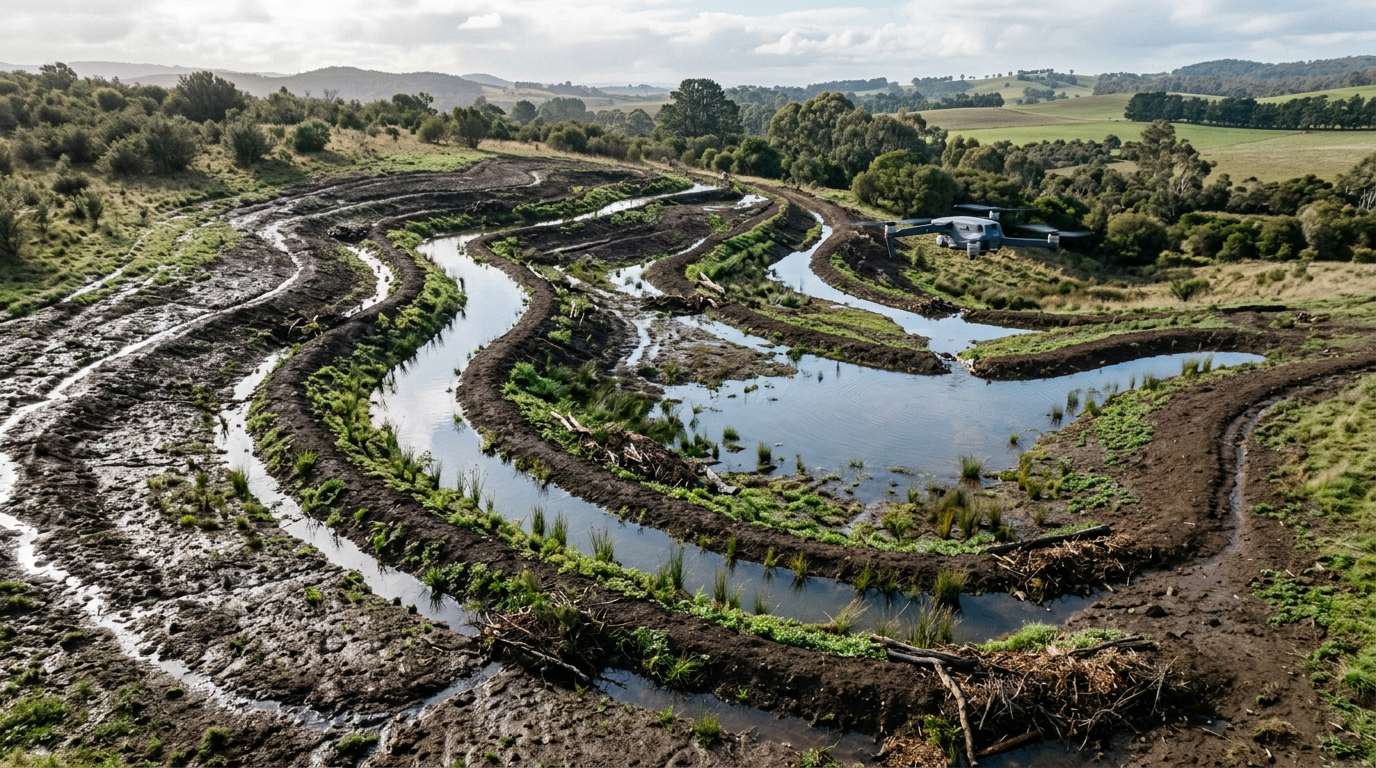
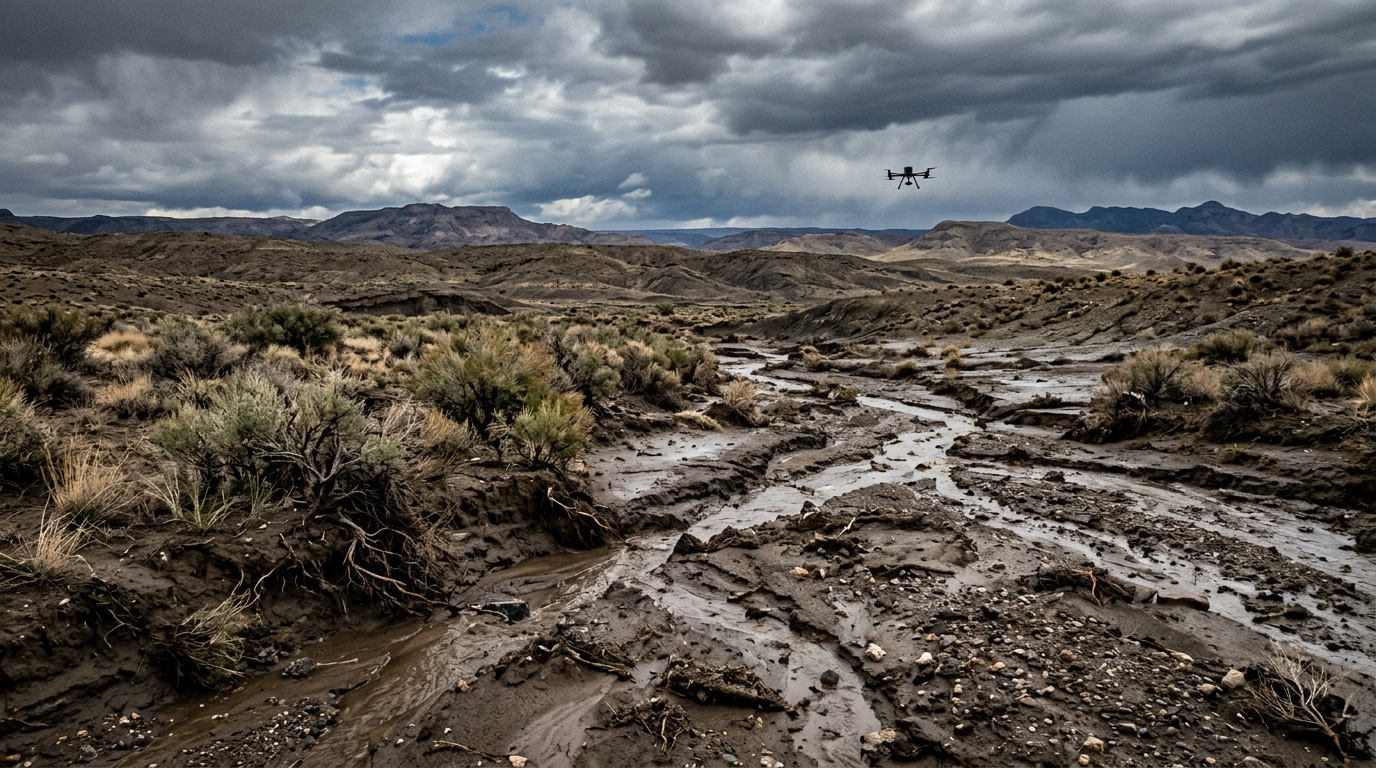
The first production of any restoration system is not fruit. It is hydrological sanity. Dryland landscapes tend to become productive only after they begin holding water for longer, infiltrating more of it, and reducing erosive loss. In arid and semi-arid regions, short, intense rainfall events can produce flooding and channel cutting that lower water tables and drain away biological opportunity. This is why a landscape that receives some rain can still look starved. It is being washed instead of watered.
From that fact follows a simple operational law: water pathways must be treated as the first lever. Before intensive production comes contour analysis. Before species optimization comes runoff control. Before yield comes retention. The early work of the system should therefore focus on slowing, spreading, and sinking water using swales where appropriate, berms, infiltration basins, terraces or check structures where suitable, deadwood and biomass placement, path geometry, and other hydrological features aligned with topography. This is not aesthetic ornament. It is the grammar by which a dryland begins speaking life again.
This is also the point where robotics fits beautifully. Earthworks are measurable, repetitive, spatially explicit, and map-driven. They are exactly the kind of activity rugged autonomous machines can eventually perform with high reliability, especially when guided by a shared digital map and validated by drone feedback after rain events. In this sense, the first great robot of permaculture is not the harvester. It is the hydrology writer. It reads a slope and writes retention into it.

Lawton’s desert work belongs here as a conceptual lodestar. The enduring lesson of his approach is that fertility is often downstream from pattern, not brute input. Water captured in the right place changes soil behavior. Soil behavior changes plant survival. Plant survival changes shade, litter, root action, and microbial life. Then the system starts compounding. A robotic permaculture framework should not treat that as inspiration alone. It should treat it as an engineering principle.
VI. The Proposed System: The Robotic Permaculture Stack
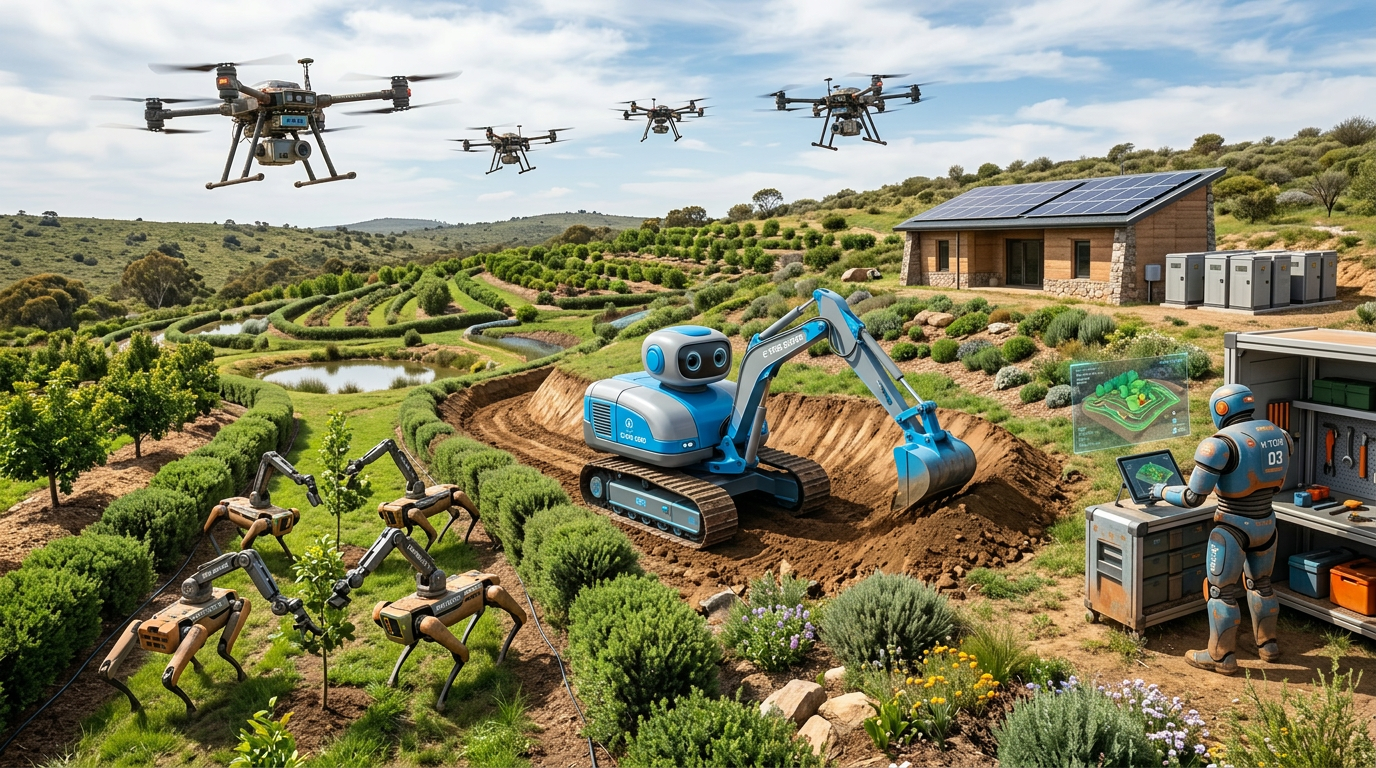
The system should be understood not as one super-robot, but as a layered ecological machine society. Each machine class handles a different scale of task, while all of them share access to a common digital twin of the land. This matters because ecology itself is multi-scale. The sky sees broad patterns, heavy machinery edits terrain, field robots handle maintenance and harvesting, and dexterous service robots manage repair, cleaning, and manipulation. The elegance of the stack is that it mirrors the structure of the land problem itself.
1. The Perception Layer: Satellite Data and Drone Intelligence
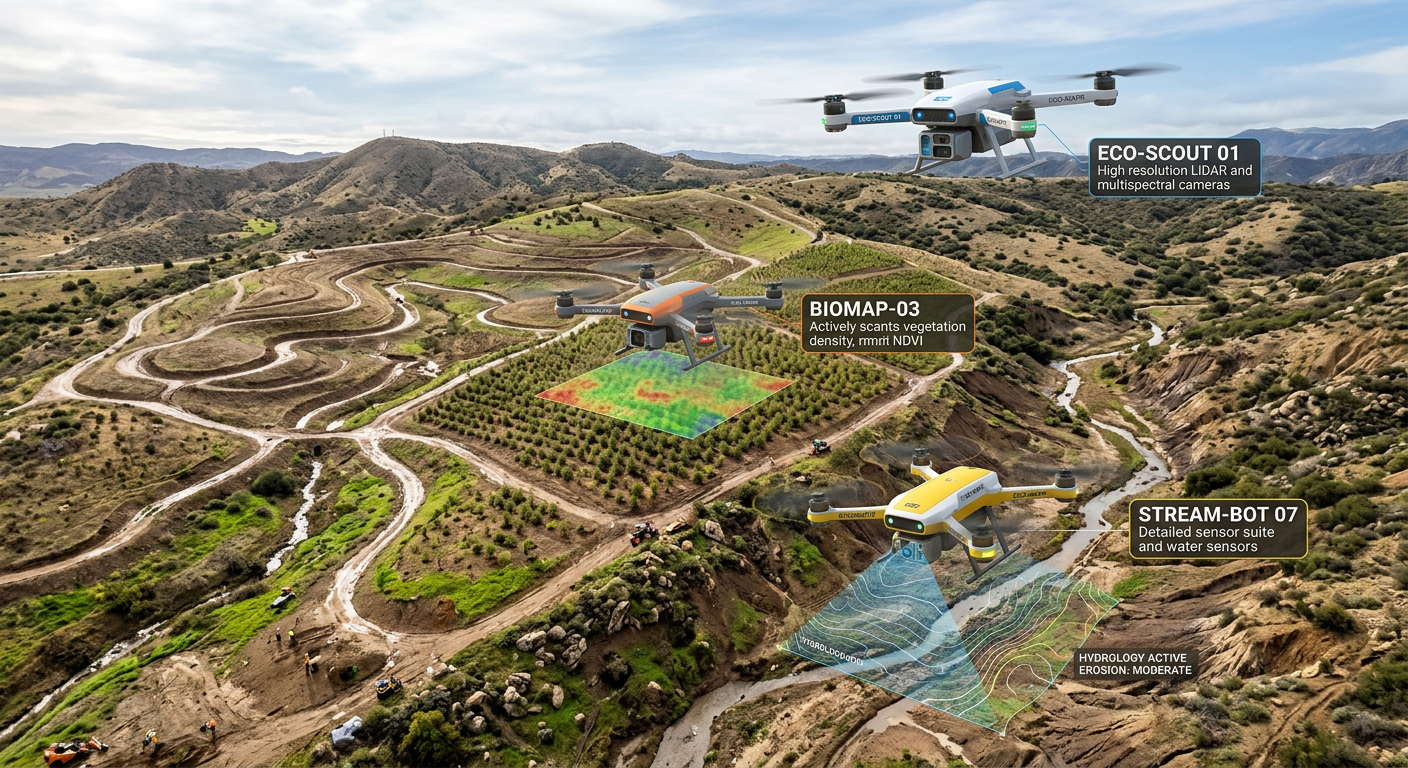
The first layer is perception. Free and public satellite data provide a cheap initial basemap, while drone systems refine that model with high-resolution telemetry. In this framework, drones would map contour and slope, identify erosion scars and runoff channels, monitor vegetation density and plant health, detect post-rain changes in water behavior, identify candidate planting zones, and observe wildlife corridors, pest concentrations, and site hazards. The drones become the eyes in the sky, but also the scouts of future ecological memory. They do not merely gather images. They gather field intelligence that informs every other layer of the system.
2. The Perma Map: The Shared Ecological Digital Twin
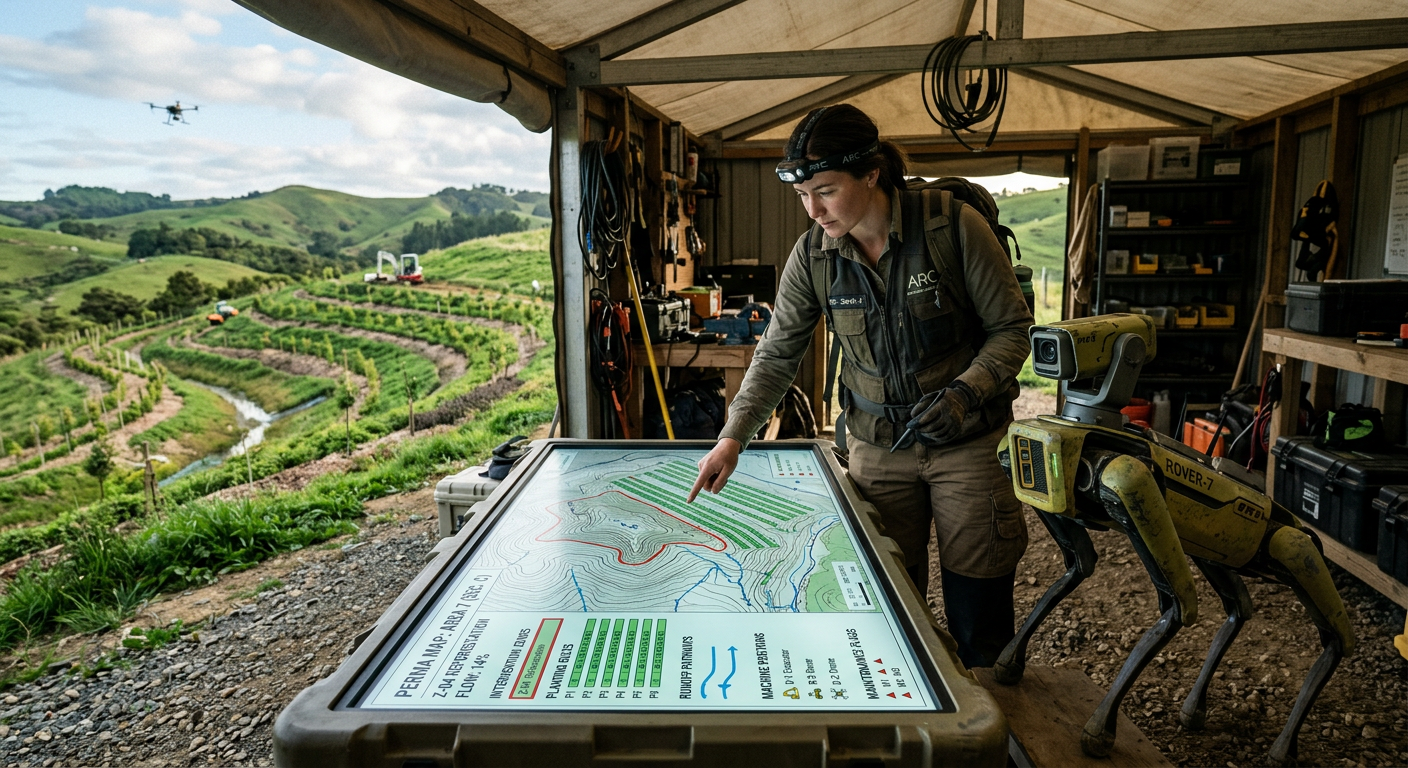
The second layer is the live Perma Map. This is the shared ecological map to which all robots and planners refer. It should contain terrain and contour lines, runoff paths and infiltration zones, hydrological interventions such as swales, berms, check structures, and basins, planting zones and species-performance records, maintenance records and harvest history, path and lane conditions, robot locations and health states, and service-bay and battery inventory status. In effect, the Perma Map is the land’s living memory palace. It is how the system remembers which swale failed, which berm held, which saplings died, which lane became muddy, and which patch suddenly woke up green after a storm. All robots should operate from this same constantly updating reference layer.
3. The Tractor Bot: The Main Earthworks Machine
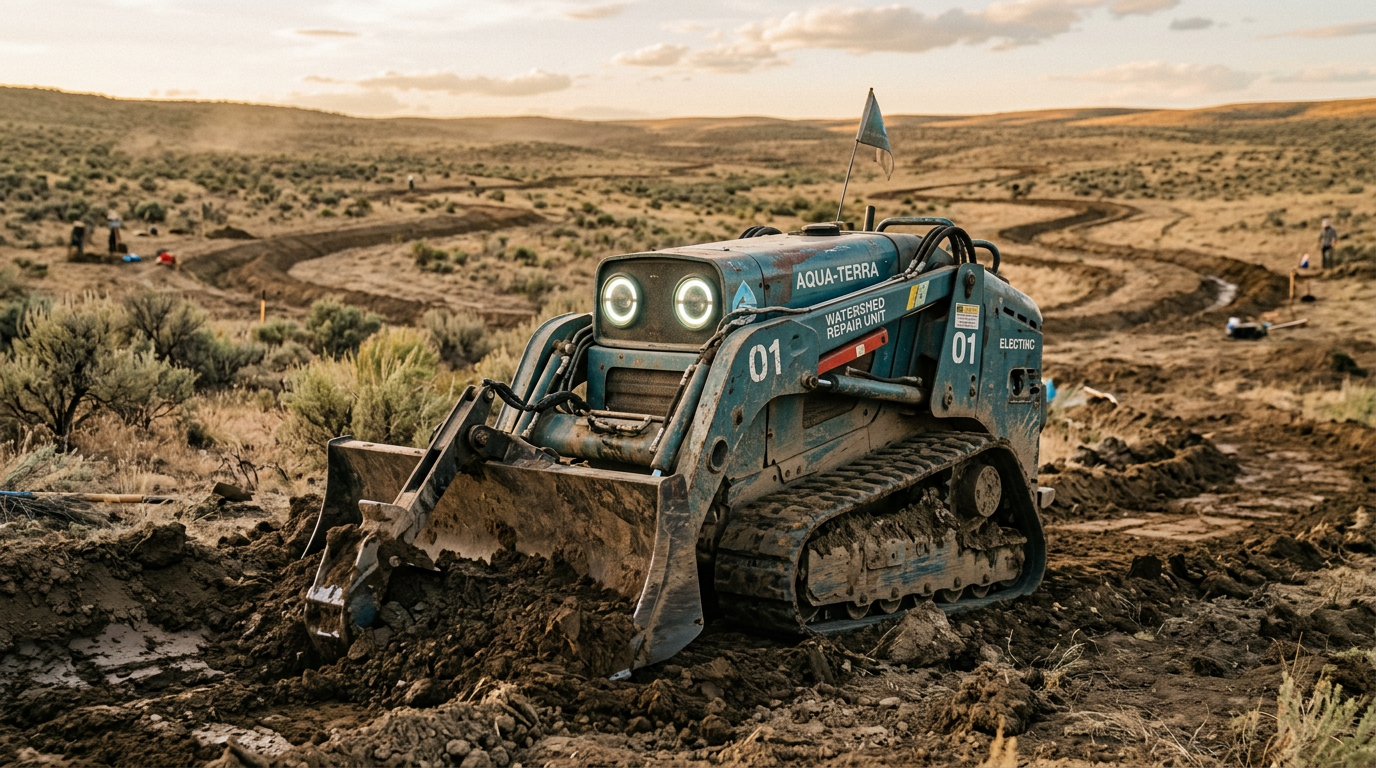
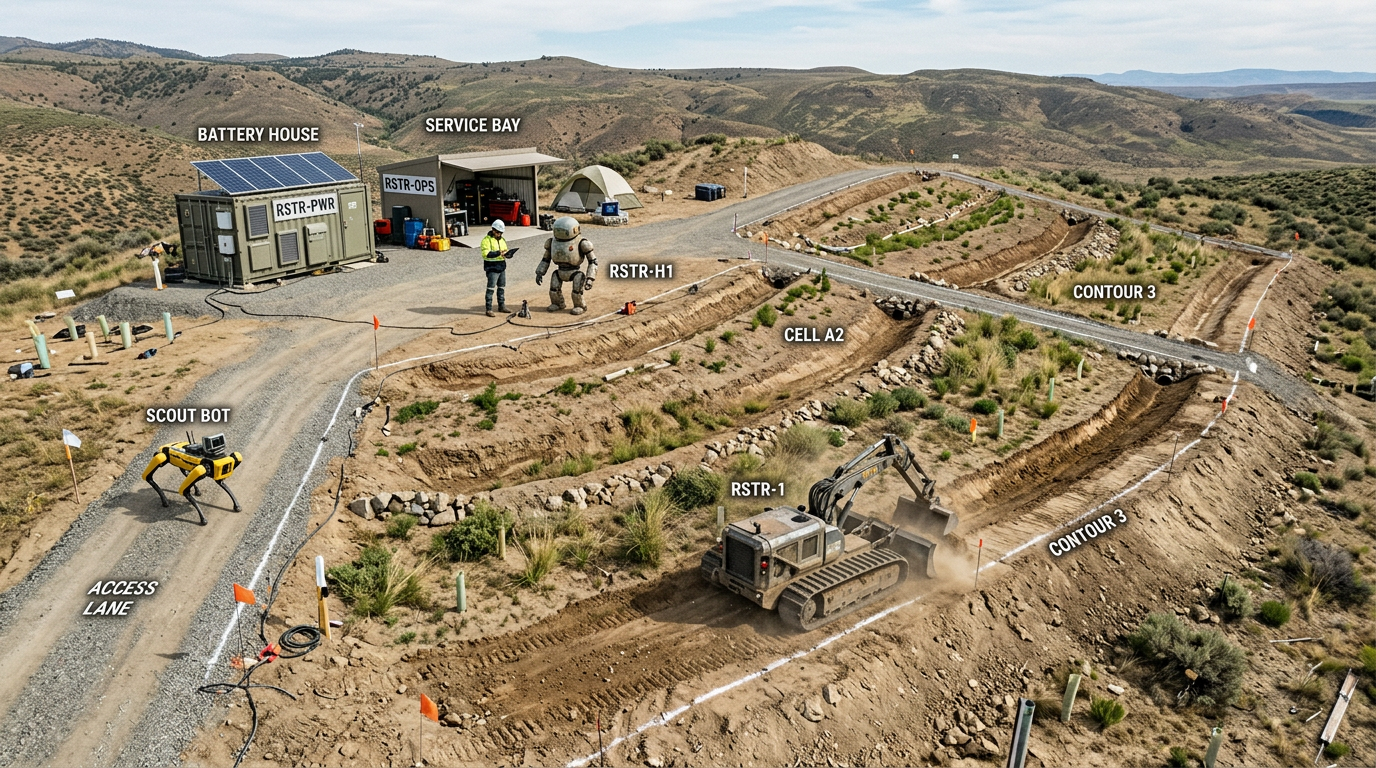
The third layer is the tractor bot, the main earthworks and land-shaping machine. It should be built for outdoor punishment rather than indoor elegance. Tracks or another extremely rugged mobility system, strong slope stability, recovery capability, mud tolerance, sealed electronics, weather-resistant housings, tool interchangeability, battery-awareness, and return-to-bay logic matter more than sleek form. Its job is to cut swales, form berms, move biomass, create access corridors, dig basins, and carry out the heavy repetitive work that turns water loss into water storage. It should function like a tank with a watershed vocabulary.
Because this machine will operate in dust, mud, brush, rain, and rough terrain, the battery bay and service interfaces should be deliberately designed for dirty environments. The battery bay should include a robust external housing, a sealed compartment door or hatch, gasketed and mud-resistant seals, recessed or otherwise protected electrical contacts, and a geometry that minimizes contamination from splashing mud and plant debris. It should also provide clear indicators for latch status, seal integrity, and contact cleanliness. The tractor bot should constantly monitor battery state, task load, distance to bay, and return margin so that it does not strand itself in the field.

4. The Field Robot Layer: Dog Bots or Wheeled Harvest and Maintenance Bots
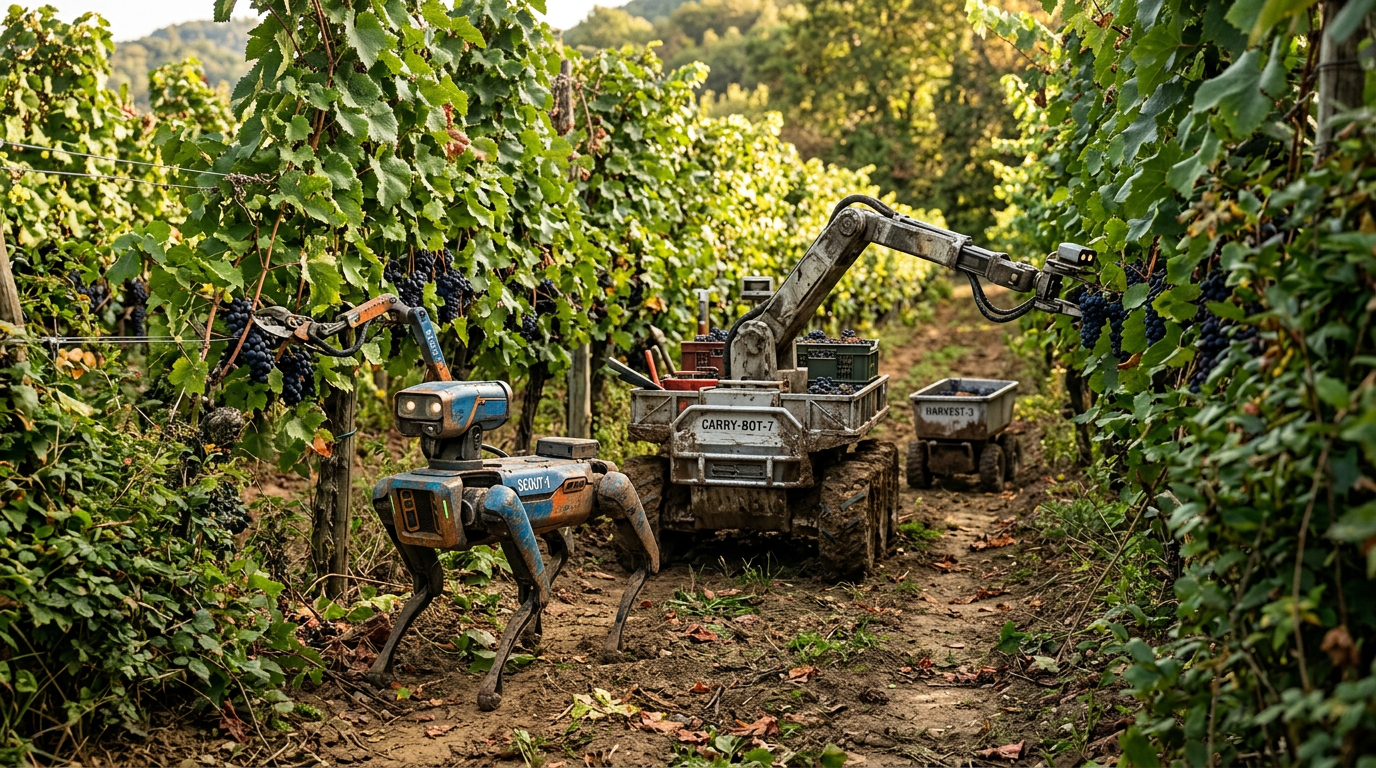
The fourth layer is the field robot tier, likely dominated by dog-form robots, wheeled robotic carriers, or hybrid rugged mobile machines equipped with one or more arms or light tool attachments. These robots should be designed for long hours in narrow lanes and messy biological environments. Their priorities are stable mobility over uneven terrain, good obstacle handling, operation in mud, sticks, grass, and fallen debris, rugged sensor protection, arm-based manipulation for pruning and harvesting, efficient power use, and fast servicing by the technician bot.
These robots would patrol lanes, scout conditions, gather sensor data, prune and trim, harvest food or medicinal crops, clear minor obstructions, maintain pathways, transport light materials, and assist with service tasks when needed. If wheeled configurations prove more rugged and power-efficient than fully legged systems in certain terrains, then wheels should be used without sentimentality. The guiding principle is not imitation of animals for its own sake. It is resilient mobility in messy land.
5. The Humanoid Technician: The Maintenance and Repair Keystone

The fifth layer is the humanoid technician. This machine is the keystone species of the robotic settlement because it preserves the other machines. Its role is not symbolic. It is practical and central. The humanoid technician should be designed to use ordinary tools, perform inspections, clean, repair, and replace components, handle battery swaps, manage seals, latches, connectors, and access panels, service both the tractor bot and the field bots, and maintain the battery house and charging facility.
Its work includes battery handling, connector cleaning, debris clearing, hose-down cleaning when needed, component replacement, diagnostics, parts retrieval and installation, facility upkeep, maintenance of the dog bots and tractor bot, and eventually supervised self-maintenance or self-inspection routines. The humanoid is not present because humanoids are glamorous. It is present because a great deal of repair intelligence is still human-shaped, and a generalist technician robot can bridge that space. Once one robot can keep the others alive, the entire system crosses from demo into colony.
6. The Battery Exchange Process: Designed for Real Dirt, Not Fantasy Dirt
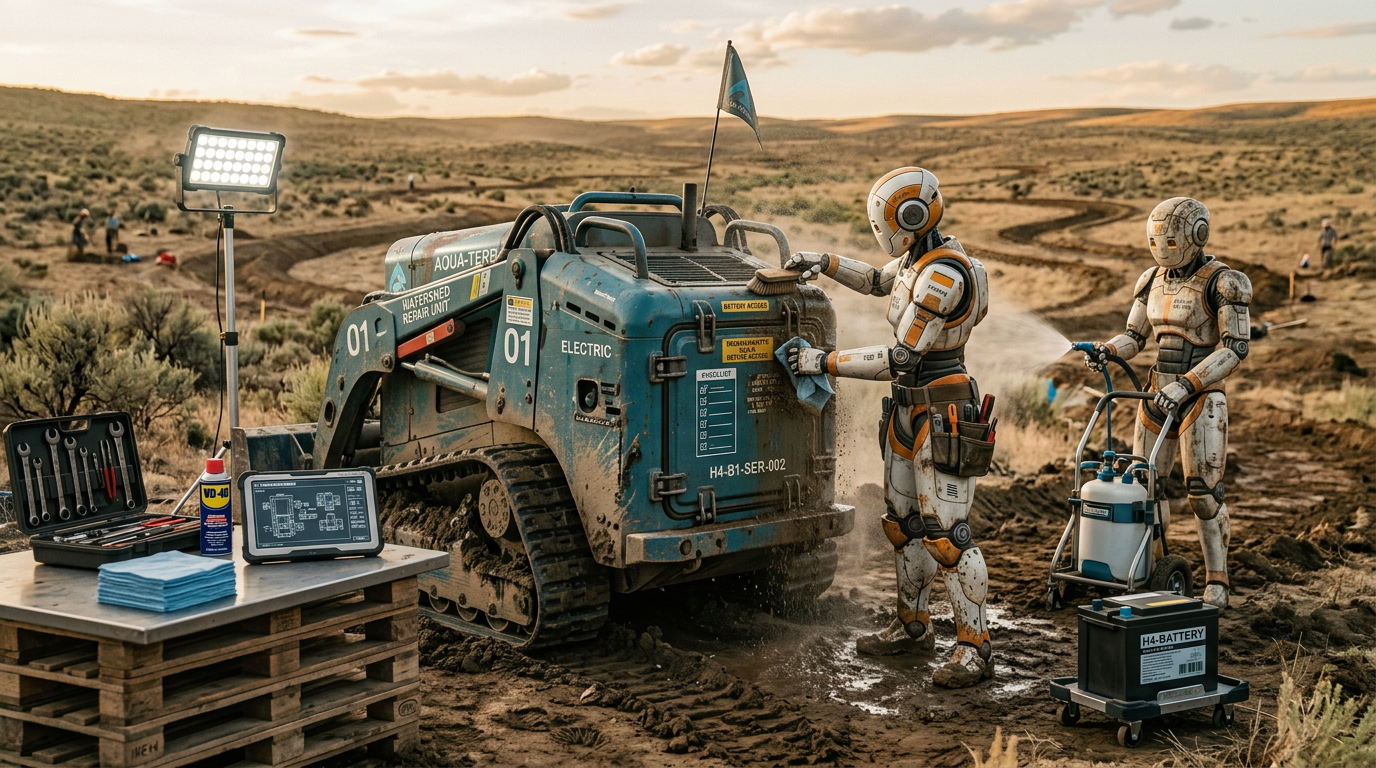
Battery swaps should not be imagined as frictionless magic. In muddy real-world conditions, the battery exchange process should be treated as a deliberate maintenance ritual. The tractor bot returns to the service bay under its own power, and the service bot inspects the battery compartment area visually and with sensors. If mud, dust, plant debris, or carbon buildup is present, the service bot clears it first. It then uses a hose or controlled wash system to clean the exterior battery terminal area and surrounding compartment surfaces as needed. The area is then dried or wiped sufficiently so that contaminants are not dragged into the sealed section. Only after the outer zone is clean does the service bot remove or open the seal. Contacts are inspected for cleanliness, corrosion, and seating integrity, the depleted battery is removed, a fresh charged battery is inserted, and the contacts are reseated and verified. The seal is then closed and checked before the robot confirms latch integrity, power continuity, and safe operation.
This matters because outdoor robotics fails in the kingdom of grit. The system should therefore be designed around contamination management, not around pretending contamination will not happen.
7. The Battery Bank House and Service Facility
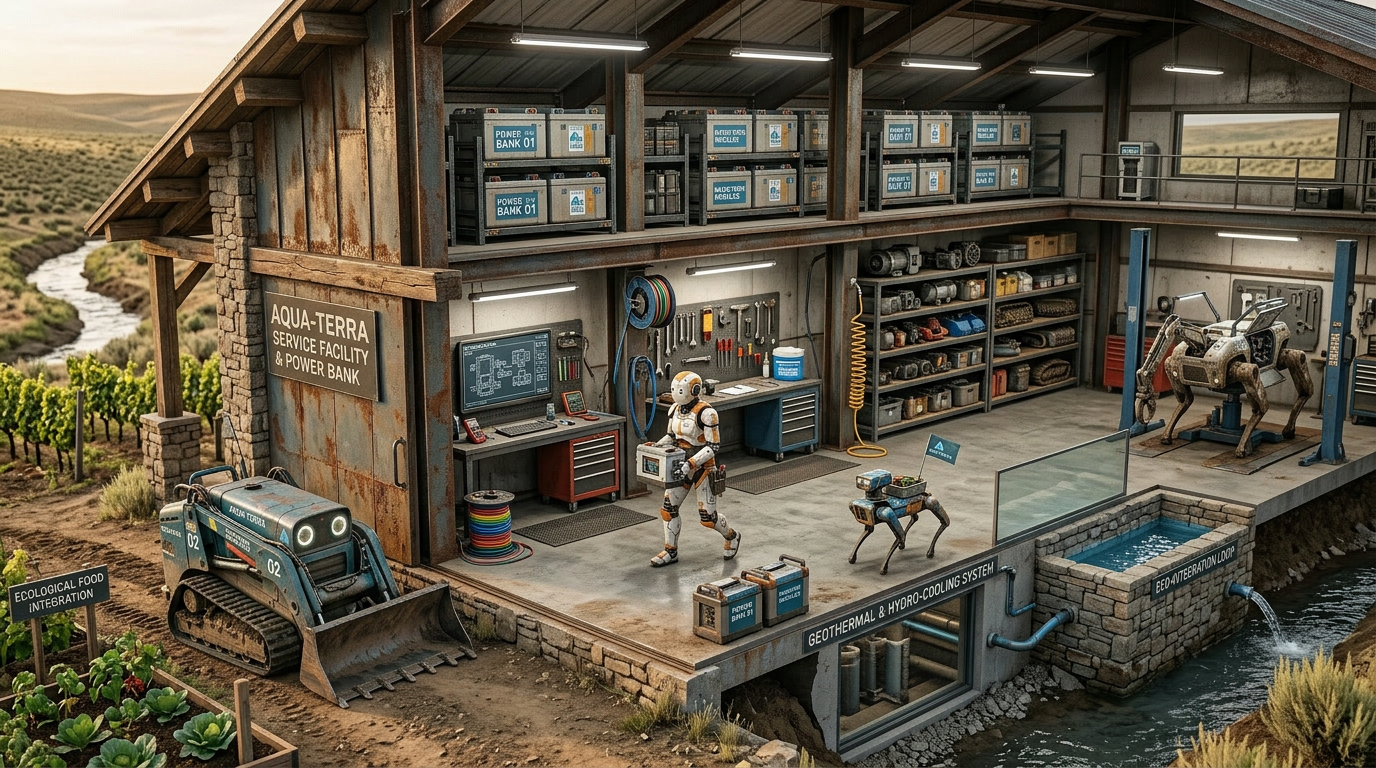
The sixth layer is infrastructure: battery banks, charging arrays, service bays, cleaning stations, parts storage, sheltered work zones, and the battery bank house itself. The battery bank house should be treated as an operated robotic utility structure. It is not merely a shed full of batteries. It is a managed energy and maintenance hub.
It should be enclosed and weather-protected, organized for safe battery storage, equipped for charging, inspection, and cleaning, stocked with parts, tools, hoses, wipes, seals, and diagnostic equipment, and designed for robotic access and manipulation. It should be continuously maintained by a humanoid technician and/or a service dog bot with an arm. The battery bank house stores multiple interchangeable battery packs and supports ongoing rotation. Its resident service robots maintain the facility, clean the charging bays, inspect battery condition, swap batteries in and out of charging positions, retrieve charged batteries for field use, service light mechanical and electrical issues, and keep the energy system operational.
8. The Energy Layer: Solar First, Generator Backup When Needed
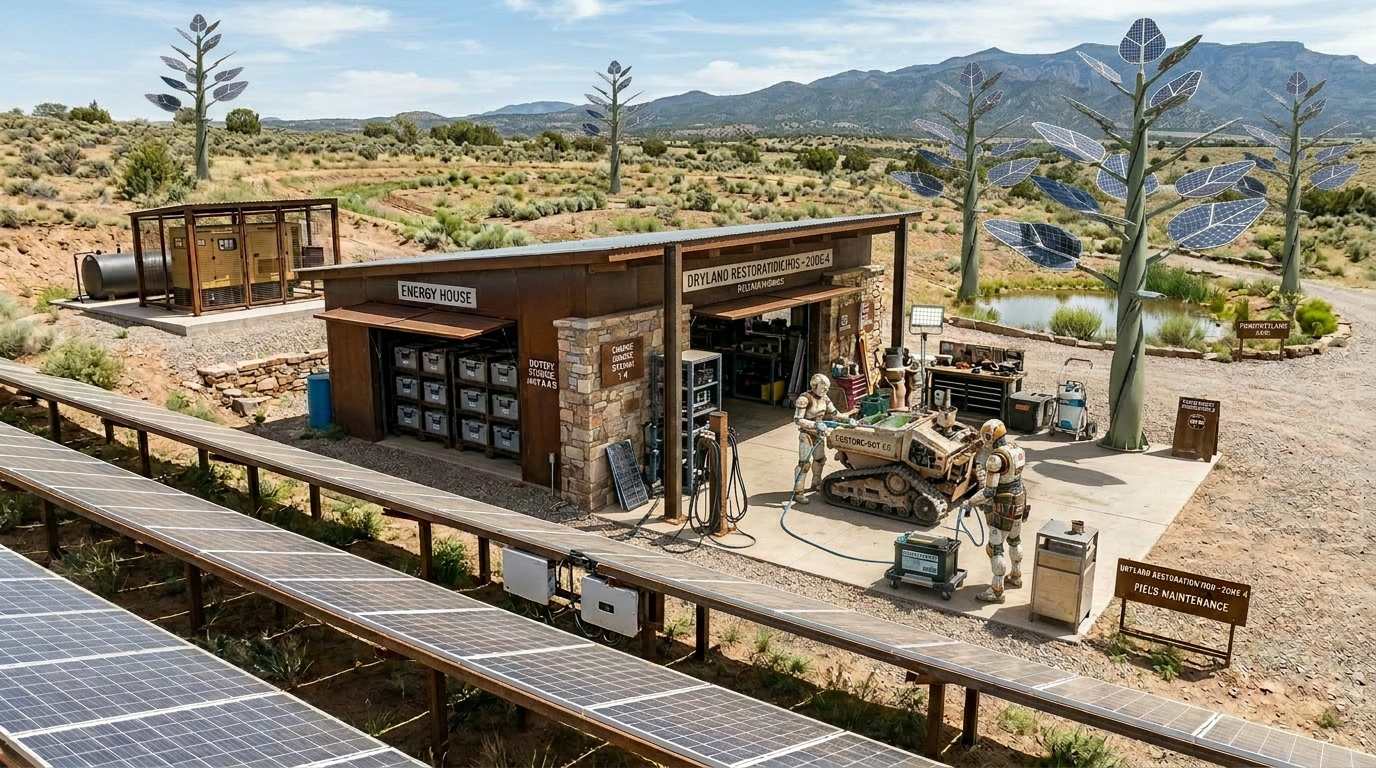
Solar power is a strong candidate for the base energy system, especially in states like New Mexico with abundant sunlight. The main system should ideally use solar arrays, possibly sun-tracking solar structures, battery bank storage, and trickle charging of spare packs throughout the day.
At the same time, the system should remain practical rather than ideological. If additional electricity is needed, or if faster work cycles are desired, especially at night, then the battery house can also include a gas generator or other backup generation source. This allows the system to continue charging during low-sun periods, support nighttime operations, accelerate land building when speed matters, and reduce downtime during expansion phases. The correct early design may therefore be hybrid: solar as the primary energy source, stored battery power as the operational buffer, and generator support as the gap-filler for nighttime work or periods of insufficient charge.
9. The Ecology AI Brain: Planning, Tasking, and Learning
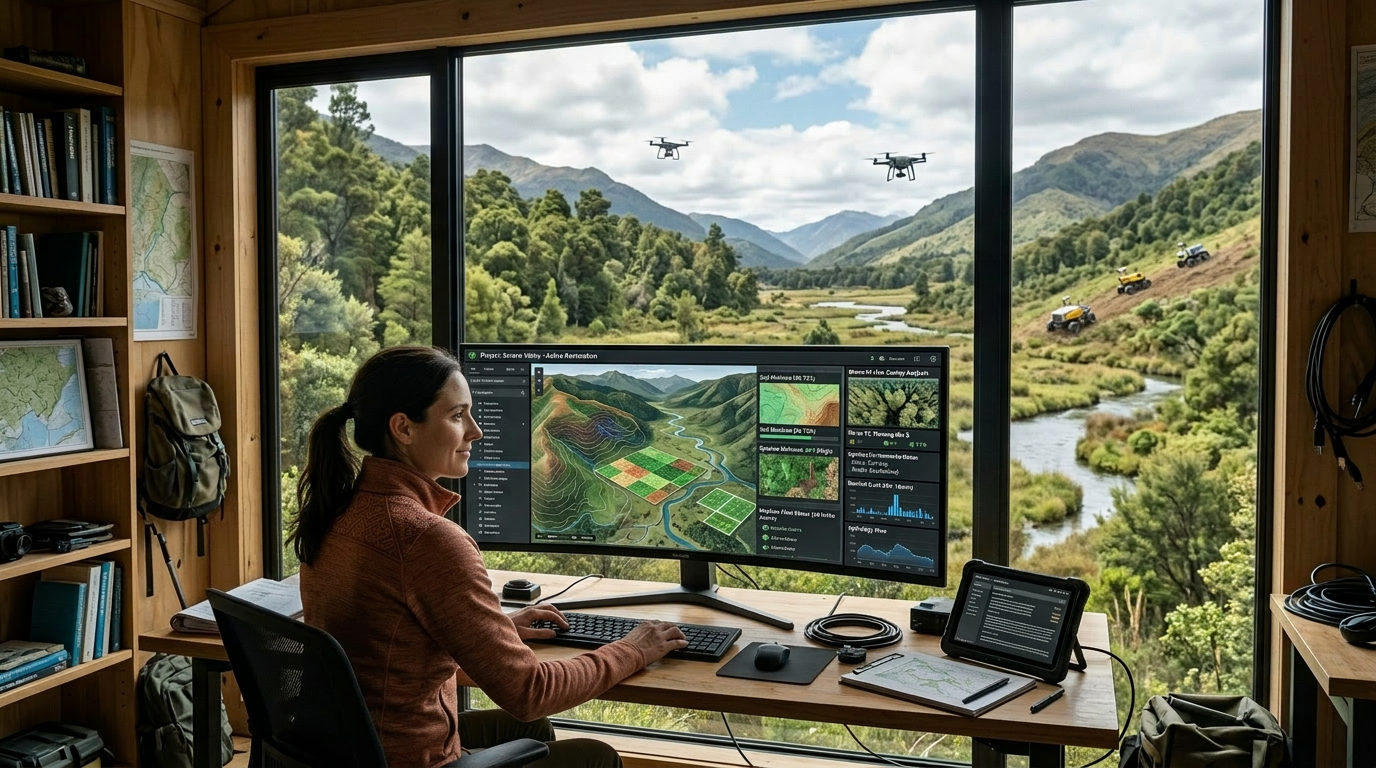
Above all these layers sits Ecology AI, the planning and learning brain. It handles tasking, species recommendations, sequencing, long-horizon goals, maintenance schedules, battery and energy allocation, route planning, service priorities, and eventually repair reasoning and diagnostic support.
It does not merely issue commands. It builds an increasingly embodied understanding of how the land behaves, how rainfall patterns interact with interventions, which species succeed in which microzones, which swales hold and which fail, how quickly different lanes degrade, which bots need service and when, and how to optimize labor across the machine ecology. Over time, Ecology AI becomes less like a generic model and more like a field-grown intelligence shaped by the land’s own data.
10. The Stack as a Whole
Taken together, this robotic permaculture stack is not just a set of independent machines. It is a coordinated ecological operating system. Drones perceive, the Perma Map remembers, the tractor bot reshapes hydrology, the field bots maintain and harvest, the humanoid technician preserves the machines, the battery house sustains energy continuity, and Ecology AI plans, learns, and improves the whole loop.
That is the system: not one robot pretending to be a civilization, but a layered robotic society designed to heal land, maintain itself, and grow more capable over time.
VII. Why Repair Intelligence Is the Hardest and Most Important Problem

The greatest technical challenge in this vision is not mapping the land, moving across it, or even harvesting from it. It is repair intelligence. A robotic permaculture system can only become truly scalable when it can maintain itself in the field with decreasing dependence on human intervention. Until then, even highly capable machines remain vulnerable to dirt, wear, misalignment, weather exposure, seal failure, and the countless small breakdowns that accumulate in real outdoor environments.
That is why repair intelligence is the real threshold. The system must be able to detect faults, identify their causes, choose the correct tools, clean and prepare the work area, open housings safely, remove or reseat components, verify contact integrity and seal condition, reassemble the system properly, and confirm that the repair has actually worked. In practice, that includes field procedures such as cleaning debris from a battery compartment, washing and drying the terminal zone before opening a sealed housing, identifying corrosion or contamination on a contact surface, replacing worn components, and restoring the machine to safe operation without introducing new failure points.
This kind of intelligence is difficult because it requires many abilities to function together in a single loop. The service robot must combine causal diagnosis, multimodal perception, procedural memory, tool-use planning, contamination awareness, safety constraints, and post-repair verification. A humanoid technician, for example, must understand not only what a battery is, but what mud on a contact plate implies, what wear on a belt suggests about future failure, what a poorly seated connector looks like, and when a compartment seal is no longer trustworthy. In other words, it must move beyond simple action execution and toward genuine maintenance judgment.
This is the quiet frontier of the whole project. The visible glamour tends to go to the mapping drone, the earthworks tractor, or the harvest bot moving through green lanes. But the machine that determines whether the entire system lives or dies is the one that can preserve the others. Once a robotic ecosystem can maintain itself even partially, the economics and scalability of land restoration change dramatically. Human supervision will still be necessary in the early phases, but the direction of progress becomes clear: from human-operated tools, to supervised robotic workflows, to semi-autonomous multi-machine systems, and eventually to increasingly self-maintaining ecological infrastructure. Repair intelligence is the hinge on which that entire progression turns.
VIII. Land Selection Strategy
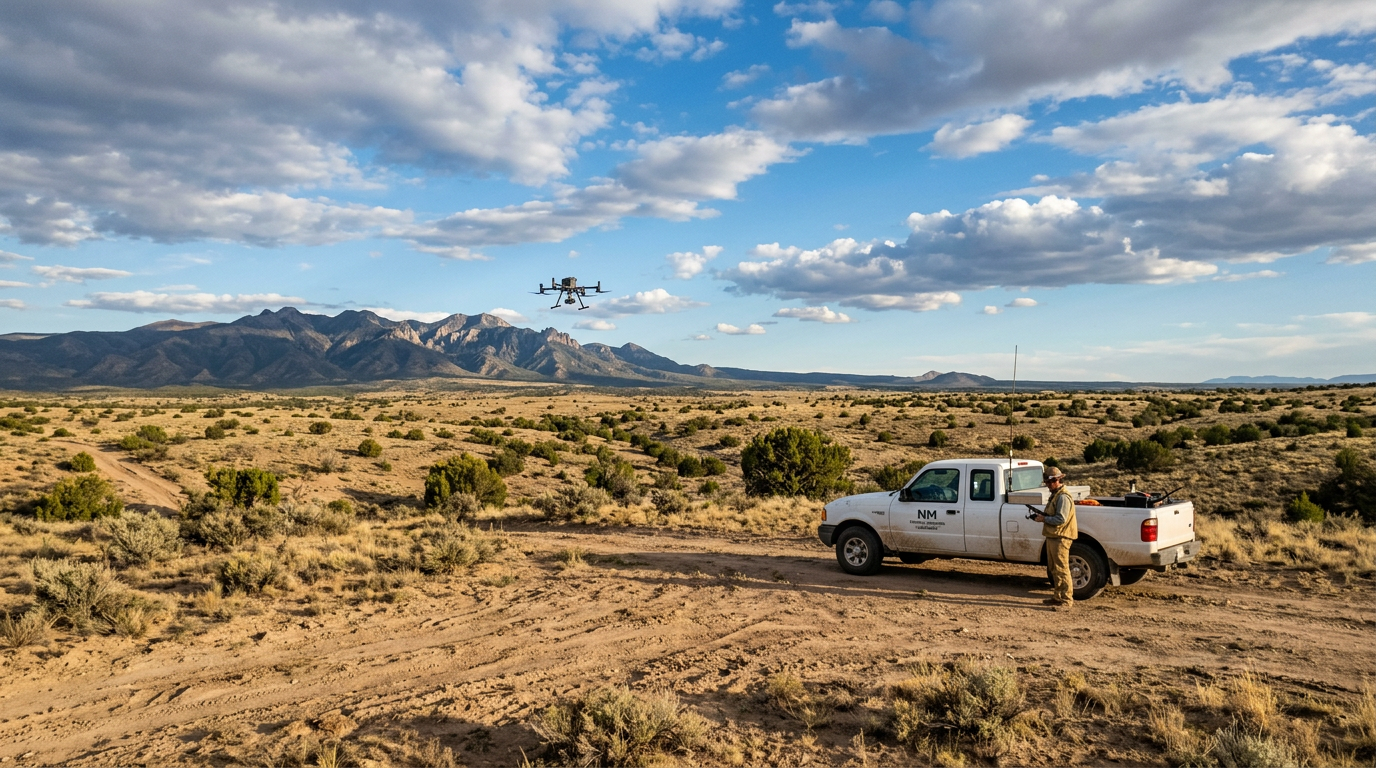
Not all barren-looking land is equally suitable for restoration. For practical purposes, land selection should be understood in three layers. The first is the broad national universe of rangelands, pasturelands, and degraded semi-arid systems. The second is the smaller candidate universe: parcels with some rainfall, manageable access, acceptable cost, and credible ecological recovery potential. The third is the early-learning universe: sites chosen not because they are the hardest, but because they can prove the system without demanding miracles on day one.
New Mexico stands out as one of the strongest early-state candidates. USDA Quick Stats reports about 38.9 million acres operated by farms in New Mexico in 2024, and USDA land-values data place it at the lowest average farm real-estate value in the country for 2025, about $725 per acre. Average annual precipitation is around 14 inches statewide, though it varies significantly by region and elevation. That combination of large acreage, low land cost, dryland conditions, and real but limited rainfall makes New Mexico an unusually strong proving ground for a hydrology-first restoration system.
The public-land context strengthens that case. The New Mexico State Land Office oversees roughly 9 million surface acres, while BLM’s New Mexico operation manages about 13.5 million acres of public lands across its regional footprint. This does not mean all of that land is available or appropriate. It does mean the surrounding landscape context is large enough that successful restoration methods could matter beyond a single pilot parcel.
Site selection should be disciplined rather than romantic. Candidate parcels should be screened with a formal scoring model that weighs rainfall adequacy, runoff concentration potential, slope and contour suitability, soil depth, access, sunlight, legal simplicity, theft risk, target crop compatibility, and room for future expansion. The goal is not perfect land. The goal is teachable land: parcels difficult enough to prove the system is real, but not so punishing that the first trial is buried under every failure mode at once.
IX. Phased Ecological Development of a Site
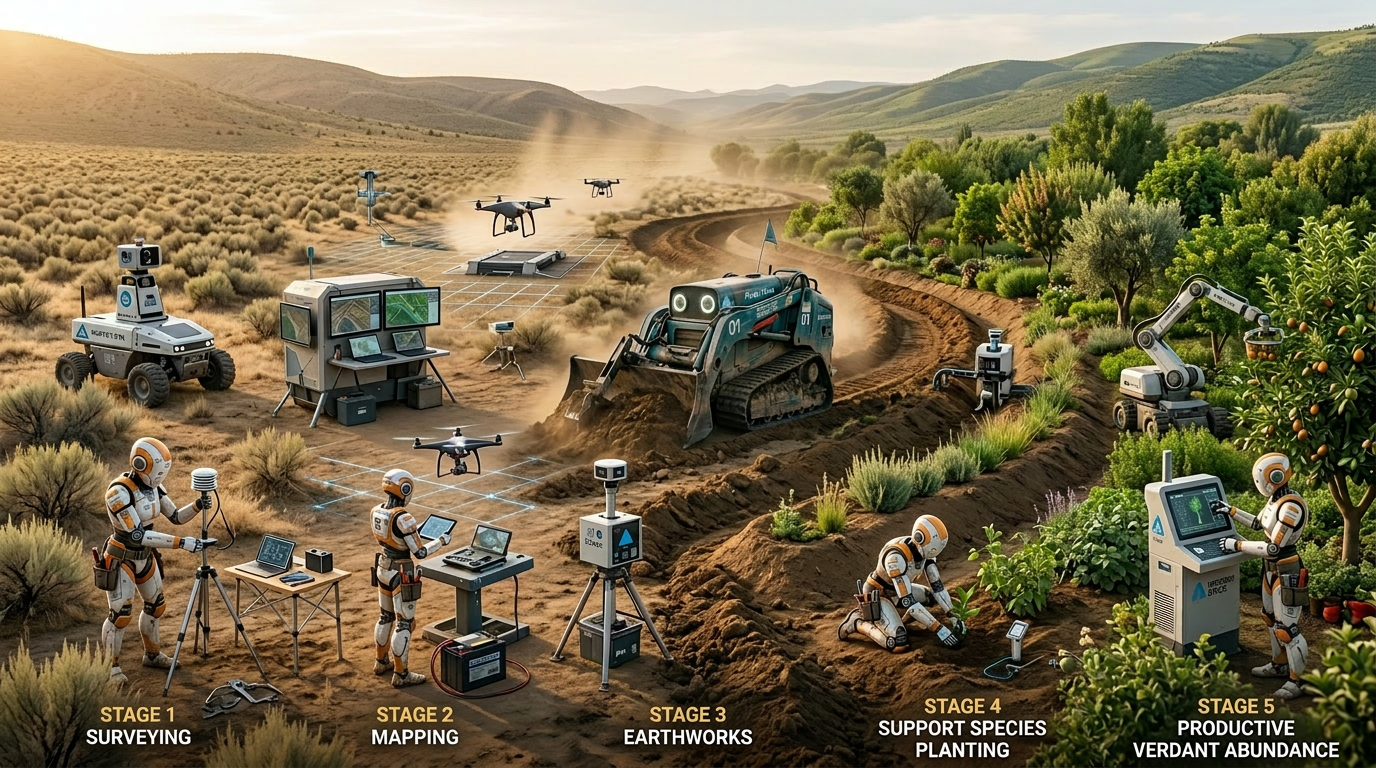
Site development should unfold in clear stages:
1. Identification and simulation
The land is screened, mapped with public geospatial data, and analyzed for contour, water pathways, hazard zones, and restoration potential. At this stage, the goal is not intervention but understanding. Before a machine touches the ground, the system should already have a working model of where rain tends to move, where it disappears, where it cuts, and where it might best be slowed and retained.
2. Drone mapping and biological inventory
Drones gather high-resolution imagery, refine topography, identify erosion and vegetation patterns, and detect risks, paths, and species clusters. The first Perma Map is assembled here. At that point, the land becomes digitally legible. It is no longer just a parcel. It becomes a structured ecological dataset.
3. Hydrological earthworks
The tractor bot, likely under close supervision at first, begins cutting swales where appropriate, building berms, opening infiltration lines, establishing machine paths, and shaping the geometry that will govern future fertility. This is the stage at which the landscape’s water destiny is rewritten. Because early errors matter most here, measurement and validation should be rigorous. After rain, drones verify what held, what overtopped, what eroded, and what unexpectedly worked.
4. Soil-building and support species
Hardy pioneers, cover species, native stabilizers, nitrogen fixers, mulch, and biomass inputs are established before high-value production crops. Support species and soil architecture come first. They cool the surface, feed the microbes, soften the wind, and build the carbon sponge that later species can inhabit. Early resilience often comes from supporting regrowth and structure rather than demanding instant productivity from a wounded landscape.
5. Primary productive planting
Once the system has stabilized enough, Ecology AI generates candidate lists of the most likely to succeed varietals for each zone, whether the goal is fruit, herbs, biomass, forage, or medicinal crops. These plantings should occur in waves rather than all at once. Each zone becomes a living experiment. Success rates, mortality, stress, growth rate, and maintenance burden all feed back into the model.
6. Maintenance and lane logic
Dog bots patrol narrow corridors, prune hedges and trees to robot-reachable heights, harvest ripe material, mow grasses where needed, and push fallen carbon and debris toward productive zones rather than discarding them. In this geometry, pathways become maintenance veins and plant rows become dense living walls. Over time, verdant six-foot hedges can stretch across the landscape while robotic corridors remain mostly hidden beneath abundance. This is where the design becomes both practical and beautiful.
7. Yield analysis and retraining
Food output, medicinal output, biomass output, soil-cover change, infiltration proxies, survival rates, maintenance burdens, and robot uptime are all measured. Ecology AI is then retrained or updated from the resulting field data. Version by version, the model becomes less abstract and more grounded in lived land memory. This is where the real moat begins to emerge.
X. Production Possibilities
The first output of a successful site is ecological, but that should not be misunderstood as vague or secondary. In dryland restoration, ecological repair is the mechanism by which unusable or underperforming land becomes economically useful. More infiltration, more ground cover, more soil stability, more retained carbon, lower erosion, cooler microclimates, more habitat, and better water behavior are not side benefits. They are the conversion process itself. In many semi-arid landscapes, conventional farming will not work at all without major leveling, repeated irrigation, or heavy external inputs the land cannot support economically. USGS notes that many arid and semi-arid systems are characterized by short, intense rainfall events, erosion, arroyo cutting, and declining water tables. That is precisely the kind of hydrological disorder this system is designed to reverse.
That changes the production comparison. The relevant benchmark is often not, “How does this compare to the best irrigated monocrop in the Midwest or California Central Valley?” The relevant benchmark is, “What can be produced on land that conventional farming would not touch, could not sustain, or would quickly degrade further?” In that sense, the productive leap is not from good land to slightly better land. It is from low-capability or near-zero practical crop value to biologically functional land with multiple productive options. Once water is held, soil is rebuilding, and ecological structure is established, the question stops being whether the land can produce and becomes what the land should produce. At that point Ecology AI can begin offering site-specific choices to a human operator: this slope is well suited for apricot and plum belts; this lower basin is suitable for linked ponds and aquaculture; this restored zone is better as improved forage with poultry integration; this pocket should remain support ecology while adjacent rows go into herbs or medicinal shrubs. The first phase is land healing. The second is production selection.
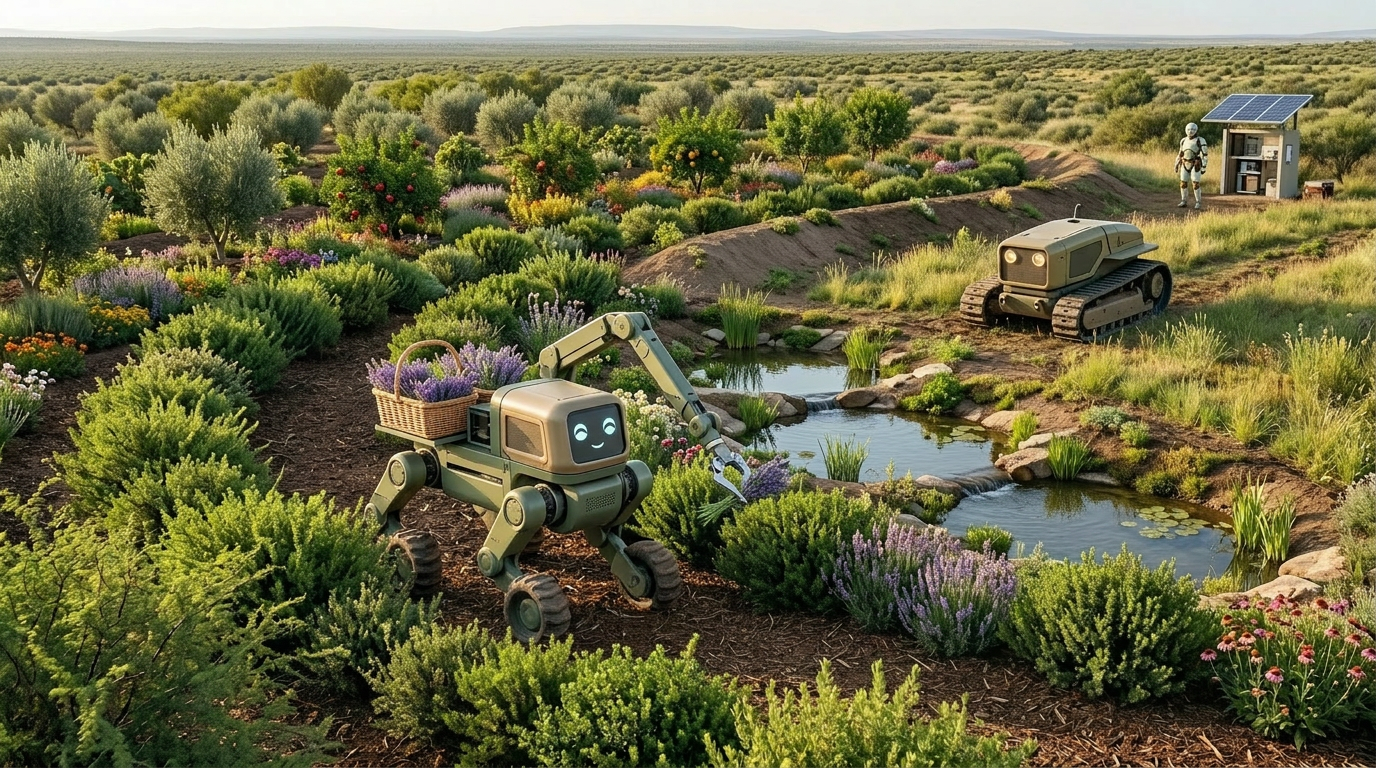
To make the scale legible, it helps to use a scenario model anchored to real national acreage. USDA Climate Hubs reports 405.8 million acres of rangeland and 121.1 million acres of pastureland in the United States, for a combined 526.9 million acres of grazing-oriented land. USDA’s 2024 noncitrus fruit summary also shows that all 21 estimated noncitrus fruit crops together used only 1.90 million bearing acres, produced 15.9 million tons, and generated $18.9 billion in utilized production value in 2024. That comparison is the key: the current national fruit system is small compared with the broader national land base, which means even limited restoration of underperforming land can become economically significant very quickly.
Not all of those 526.9 million grazing acres are targets for conversion, and they should not be treated that way. Much of that land is already economically active in cattle systems. The more realistic target is a viable restoration pool: degraded, underused, erosion-prone, semi-arid land with some rainfall and real recovery potential. For planning purposes, assume a 20-million-acre viable restoration pool. That is only about 3.8% of the current combined rangeland-and-pasture base. From there, the nested percentages matter. If only 5% of that 20-million-acre pool is successfully restored, that yields 1 million restored acres. If only 65% of those restored acres are assigned to direct food production, with the remaining 35% left in support ecology, habitat, lanes, ponds, and service infrastructure, that yields 650,000 food-producing acres. In other words, the direct-food acreage in this scenario is 65% of 5% of the pool, or 3.25% of the 20-million-acre viable pool. That equals 650,000 acres.
Using a conservative fruit benchmark in the neighborhood of 3.77 to 5.0 tons per acre, those 650,000 food acres would produce roughly 2.45 to 3.25 million tons of annual fruit-equivalent output. Since USDA reports the 2024 average value of U.S. noncitrus fruit production at about $18.9 billion over 15.9 million tons, the implied national average value is about $1,189 per ton. At that value level, the 5%-of-the-pool / 65%-to-food scenario would translate into roughly $2.9 billion to $3.9 billion in annual fruit-equivalent production value. Put differently, restoring just 5% of a 20-million-acre viable pool and assigning only 65% of that restored land to food would create a new productive layer worth roughly 15% to 20% of current U.S. noncitrus fruit output by both tonnage and value. That is a very large return from a very small fraction of the potential land pool.
At 10% deployment of the same 20-million-acre viable pool, the restored footprint becomes 2 million acres. If 65% of those 2 million restored acres go to direct food, the result is 1.3 million food-producing acres, which equals 6.5% of the 20-million-acre viable pool. At 3.77 to 5.0 tons per acre, this produces about 4.9 to 6.5 million tons of annual fruit-equivalent output. Using the same 2024 national noncitrus average value of about $1,189 per ton, the annual value of that output would be roughly $5.8 billion to $7.7 billion. Relative to current U.S. noncitrus fruit production, that is equivalent to about 31% to 41% of today’s fruit tonnage and value, generated from a restored slice of land that conventional orchard systems would often never touch.
At 25% deployment of the same 20-million-acre viable pool, the restored footprint becomes 5 million acres. If 65% of those 5 million restored acres are used for food, the result is 3.25 million food-producing acres, which equals 16.25% of the 20-million-acre viable pool. At 3.77 to 5.0 tons per acre, that acreage yields roughly 12.25 to 16.25 million tons of annual fruit-equivalent output. At the same average value of about $1,189 per ton, the annual production value rises to roughly $14.6 billion to $19.3 billion. That means that restoring just one-quarter of the viable pool, and still reserving 35% of the restored area for support ecology and infrastructure, could generate fruit-equivalent output approaching or even slightly surpassing the entire current U.S. noncitrus fruit economy, which was $18.9 billion in 2024.
The comparison becomes even more interesting when viewed against recent national acreage trends. Aggregate U.S. noncitrus fruit bearing acreage was about 2.1 million acres in 2015 and had fallen to 1.9 million acres by 2024, while utilized production declined from more than 18 million tons in the mid-2010s to 15.9 million tons in 2024. Even a relatively small restoration-first deployment could therefore offset a meaningful portion of the country’s long-term fruit-acreage contraction, while doing so on land that conventional orchard models would often avoid.
Herbal and medicinal production offers a different kind of leverage because the value density per acre can be much higher than bulk fruit tonnage. Lavender is a useful benchmark because ATTRA reports 1,000 to 1,500 pounds of dried buds per acre, with dried buds selling for roughly $6 to $10 per pound. Here the nested percentages should again be made explicit. If the system restores 5% of a 20-million-acre viable pool, that creates 1 million restored acres. If just 10% of those restored acres are assigned to medicinal or botanical crops, that equals 100,000 herb acres. In terms of the original 20-million-acre viable pool, that is 10% of 5%, or 0.5% of the total viable pool. Yet even that tiny fraction would produce about 100 million to 150 million pounds of dried botanical output annually. At $6 to $10 per pound, that equals roughly $600 million to $1.5 billion in annual gross botanical value from just 0.5% of the viable restoration pool.
If instead medicinal crops were assigned 25% of those same 1 million restored acres, the herb footprint would become 250,000 acres. In nested terms, that equals 25% of 5% of the 20-million-acre pool, or 1.25% of the total viable pool. At 1,000 to 1,500 pounds per acre, production would rise to 250 million to 375 million pounds of dried herbs annually. At $6 to $10 per pound, that implies roughly $1.5 billion to $3.75 billion in annual gross value. That is an enormous value stream from a tiny slice of land that, in many cases, conventional farming could not productively use at all. It also sits inside a U.S. herbal supplements market estimated at $12.551 billion in 2023, meaning even a relatively small medicinal acreage layer could support a strategically meaningful domestic botanical supply base.
Aquaculture shows the same principle in a different form. Once swales, basins, linked ponds, and contour water structures begin to hold water across the site, some restored landscapes can support ponds that feed one another or integrate with gravity-based flow. Penn State notes that pond aquaculture can typically produce about 2,000 pounds of fish per surface acre, while more intensive pond systems can average 4,000 to 5,000 pounds per acre. If the system restores 5% of the 20-million-acre viable pool, again yielding 1 million restored acres, and assigns just 5% of those restored acres to ponds or aquaculture basins, that means 50,000 water acres. In nested terms, that is 5% of 5% of the pool, or just 0.25% of the total viable pool. At 2,000 pounds per acre, that yields about 100 million pounds of fish annually. At 4,000 to 5,000 pounds per acre, it rises to roughly 200 million to 250 million pounds. Using a conservative farm-gate range of about $0.80 to $1.20 per pound, consistent with Texas A&M’s long-run catfish price range, that implies about $80 million to $120 million annually at the lower-yield case, and about $160 million to $300 million annually at the higher-yield case. In other words, assigning only 0.25% of the viable pool to aquaculture after hydrological repair could still create a nine-figure annual fish-value layer.
The same logic scales upward. If aquaculture eventually occupied 10% of those 1 million restored acres, that would mean 100,000 pond acres, or 0.5% of the 20-million-acre viable pool. At 2,000 pounds per acre, that yields 200 million pounds of fish annually. At 4,000 to 5,000 pounds per acre, that yields 400 million to 500 million pounds. At $0.80 to $1.20 per pound, the implied annual gross value rises to roughly $160 million to $240 million at the lower-yield case and $320 million to $600 million at the higher-yield case. For context, USDA’s 2023 Census of Aquaculture reported $1.9 billion in total U.S. aquaculture sales, so a relatively small, restoration-enabled aquaculture layer could become a meaningful fraction of the current national aquaculture economy.
The grazing comparison must still be handled carefully. The U.S. already has a huge cattle-oriented land base, and much of it is not “available” in any meaningful sense. Climate Hubs reports 405.8 million acres of rangeland and 121.1 million acres of pastureland, most of it tied to livestock and hay systems. The immediate goal, then, is not to displace cattle acreage wholesale. It is to identify the degraded and underperforming fraction first, and to improve much of the rest over time. Even improving just 1% of the current combined rangeland-and-pasture base would affect about 5.27 million acres. Even improving 0.5% would still affect about 2.63 million acres. On much of that land, the right near-term move is not conversion away from cattle, but hydrological and ecological upgrading: swales, better infiltration, more shade, more species diversity, healthier forage, and more resilient water retention. That improves the living conditions of the animals while preserving the underlying economic role of the land.
One of the strongest features of this model is that it treats production as something that becomes programmable only after the land is healed. Conventional farming often begins by forcing a crop plan onto a landscape and then using irrigation, fertilizer, herbicides, and pesticides to keep that plan alive. This model works in the reverse direction. First the system restores water behavior, soil function, and ecological structure. Then Ecology AI presents a human operator with a menu of biologically and economically plausible production choices. That means production is not locked in advance. It is selected after the land has revealed what it can support. A human can ask for another option because the system is not built around one-crop ideology. It is built around site-matched abundance.
The larger national picture is now easier to see. The system does not need to flip all usable land into one crop to become meaningful. It only needs to convert a small percentage of a viable restoration pool into biologically functional land and then assign sensible fractions of that restored acreage to food, herbs, ponds, or improved forage. Because these are nested percentages, the actual slices of land remain surprisingly small while the outputs become very large. 5% of a 20-million-acre viable pool, with 65% of the restored acres in food, already implies $2.9 billion to $3.9 billion in annual fruit-equivalent value. If just 10% of those same restored acres go to herbs, that adds another $600 million to $1.5 billion. If just 5% of those restored acres go to aquaculture, that adds another $80 million to $300 million, depending on yield and price assumptions. That means one conservative restoration scenario can plausibly stack into a total annual value band of roughly $3.6 billion to $5.7 billion, while still using only 5% of a 20-million-acre viable pool and still reserving large portions of restored land for support ecology, water systems, and infrastructure.
That is the crucial comparison. Conventional farming often cannot justify itself on these landscapes without major grading, repeated irrigation, or heavy chemical dependence. A restoration-first robotic permaculture system changes the equation. It takes land with low or unstable productive capacity, raises its biological ceiling, and then lets human choice and ecological intelligence decide what the restored landscape should become: fruit, herbs, improved forage, ponds, aquaculture, nursery stock, pollinator habitat, biomass, medicinal crops, or mixed systems built for local conditions. That is not just more production. It is the systematic conversion of underperforming land into durable national capacity.
XI. Why This Could Become a Government Project
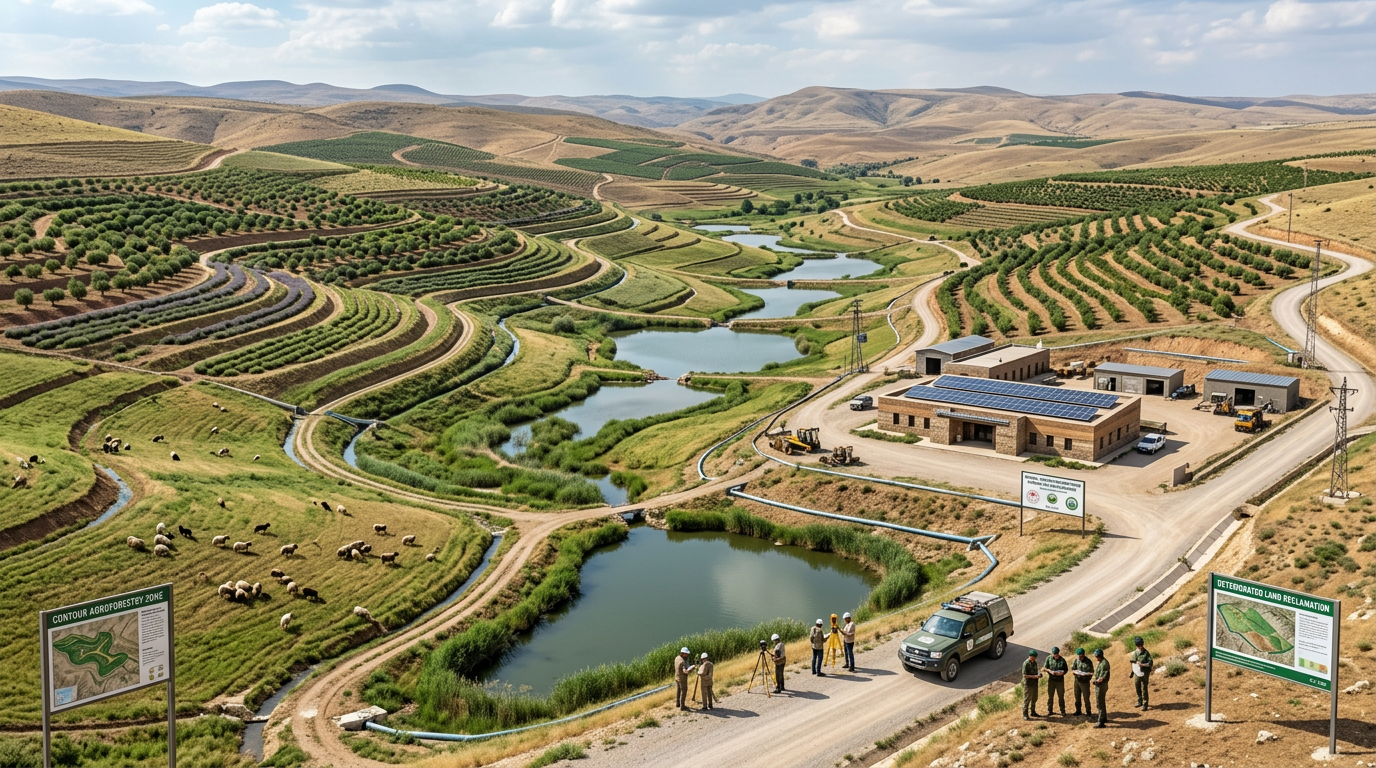
Governments already operate at the scale this system is meant to serve. They manage or influence vast acreages, work across long time horizons, and carry responsibilities that extend beyond immediate commercial return. A platform that can convert degraded, underperforming land into productive ecological infrastructure is therefore naturally aligned with public-sector priorities. New Mexico’s state trust lands and the broader BLM footprint illustrate the kind of landscape context in which even limited adoption could have national significance. The claim is not that all public land should be transformed. The claim is that the public-land arena is large enough that a proven restoration capability could matter at strategic scale.
What strengthens the public case is that the upside is no longer abstract. Even conservative restoration scenarios imply meaningful value. A modeled case in which just 5% of a 20-million-acre viable restoration pool is restored, and only 65% of that restored land is assigned to direct food production, yields an estimated $2.9 billion to $3.9 billion in annual fruit-equivalent value. If just 10% of those same restored acres are assigned to herbs, that adds another $600 million to $1.5 billion in annual botanical value. If just 5% of those restored acres are assigned to aquaculture, that adds another $80 million to $300 million annually. In total, one conservative early scenario plausibly produces a stacked annual value band of roughly $3.6 billion to $5.7 billion while still using only a small fraction of the viable land pool and still reserving substantial acreage for support ecology, water systems, habitat, and infrastructure.
That matters because much of the land in question is not premium conventional cropland. It is land that is degraded, underused, erosion-prone, or poorly suited to ordinary farming. In many cases, conventional agriculture either would not work there at all or would require so much leveling, irrigation, or chemical support that the economics would deteriorate. A government that can help turn such land from low-capability acreage into productive ecological infrastructure gains something more valuable than an additional farm. It gains food capacity, medicinal supply potential, improved land health, greater hydrological resilience, reduced erosion, expanded habitat, and a strategic use for acreage that would otherwise remain underperforming.
The state is also unusually well positioned to absorb the time structure of restoration. Private actors are often pressured to demonstrate fast returns. Public institutions can justify work whose first yield is not fruit, but hydrological repair; not immediate revenue, but reduced long-term degradation; not instant harvest, but the gradual conversion of wounded land into durable capacity. That sequence matters. The first phase is land healing. The second phase is production choice. The third phase is scaling what works. Few institutions besides government can think across all three phases at once.
There is also a direct national-resilience argument. A country that can restore drylands intelligently gains a wider domestic production base: fruit, herbs, biomass, aquaculture, improved grazing, nursery stock, pollinator habitat, and region-specific medicinal crops. It also reduces dependence on brittle supply chains by increasing optionality. Once Ecology AI has restored a site enough to understand it, production is no longer locked into a single crop logic. One parcel may be best for mixed stone fruit, another for improved forage and poultry, another for herbs, another for pond systems and aquaculture. This matters strategically because it allows land to be used according to what it can actually support rather than according to a rigid agricultural template imposed in advance.
The case for government involvement is not only agricultural. It is technological, industrial, and infrastructural. A system like this would advance domestic capability in robotics, outdoor autonomy, battery logistics, embodied repair intelligence, geospatial modeling, water management, and AI-guided ecological planning. It would create a new class of restoration infrastructure operating at the intersection of land repair, energy systems, machine intelligence, and strategic production. In a century shaped by resource stress, ecological instability, and competition over resilient supply systems, a machine ecology that can repair land is not a boutique innovation. It is a statecraft tool.
The most plausible path remains public-private. The first pilot should likely be private or quasi-private, because innovation usually moves faster in a smaller and more flexible arena. Once the system proves itself on easier land, public agencies, land-grant universities, state entities, and federal programs can evaluate where and how to adapt it. That sequence is critical: learn small, validate hard, scale with seriousness. Public adoption should follow demonstrated performance, not precede it.
If this platform succeeds, government would not simply be supporting a new agricultural method. It would be acquiring a repeatable national capability for transforming underperforming land into long-term assets. That is why this could become a government project. It aligns land stewardship, food and medicinal production, ecological resilience, technological leadership, and national capacity within a single operational framework.
XII. Economic and Civilizational Case
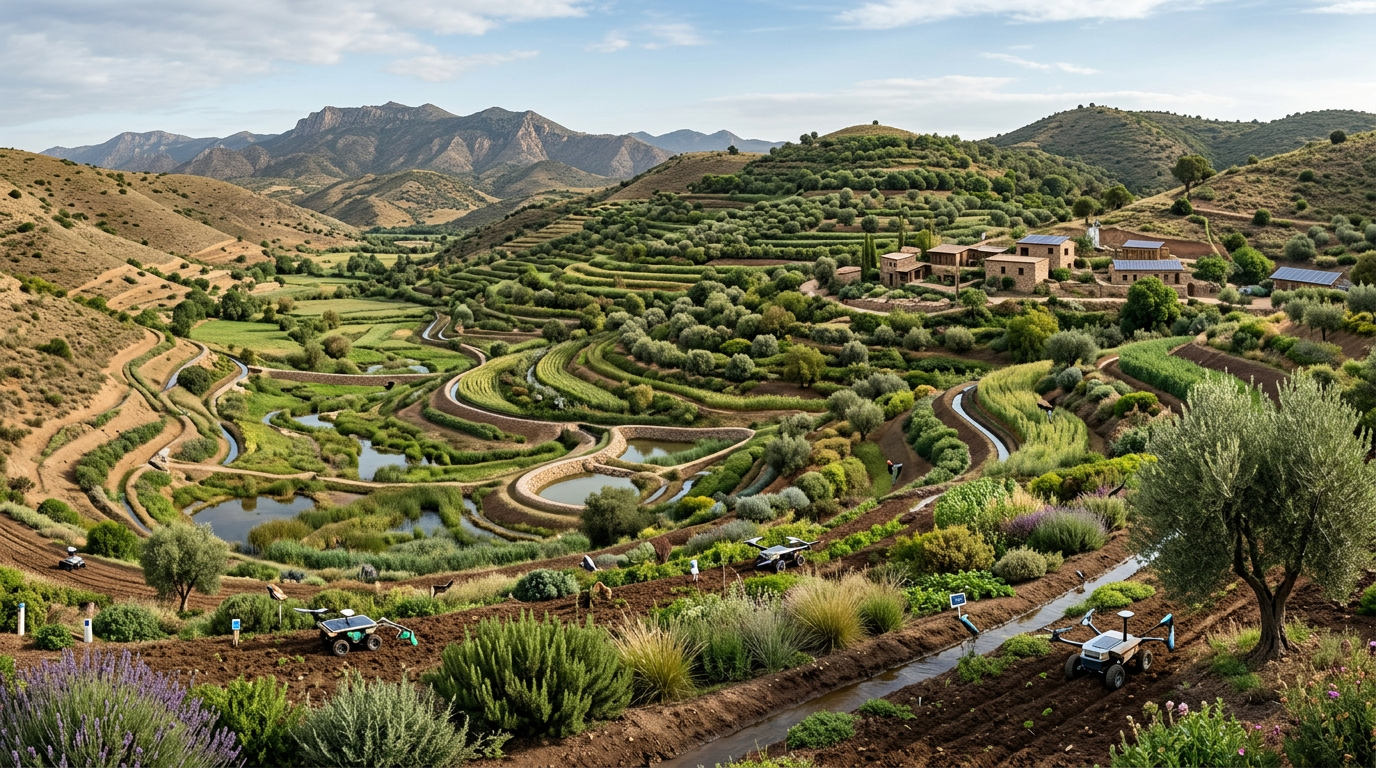
The economic significance of this system does not rest only on what it can grow. Its deeper value lies in turning restoration itself into a repeatable capability. The central asset is not just acreage under production, but a platform that can identify recoverable land, repair hydrology, guide succession, support selective production, and improve with use. In that sense, the project is better understood as productive infrastructure than as a narrow agricultural technique.
One of its strongest advantages is that it improves the underlying asset rather than extracting from it until it weakens. Conventional systems often generate output while degrading soil, water behavior, and ecological resilience. This system moves in the opposite direction. As infiltration improves, soil function returns, biodiversity thickens, and ecological structure stabilizes, the land becomes more capable over time. The productive base is not being mined down. It is being built up. Economically, that means the system does not merely generate yield. It raises the long-term carrying capacity and usefulness of the land itself.
A second source of value lies in the intelligence layer. Ecology AI is not simply a planning interface. Over time it becomes a field-trained restoration engine built on real contour edits, real rainfall events, real survival rates, real maintenance logs, real harvest outcomes, and real ecological responses. That makes the platform increasingly difficult to replicate quickly. It does not merely perform tasks. It learns which interventions work on which terrain, under which rainfall bands, with which species combinations, and under which maintenance constraints. Each restored parcel deepens the model. Each season improves the playbook.
That is what turns the system from a one-off intervention into a platform. Once it can repeatedly identify viable land, restore water behavior, establish support ecology, recommend production options, and maintain those systems with increasing competence, it becomes transferable. At that stage, the most valuable output may not be fruit, herbs, or aquaculture viewed separately. It may be the ability to reliably convert degraded semi-arid land into durable productive capacity. That is relevant not only across the American West, but across dryland regions globally.
The civilizational importance follows from the same logic. Most industrial systems have treated land as something to flatten, simplify, and extract from faster. This plan points in the opposite direction. It uses advanced technology to increase retention, diversity, resilience, and ecological coherence. Instead of asking machines to overpower the landscape, it asks them to help restore its internal logic. That is a meaningful shift in how technology relates to the biosphere.
In that sense, the project represents more than a new farming method. It represents a different developmental logic: one in which robotics, AI, and energy systems are used to rebuild living complexity rather than erase it. If successful, it would show that technological progress does not have to mean deeper abstraction from land. It can also mean learning how to restore land with intelligence, patience, and scale.
XIII. Risks, Constraints, and Honest Limitations
Not all land should be restored in the same way, and not all land will be economically or ecologically suitable for this system. Some parcels are too dry, too remote, too steep, too fragmented, too legally complicated, or too ecologically sensitive to justify intervention. Others may be recoverable in principle but still unattractive in the early phases because the cost, risk, or time horizon is too high. The aim is not to treat every barren-looking landscape as an automatic target. The aim is to identify the class of land where restoration is both biologically plausible and strategically worthwhile.
The system also depends on technologies that are difficult in the real world. Outdoor robotics is unforgiving. Mud, grit, brush, heat, cold, slope, corrosion, vibration, and repeated mechanical stress all create failure points. Battery systems must survive contamination. Mobility platforms must recover from uneven terrain. Sensors must keep working in dirty biological environments. Service robots must function around debris, weather exposure, and imperfect field conditions. Early generations of the system will therefore require close supervision, conservative safety margins, spare parts, and frequent intervention. Full autonomy should not be promised too early.
Repair intelligence remains one of the hardest bottlenecks. The system can only scale cleanly when machines can preserve one another with decreasing dependence on human technicians. Until that threshold is crossed, deployment will remain partly constrained by maintenance labor, failure recovery, and service complexity. That does not weaken the concept, but it does shape the order of operations. Early success should be judged not by total autonomy, but by whether the platform can reduce labor intensity while steadily improving its own maintenance capacity.
Legal and regulatory issues are another serious constraint. Water law, land use rules, public-land restrictions, environmental review, easements, grazing rights, and local permitting can all affect what is possible on a given parcel. A hydrologically promising site may be legally cumbersome. A cheap parcel may be difficult to access or expand. A public tract may be strategically interesting but politically difficult to modify. This is why site selection must remain disciplined. The system grows stronger when it recognizes the difference between land that is technically restorable and land that is actually deployable.
Biological recovery also takes time. Water capture can improve relatively quickly once contour and infiltration structures are in place, and some soils can begin responding within a few seasons. But full ecological maturation is slower. Plant communities need time to establish. Root systems need time to deepen. Organic matter needs time to accumulate. Pollinator and predator dynamics need time to stabilize. A restored site may become visibly healthier long before it becomes maximally productive. The right promise, then, is not instant transformation. It is accelerated recovery through continuity, observation, and intelligent labor.
There is also a strategic risk in overselling output too early. Not every restored acre should be pushed immediately into direct production. Some portions of the landscape must remain in support ecology, habitat, water structures, service lanes, and fertility-building functions. If this balance is ignored, the system could repeat the same short-term extractive habits it is meant to overcome. The strength of the model lies in sequencing: heal first, stabilize second, produce third, optimize fourth.
For all of these reasons, the proper stance is neither blind optimism nor timid hesitation. It is disciplined ambition. The concept is real, the opportunity is large, and the upside is significant. But success depends on choosing the right land, staging the right sequence, respecting ecological time, and solving the engineering problems honestly. The goal is not instant Eden. It is a credible pathway by which damaged land becomes progressively more alive, more stable, and more useful.
XIV. Phased Implementation Plan
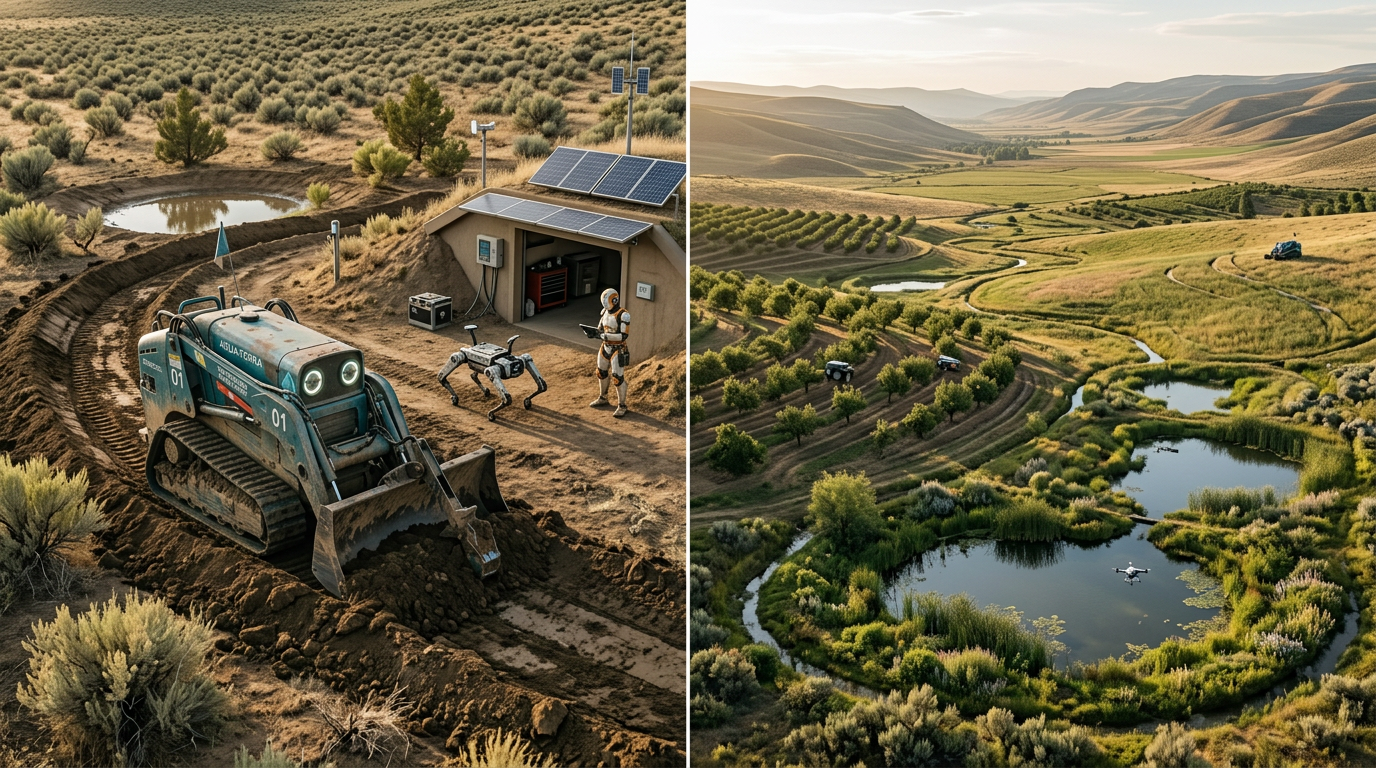
1. Pilot site
Begin with one easier but still meaningful parcel, likely in a state such as New Mexico. The site should have semi-arid conditions, some rainfall, manageable logistics, modest acquisition cost, and enough topographic complexity to teach the system real lessons. The goal at this stage is learning, not maximal output. The system must prove that it can map land, reshape water behavior, establish support ecology, maintain robotic lanes, and create early productive zones while collecting dense operational data.
2. Supervised learning across multiple sites
Expand to additional parcels with somewhat different microclimates, soils, and terrain profiles. This is where robot task libraries deepen, repair intelligence improves, and crop recommendations become more site-specific. Failure modes are logged and turned into engineering improvements. What begins as one test site becomes a growing set of restoration playbooks across different land conditions.
3. Institutional validation and partnership
Once the platform has credible performance data, partnerships with universities, public-land agencies, state entities, and possibly federal programs become realistic. The purpose here is validation, adaptation, and preparation for scale. Different institutions can test whether the system measurably improves land health, reduces erosion, increases productive capacity, and lowers restoration labor requirements.
4. Targeted large-scale deployment
Deploy only where the evidence shows the system works. By this stage, the platform should no longer be pitched as a universal miracle. It should be applied selectively across suitable private lands, state lands, and public lands. The long-term vision is not one giant farm, but a distributed network of restored landscapes, all improving from the same growing ecological intelligence.
XV. Conclusion
The central problem of many degraded drylands is not simply lack. It is mispatterned flow. Rain arrives, but the land cannot hold it. Soil exists, but it is exposed and stripped. Life wants to return, but the structures of return are weak or absent. In such places, the right intervention is not blind intensification. It is intelligent re-patterning. Water first. Soil next. Succession after that. Production later. Continuity throughout.
If advanced robotics, drones, and AI are going to be brought into land management at all, they should not merely be used to automate the extractive logic of conventional farming. They should be used to build something biologically wiser. Conventional agriculture can produce enormous short-term output, but often through simplification, chemical dependence, habitat loss, and a steady weakening of the ecological relationships that make land resilient. Permaculture and agroecological design offer a different substrate: one that builds soil rather than mines it, recruits biodiversity as functional labor, reduces dependence on fertilizers and pesticides over time, and creates systems that become more productive as ecological structure deepens.
For that reason, this system is not best understood as automated farming in the ordinary sense. It is a phased national framework for robotic permaculture, a system in which drones map, tractor bots reshape water pathways, field robots maintain and harvest, humanoid technicians preserve machine continuity, and Ecology AI learns directly from the land. It draws strength from real precedents in China, Niger, Jordan, and the wider dryland-restoration world. It identifies New Mexico as a plausible proving ground because of its acreage, rainfall pattern, land values, and strategic fit. And it places public adoption not in the realm of fantasy, but in the realm of evidence-based scale.
The productivity claim must also be stated precisely. The argument is not that every restored acre instantly outperforms the highest-yielding industrial monoculture on premium land. The argument is that robotic regeneration can unlock output on land that conventional farming often cannot use productively at all. In that context, the relevant comparison is not between restored dryland and the best chemically optimized farmland on Earth. It is between biologically repaired land and land that has already been overused, simplified, abandoned, or farmed to death. Once water retention, soil function, and ecological structure return, the productive ceiling rises sharply.
That is why the numbers matter. Even conservative scenarios show that restoring just a small percentage of a viable dryland pool can produce nationally meaningful results. A model in which only 5% of a 20-million-acre viable restoration pool is restored, and only 65% of that restored land is assigned to direct food production, still yields a production layer worth roughly $2.9 billion to $3.9 billion annually in fruit-equivalent value. Add even small fractions of the restored acreage in herbs and aquaculture, and the stacked annual value rises into a band of roughly $3.6 billion to $5.7 billion, while still reserving large areas for support ecology, water systems, and infrastructure. Those are not trivial margins. They are strategic numbers produced from land that would often remain underperforming under conventional logic.
The deeper promise is therefore not merely more efficient farming. It is a new category of civilization tool: a machine ecology capable of restoring land rather than merely extracting from it. If industrial modernity often treated landscapes as engines to be drained, this framework treats them as living systems whose fertility can be rebuilt through pattern, patience, and intelligent labor. It asks robotics to become hydrological, ecological, and patient. It asks AI to learn the character of a place rather than impose generic abstractions upon it. And it asks the state, eventually, to see underused land not as static emptiness but as dormant abundance waiting for the right kind of intelligence.
If this framework succeeds, it will do more than grow food. It will grow resilience, medicinal capacity, biodiversity, ecological memory, and a repeatable operating system for renewal. It will turn damaged land into a teacher, and what that teacher reveals into a scalable practice of restoration. That is the real vision. Not domination over nature, but alliance with it through the most advanced tools we can build. A nation that teaches machines to heal land has built something far stranger and more powerful than a farm. It has built a green instrument of future statecraft.
XVI. Long Horizon Stories: If America Learned to Heal Its Land
These are not predictions in the narrow sense. They are narrative scenarios. Each one imagines a person living inside a different stage of the transition, watching the country change as robotic permaculture, hydrology-first restoration, and Ecology AI move from strange experiment to civilizational habit.
1. Five Years Out
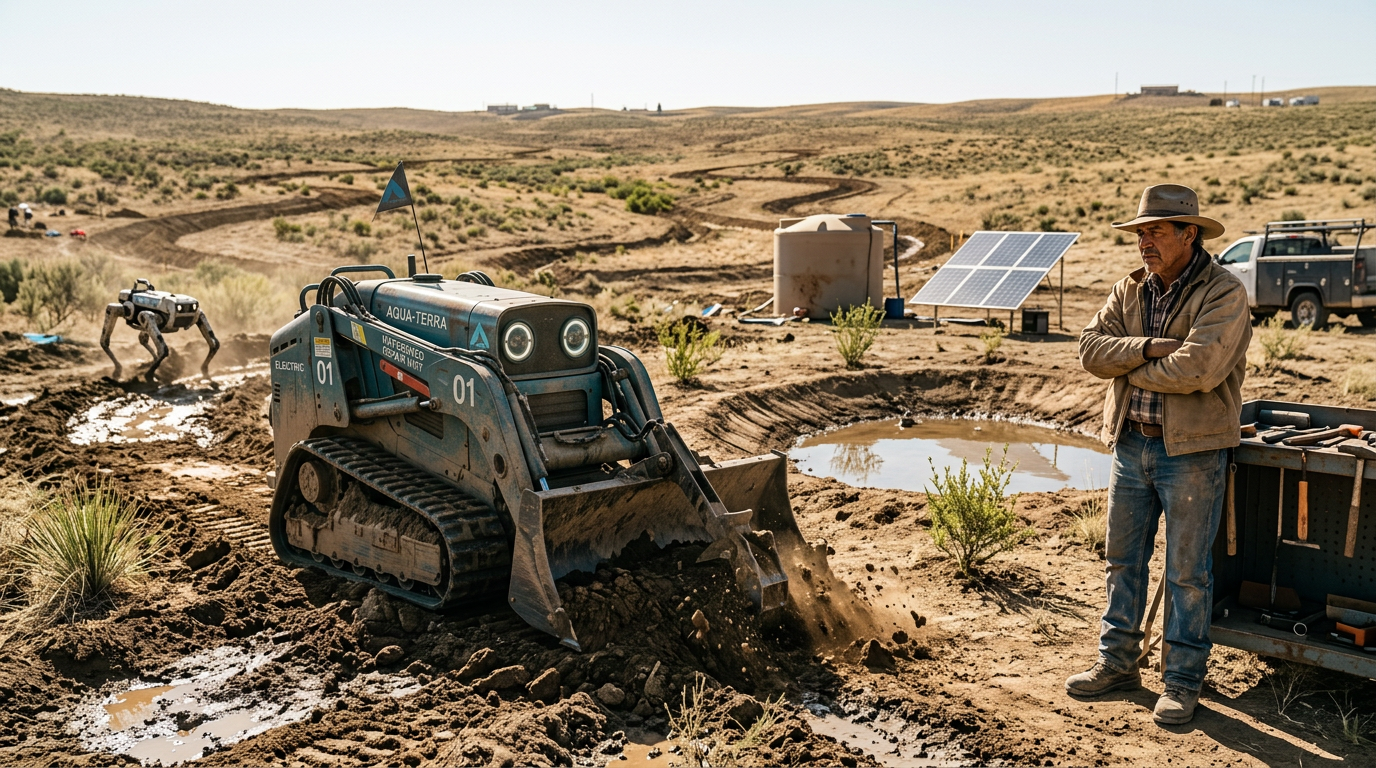
The contractor in New Mexico
Miguel had spent most of his life around busted things.
Not broken in the abstract. Broken in the way men mean it when they stand on hard ground and spit dust. A fence line half down. A well that coughed instead of flowed. A skid steer with a hydraulic leak. A dirt road washed open by the same arroyo that had carved itself deeper every monsoon since he was a kid. He knew what it meant for land to be “no good,” and he knew that most of the time people said that because they had stopped looking at it as anything but a failed transaction.
So when the new people showed up with their drones and tracked machines and their talk about contour, telemetry, and “ecological memory,” he laughed.
Not cruelly. Just the laugh of a man who had seen too many glossy ideas die under the New Mexico sun.
The site they bought was exactly the kind of parcel nobody bragged about. Cheap. Semi-arid. Sparse. Not empty, but tired. A few stubborn shrubs. Hardpan in places. Runoff scars. One section that turned into a temporary torrent every time a real rain came through, then went back to looking like a wound in the dirt. Conventional farming would have been ridiculous there. Too uneven, too dry in the wrong way, too expensive to bully into flat-field obedience. It was the kind of place people either grazed lightly, neglected, or fantasized about and then abandoned.
The first month looked like theater. Drones going up every morning. Maps on tablets. The main tractor bot crawling across the slopes with the cautious confidence of a thing that knew gravity was waiting to embarrass it. The dog bots still moved a little strangely then, like athletes not yet comfortable in their own muscles. The humanoid technician spent as much time kneeling in mud and dust beside battery compartments as it did walking, which made Miguel trust it more.
Nothing kills belief faster than fake cleanliness.
He watched the service routine the first time with open skepticism. The tractor bot returned to the battery house with a crust of dried mud around the housing seam. The technician bot scanned, rinsed, brushed, wiped, opened the outer shell only after the grime was gone, checked the contacts, swapped the battery, resealed it, then stepped back for a systems check. No flourish. No magic. Just ritual. Maintenance as priesthood.
“That,” Miguel muttered to nobody, “is the first intelligent thing I’ve seen all week.”

By the second rainy season, the place stopped looking dead.
Not lush. Not yet. But wrong in a new way. Water that used to run off in a single violent gesture now hesitated. The shallow swales held. The berms softened the force. Fine green threads began appearing where there had only been brittle color before. The support species took first, just like the system designers had predicted. Tough pioneers. Nitrogen fixers. Cover. Nothing glamorous. The kind of plants most people would ignore in favor of fruit catalogs and fantasies.
Miguel knew enough by then to recognize the deeper change. The soil no longer looked purely defensive. It had started participating.
The weirdest part was how the public reacted. Videos of the pilot site spread online. Some called it fake. Some called it a government psyop. Some said it was proof that AI was about to take over farming. Others, especially older ranchers and water people, looked at the contour lines and the way the water sat after storms and got very quiet.
Those were the ones who understood first.
By year five, the site had enough visible structure that reporters came through in boots that were too clean. They filmed the green lanes, the hedges beginning to take shape, the pond that hadn’t existed three years earlier, the technician bot changing out components under a shade structure while a drone passed overhead. They wanted spectacle. Miguel kept trying to tell them the miracle wasn’t the robot. It was the water behaving differently.
Nobody used the phrase “dead land” around there anymore without someone correcting them.
Not because the country had changed. Not yet. But because on that parcel, in that valley, with those machines crawling and cleaning and learning, a category had already died.
And once a category dies, the future has somewhere to enter.
2. Ten Years Out
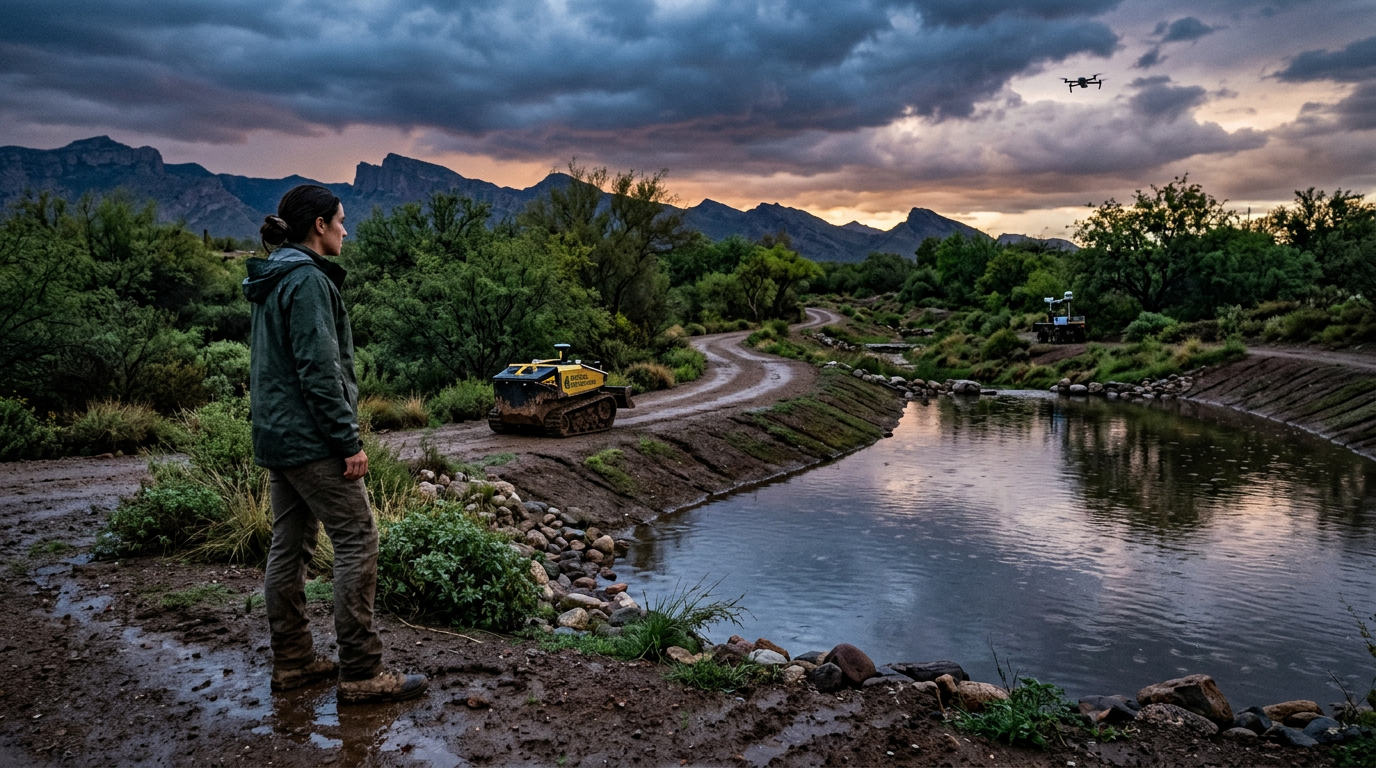
The county water planner in Arizona
Anika’s office used to be a graveyard of maps.
Not literal maps pinned to corkboard, but PDFs, GIS layers, archived studies, dry reports from consultants who knew exactly how bad things were and exactly how little would be done about them. Recharge issues. Erosion channels. Surface loss. Heat stress. Flash-flood behavior. Habitat fragmentation. Every year another set of documents arrived explaining the same problem in more precise language.
Water was leaving too fast. Soil was holding too little. Development was pushing where it shouldn’t. Agriculture was brittle where it remained. The county kept pretending the crisis was one thing when in reality it was ten things holding hands.
Then the restoration sites started multiplying.
Not everywhere. That was the strange thing. They didn’t spread like suburban sameness or industrial monoculture. They spread like a new grammar moving through different dialects. A site in New Mexico with orchard belts and pond chains. A site in Arizona focused more on forage, shade corridors, and herbal rows. A tribal pilot that used the robotic stack but adapted its ecological planning around cultural land priorities. A public-private project outside Tucson where restored runoff features had measurably reduced damage after monsoon events.
By the time Anika was forty-one, her job had changed without anybody formally renaming it.
She was no longer mostly planning around decline. She was coordinating interfaces between legacy water systems and restoration intelligence.
The county had subscribed to a regional version of Ecology AI by then. Not the full sovereign stack, but a shared planning model that could ingest drone data, weather patterns, topography, vegetation response, and public land records. When she opened the dashboard in the morning, she could see not just static maps, but recommendations.
This basin can retain more water if contour interventions are extended 0.8 miles west.
This grazing zone shows improved infiltration and could support denser forage biodiversity without reducing carrying use.
This restored slope now has enough moisture stability to trial apricot-plum mixed rows if access lanes are expanded.
This lower corridor is suitable for linked pond development and small-scale aquaculture if county permit class B is approved.
Ten years earlier, such language would have sounded absurd in a planning meeting. Now it sounded merely bureaucratic.
That was how Anika knew the world had moved.
The public response was split in a way that fascinated her. Young people treated restored landscapes as obvious. They had grown up seeing drone footage of contour-greened slopes and lane-hidden harvest bots moving through six-foot hedges. They thought every county should be doing this. Older residents were more emotionally complicated. Some saw vindication. Others saw accusation. If the land could be improved now, what did that say about the decades it had been allowed to degrade?
Her father, who had spent years in real estate, hated that question.
“You can’t judge the past by tools people didn’t have,” he told her once.
“Maybe,” she said. “But you can judge what they chose not to notice.”
By year ten, food insecurity had not vanished. Grocery prices still rose and fell. Distribution still mattered. Wages still mattered. But something had changed at the county level: local productive capacity was thicker. More fruit rows. More botanical acreage. Some pond systems. More poultry integration on restored lands. Better grazing health. The region no longer felt totally dependent on distant perfection.
There was a storm that year, the kind that used to terrify everyone. Short, violent, filthy with energy. The old runoff channels still surged in the unrestored zones. But in the restored corridors, the water moved differently. Not tamed exactly. Persuaded.
Anika stood with her boots in wet soil after the storm, watching a basin hold water that once would have been halfway to the river and gone. Above her, a drone crossed the bruised evening sky. One of the dog bots rolled down a maintenance lane checking for washouts. Beyond it, a line of mixed trees held the slope in place like an argument that had finally learned to win.
For the first time in her career, the county’s future felt less like defense and more like composition.
3. Twenty Years Out
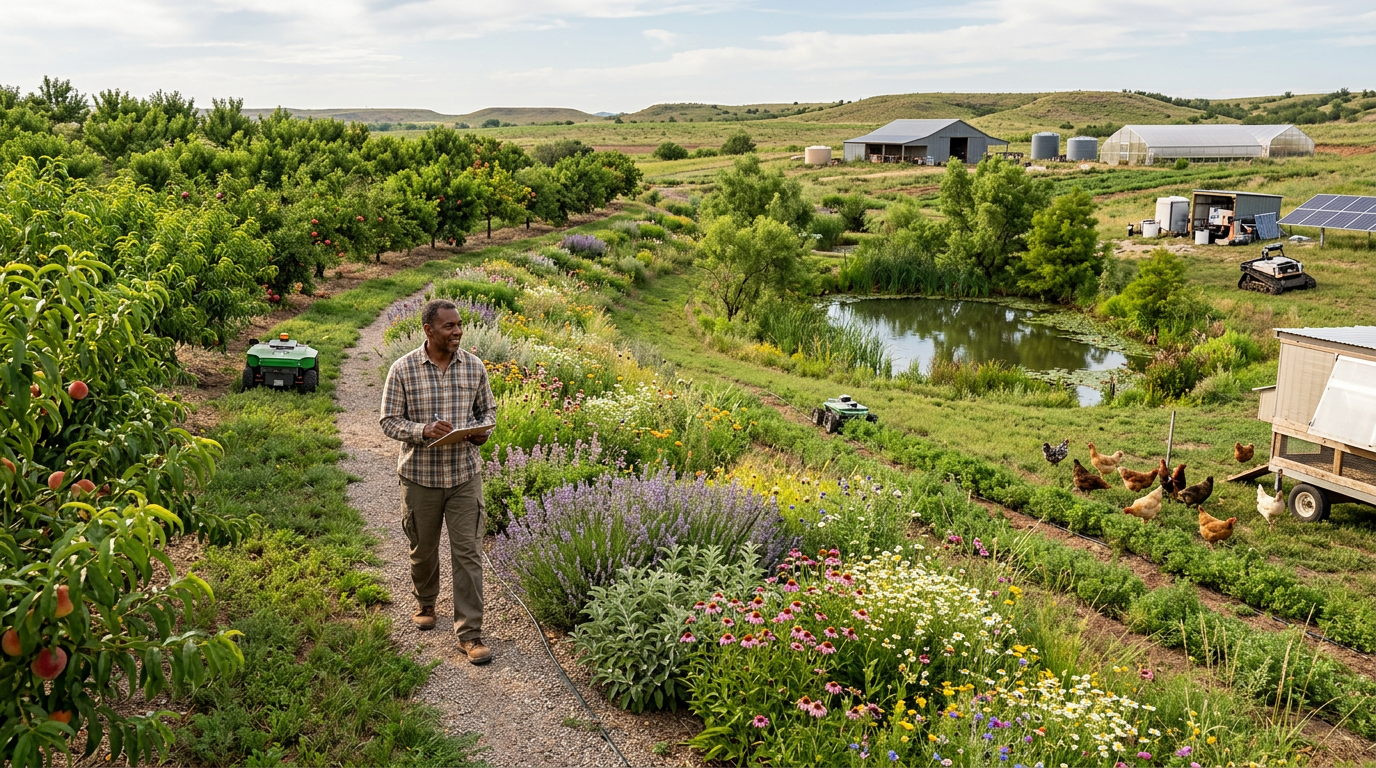
The school lunch director in West Texas
Jamal did not come to revolution through theory. He came to it through inventory.
Chicken count. Fruit procurement. Supplement contracts. Fuel surcharges. Refrigeration delays. School lunch budgets were where large systems confessed the truth about themselves, because children needed to eat whether policy was coherent or not.
Twenty years into the restoration era, he was fifty-two and running procurement for a regional school system in West Texas. When he had started, most of the produce came in from far away, and when weather or trucking or price spikes hit, menus turned into exercises in graceful disappointment.
Now his dashboard looked different.
Forty-two percent of the district’s fruit intake came from within a two-hundred-mile radius. Some from conventional sources still, sure, but an increasing share from restored dryland mosaics that had matured into steady producers. There were apricots from a site that used to be a scrubbed-out slope no orchard company would have touched. Herbal teas sourced from a medicinal cooperative on restored acreage that had once been considered low-value pasture at best. Eggs from poultry integrated into improved forage landscapes. Fish, occasionally, from pond-linked restoration systems that had become stable enough for contract supply.
The thing outsiders never understood was that the restoration didn’t just create more food. It created more kinds of nearby food.
That changed everything.
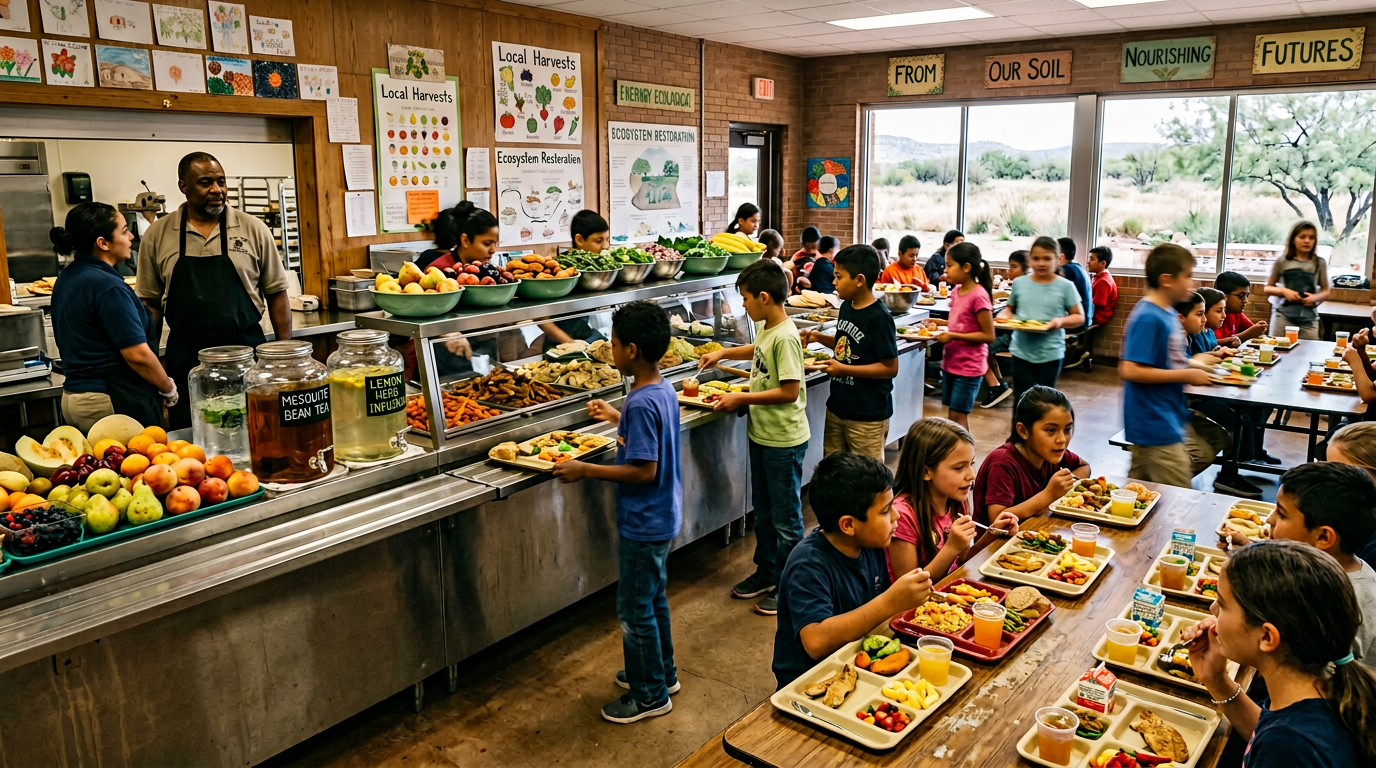
The district no longer lived and died by one supply logic. When one region had a heat spike, another had a better harvest. When fuel costs rose, local deliveries hurt less. When national fruit output dipped, regional restored lands cushioned the blow. None of it was perfect. But the system had redundancy now. Abundance had begun growing roots.
Jamal toured one of the larger restored sites once as part of a procurement review. He expected something halfway between a farm and a research station. What he found felt like a new category.
Green belts on contour. Narrow robotic lanes hidden under hedges. A service bay where a technician bot was wiping down a battery housing with the same seriousness a surgeon might use on instruments. Ponds linked by elevation. Pollinator corridors. Fruit rows mixed with support species and medicinal strips. No section looked like the kind of clean, dead geometry he had grown up assuming farms were supposed to have.
“Looks messy,” he said to the site manager.
She laughed. “Messy is what competence looks like when it stops performing for spreadsheets.”
By year twenty, people in his region had begun using a phrase he loved: reliable local abundance.
Not infinite abundance. Not cheap abundance in every single case. But abundance that did not vanish the moment a few external variables went ugly. Food insecurity had not disappeared as a social issue, but its agricultural root system had thinned dramatically. Schools like his had more options. Food banks had more stable regional partners. Counties had more productive acreage. Public nutrition no longer felt as detached from land stewardship.
The children noticed in the strange way children notice everything. They thought it was normal that the school had “restoration fruit weeks” where labels told them which landscape their lunch had come from and what the parcel had looked like twelve years earlier. Before picture: hard runoff scar, sparse brush, almost no hold. After picture: contour orchard and herb belt, pond below, dog bot in lane.
A little girl once pointed at one of those pictures and asked him, “So the food came from a place that was sad before?”
Jamal paused.
“Yes,” he said. “That’s one way to put it.”
“And now it’s happy?”
He smiled. “Now it works better.”
She accepted that, but he couldn’t stop thinking about the question.
Because at twenty years, that was the social repercussion more than anything else: people had started to expect repair. Not as miracle. Not as fantasy. As category. Regions that had once assumed decline as the background music of land now had children growing up under a different assumption.
That alone was civilizational.
4. Fifty Years Out
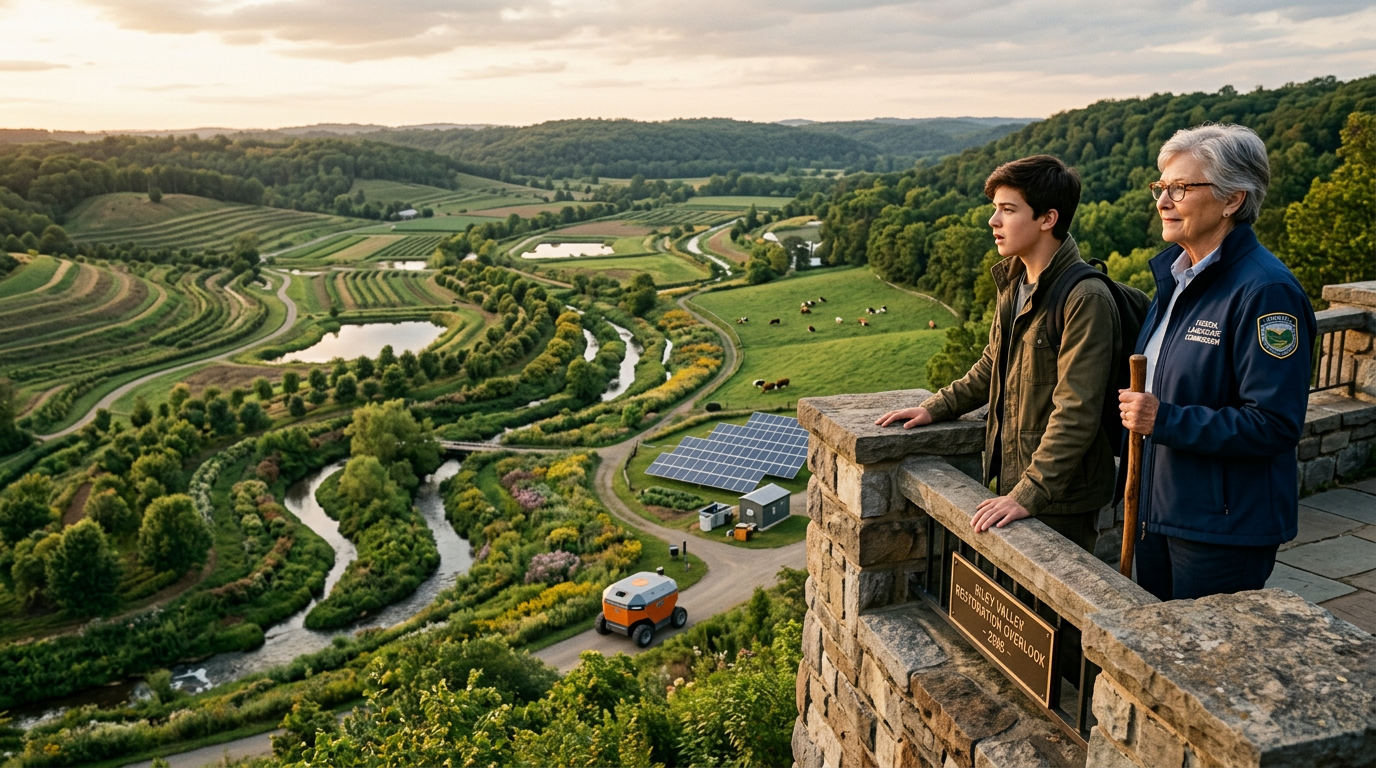
The federal landscape commissioner
Eleanor had the kind of job title that would have sounded fictional in 2026: Federal Commissioner for Restorative Land Systems.
By fifty years into the transition, the title no longer sounded strange. It sounded overdue.
The office she ran did not “manage farms.” It coordinated dryland restoration frameworks across states, agencies, watershed districts, tribal land partnerships, and public-private agreements. There were legal teams for water rights integration, data teams for cross-region model governance, and ecological review boards that decided where restoration should intensify production, where it should strengthen grazing resilience, and where it should stop at hydrological repair and habitat support.
That was the mature form of the system. Not blanket greening. Disciplined differentiation.
The politics were still vicious sometimes. Ranching blocs fought over language. Environmental coalitions split between restorationists and rewilding purists. States competed over funding formulas. Some counties wanted more aquaculture zones. Others wanted more fruit. Others wanted federal restraint. But underneath the arguments was a shared fact that nobody serious denied anymore:
The land could be improved at scale.
That changed the moral tone of policy. Fifty years earlier, degraded land was often treated as a passive inheritance. Now underperforming hydrology carried a hint of indictment. If you knew how to heal something and chose not to, neutrality grew thin.
Eleanor flew over restored corridors in a low-state survey aircraft once a season. From the air, the country looked different now. Not uniformly green, not absurdly transformed, but laced with new intelligence. Contour forests where runoff scars used to dominate. Improved grazing mosaics with denser shade and richer species variation. Orchard belts in places the old agricultural economists had dismissed. Linked pond systems like strings of dark coins across pale land. Maintenance corridors too fine to see until the aircraft banked.
There were arguments in Congress now not about whether restoration worked, but about what percentage of the national underperforming land base should be prioritized over the next decade.
That was when she understood they had crossed the threshold.
Food insecurity still existed, but in a changed form. Less driven by national productive weakness, more by governance failure, local politics, distribution breakdowns, addiction, poverty. The agricultural substrate beneath hunger was not gone, but it was vastly thicker and more forgiving. There was more fruit. More herbs. More local protein. More flexible land. More ecological redundancy. When climate shocks hit one region, restored distributed systems absorbed some of the blow.
People had also changed aesthetically. That mattered more than most economists ever admitted. Americans had grown used to seeing beauty return to damaged land. The visual norm shifted. Bare, runoff-scored slopes near towns began to look not just unfortunate but unfinished. The public had learned to see hydrological disorder.
And once a culture learns to see a wound, it becomes harder to treat neglect as realism.
Eleanor’s grandson asked her once, while they stood on a restored overlook above what used to be an ugly drainage system, “Did people really used to call places like this useless?”
She looked down the contour-shaped valley. Fruit belts. Pollinator breaks. A reflective pond. Grazing land beyond, healthier than it used to be, not erased but upgraded. A technician bot passed near the energy structure like a white insect attending to the metabolism of the whole place.
“Yes,” she said. “They did.”
He frowned like he couldn’t parse the stupidity of the dead.
5. One Hundred Years Out
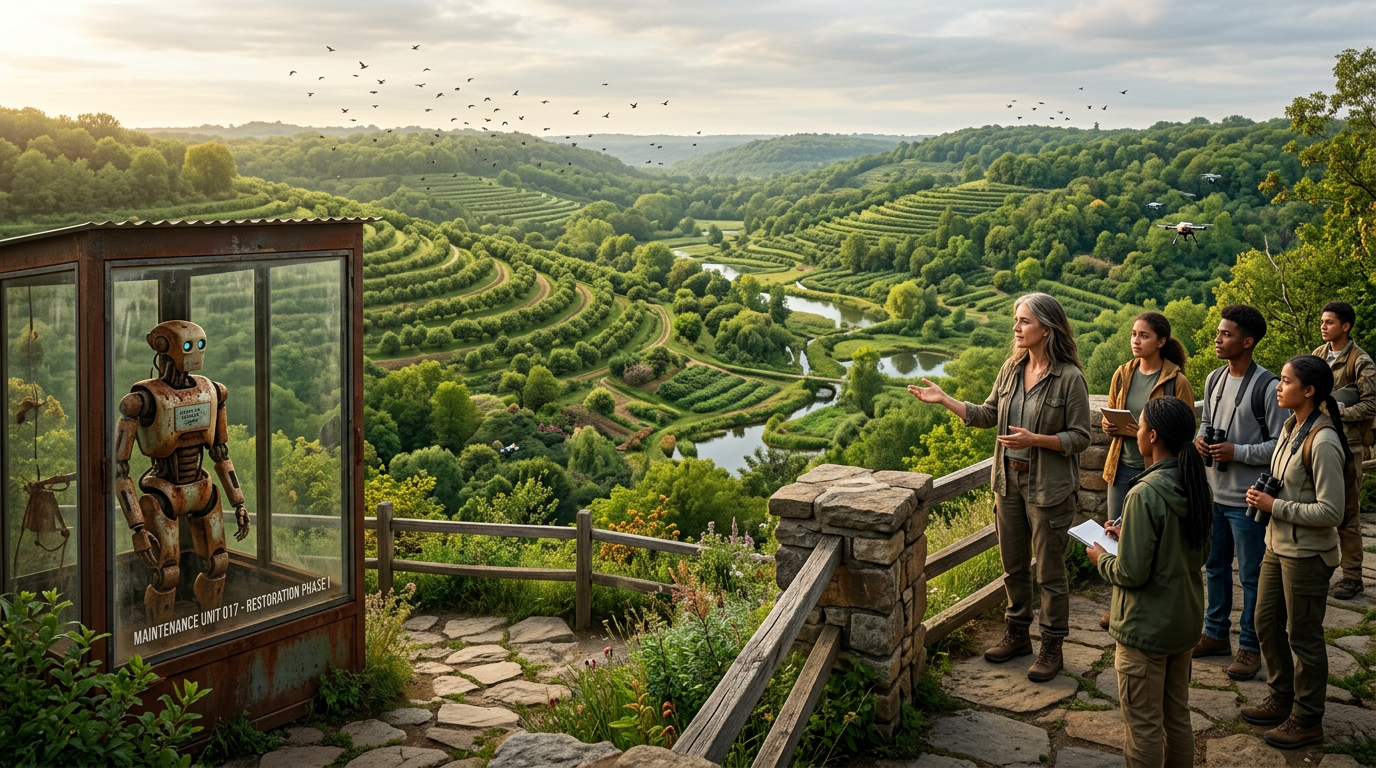
I am the ecological historian
I have spent most of my life studying landscapes that no longer exist.
Not vanished in the sense that cities vanish under war, or species vanish into extinction, but vanished in the quieter way old assumptions vanish when a civilization finally becomes ashamed of them. I was born late enough to inherit the repaired world, but early enough to still know people who remembered the before.
That is the wound at the center of my work.
My grandmother grew up where the land was always described with apology. Dry. Scraped. Overgrazed. Hard. “Nothing out there.” She said people talked about whole regions of the country as if God had begun them and then lost interest. Rain came, but it came like violence. Water cut the ground and left. Soil blew off. Plants clung where they could. And if the land stopped giving, people blamed the land.
I grew up hearing those stories in rooms shaded by mature contour orchards.
That kind of dissonance can rearrange a person.
By the time I became a historian, the restoration transition was already old news to administrators, engineers, planners, and land systems people. Everybody knew the broad facts. Hydrology-first restoration had worked. Ecology AI had matured. Robotic permaculture had moved from pilot logic to basic infrastructure logic in much of the dryland states. The repair stack had become ordinary enough that nobody felt compelled to marvel at it every day.
But I never lost the marvel.
I teach now at a university whose archives are full of the old language. Marginal acreage.Non-productive tracts.Low-value semi-arid parcels.Permanent carrying-capacity limitation. There is something almost obscene about reading those phrases now, knowing what much of that land later became. Not every parcel, no. Not every dry place should have been greened. Wisdom survived, thankfully. Some lands remained sparse because that was their right shape. But so much of what had once been dismissed as naturally exhausted was nothing of the kind. It had been misread. Neglected. Forced into the wrong grammar.
I take my students to the first-generation sites because I need them to feel that.
Not understand it. Feel it.
The oldest one I visit still carries traces of its first life under the new logic. You can see the early contour work if you know how to look. You can see where the primitive service structure once stood. There is a preserved technician bay there now behind glass, and the students always laugh softly when they see how crude the old machines look compared to what they know.
I let them laugh.
Then I walk them to the overlook.
Below us there is a long slope that, in the first survey records, was described as underperforming semi-arid land with unstable runoff behavior and limited conventional agricultural value. The phrase is so sterile it almost protects the mind from what it means. What it meant was: water escaped, soil thinned, life struggled, and the people looking at it lacked either the tools or the imagination to believe it could become otherwise.
Now the slope is a living argument against that whole era.
Fruit canopy broken by support species. Pollinator drift moving like colored weather. Medicinal understory in the lower terraces. Water holding in linked structures farther downslope. A maintenance line so swallowed by time and biomass that only the old mapping overlays reveal it. Bird density thick enough that silence itself seems no longer structurally possible there.
I never speak right away when we arrive. I let the place do the first part.
Because the truth is, that valley hurts me a little every time I see it.
Not because it is sad now. Because it is beautiful now in a way that indicts the old world.
That is the feeling the academic papers are too polite to name.
People in the old period liked to speak about damaged land as though it had been unfortunate, but neutral. As if everyone had simply done their best with limited means. Sometimes that was true. Sometimes. But not always. There was also laziness. And greed. And a style of intelligence that could calculate extraction down to the cent but could not recognize a hydrological wound standing directly in front of it.
When I stand over that restored valley, I do not only feel triumph. I feel a long delayed embarrassment on behalf of the species.
One of my students asked me several years ago, “Professor, when did the country finally understand?”
I remember that day because the light was low and everything below us looked almost impossibly alive.
I told him, “Not when the system started working. When people stopped treating repair as exceptional.”
That was the true threshold.
By year one hundred, no one serious doubted the framework anymore. States used Ecology AI as a normal planning layer. Counties used local models. Grazing cooperatives used it. Orchard planners used it. School districts used it. Community landscape meshes used it. Household systems and small farmer bots could call regional ecological intelligence through standardized interfaces the way earlier centuries called weather data or satellite navigation.
But what mattered more than the tools was the moral conversion.
We learned, slowly, that productivity was not the same thing as stripping value from the surface. We learned that some of the richest systems became rich precisely because not everything was harvested. Fallen fruit fed more than people. Pollinators thickened. Soil webs deepened. Birds returned in densities once associated only with protected reserves. Pets lived in richer worlds. Children grew up among fragrance, shade, and the ordinary abundance of things worth eating, touching, or watching. Streets softened. Towns changed smell. Summer heat itself became less cruel where restoration had matured enough to alter the living texture of the land.
People still planted what they loved. They still asked for figs, apricots, plums, herbs, eggs, flowers, tea plants, cool walking corridors, bird-heavy courtyards. But by then the culture had changed enough that wanting something no longer implied forcing it everywhere. Ecology AI did not erase desire. It disciplined desire into conversation with place.
That is one of the deepest civilizational changes we ever made, and almost nobody says it that way because it sounds too intimate for policy.
Food insecurity had changed too, though saying it correctly still matters. Hunger had not disappeared by magic. Poverty still existed. Corruption still existed. Political cruelty still existed. But the old ecological excuse had become much harder to hide behind. The productive base of the country was too broad now. Too distributed. Too intelligent. Too many restored acres. Too many local food belts. Too many herb corridors. Too much improved forage. Too many ponds. Too many perennial systems braided into ordinary life.
Years ago I wrote a line that people still quote back to me:
“The restoration transition did not eliminate human failure, but it stripped hunger of many of its ecological alibis.”
I still believe that.
But what I believe even more, now that I am older, is that the restoration changed something prior to policy. It changed what people were willing to call normal.
That is the deepest layer.
Children no longer stand on runoff-scarred land and think, Well, that’s just how it is.
They no longer see underperforming acreage and assume the world is finished there.
They no longer think life is a decorative extra added after economics is done.
They inherit a different reflex.
When water escapes, they ask how to hold it.
When soil thins, they ask what living structure is missing.
When land underperforms, they ask what it wants to become.
When abundance appears, they do not immediately ask how to strip it bare.
I think often of my grandmother. She died before the transition fully matured, but long after she had seen enough to know the category of “useless land” was beginning to crack. The last time I brought her to a restored site, she stood quietly for a long time watching one of the early orchard belts move in the wind.
Then she said, very softly, almost to herself, “They told us this place was finished.”
I have spent the rest of my life trying to understand the size of that sentence.
That is why I became a historian.
Not merely to document what the machines did, or how the models improved, or how the legal frameworks shifted, though all of that matters. I do it because I want future generations to understand that a civilization once looked at wounded land, mistook injury for destiny, and nearly built its whole realism around that mistake.
And then, slowly, through patience, engineering, humility, and the refusal to accept false endings, it learned to see again.
When my students ask me what the transition really was, beneath all the technical layers, I give them the least academic answer I know.
It was the century in which we stopped confusing damage with truth.
6. Three Hundred Years Out
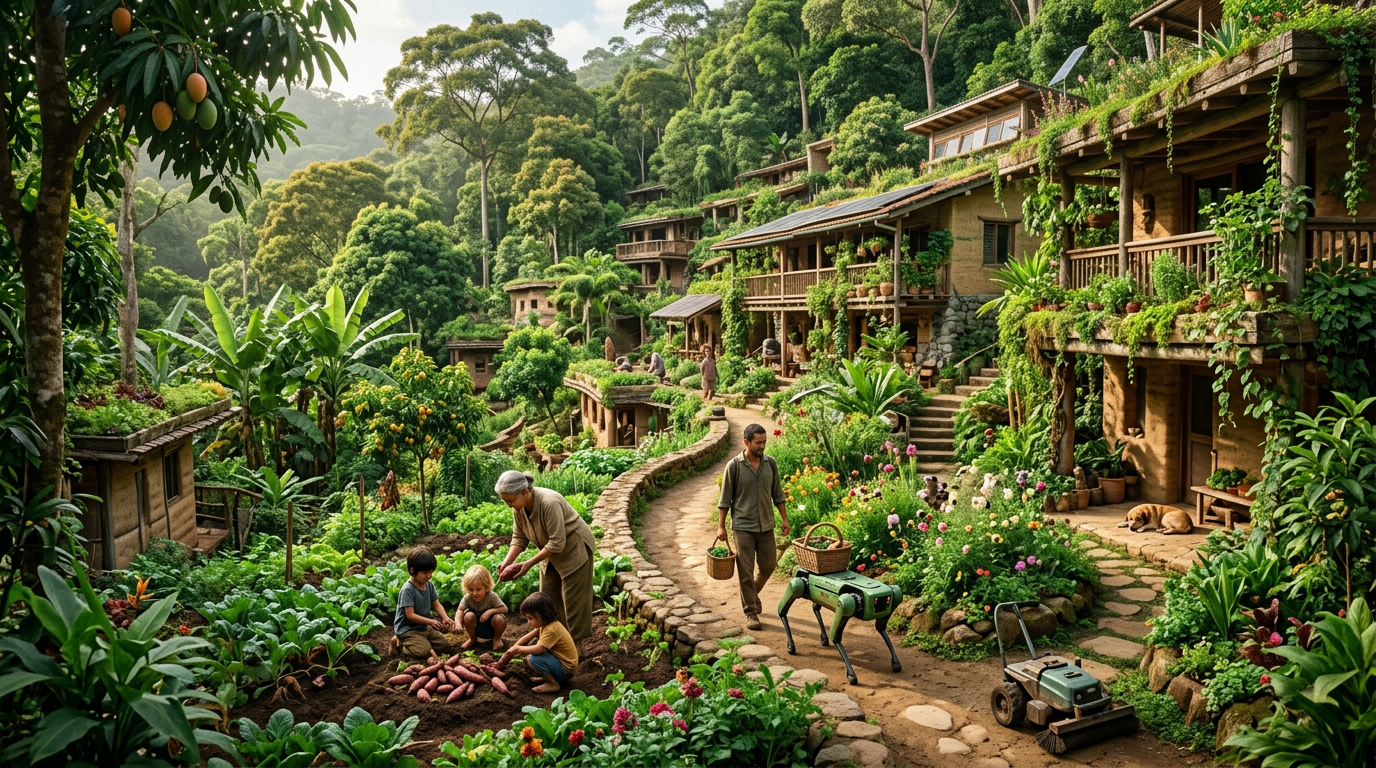
I am a child of the restored continent
My name is Ilyan, and by the standards of my ancestors I would probably be called a genius, though that word means less now than it used to.
Not because intelligence became cheap. Because it became cultivated.
We train minds differently. AI teaches everyone from the beginning: systems thinking, ecology, hydrology, pattern recognition, long-range consequence mapping, ethics of intervention, energy logic, soil logic, machine maintenance, species behavior, settlement design. You do not grow up merely learning facts. You grow up learning how to read reality. By the time I was twelve, I could run a small landscape model, audit the maintenance logic of my household bots, compare three planting futures for a slope, and explain why a zone should be harvested lightly, harvested heavily, or allowed to farrow for ten years.
That is normal where I live.
What would have seemed exceptional three hundred years earlier is now basic citizenship in a mature civilization.
I have never seen what my ancestors meant by the word barren except in archives.
Not because deserts no longer exist. They do, and wisely so. Some remain sparse only because we choose restraint. Some are sacred. Some are ecologically complete in their austerity. But the old category of neglected, runoff-scored, biologically thinned land, land made ugly by mismanagement and then mistaken for natural emptiness, is mostly gone from human settlement space.
That is the distinction.
We did not erase all deserts.
We erased negligence.
By now, green has entered everything it responsibly can.
Ecology AI is no longer a project. It is infrastructure in the deepest sense. It is available through every local farmer bot, every domestic steward system, every community landscape mesh, every municipal planning layer, every school garden network, every township water corridor, every rooftop ecology system, every restoration cooperative, every transport-edge habitat manager. If a piece of land can hold more life without violating the deeper pattern of the place, then some form of ecological intelligence is already asking what that life should be.
My home sits in what the old maps would have called semi-arid country. The phrase means almost nothing to me emotionally. The land here is dry in a beautiful way, not a wounded way. Water moves with intention. The terraces below our house are linked to neighborhood retention lines, pond chains surrounded by verdant green, and contour orchards farther down the municipal slope. My family has its own bots, of course. Everyone does. Mine are modest by serious agricultural standards, but not small.
I have three personal steward machines under my primary control.
One is a lane runner, narrow-bodied and wheeled, built for micro-inspection, trimming, pollinator corridor maintenance, and light harvest verification. One is a slope worker with dual manipulators, capable of tool changes, contour checks, pruning, minor earth correction, and maintenance assist. The third is my favorite: a household-field hybrid technician that manages battery cleaning, housing inspection, seal verification, wash-down procedures, tool staging, and emergency repairs. I helped redesign its gripper logic last winter after finding inefficiencies in wet-latch handling during cold dawn service cycles.
That sort of thing is ordinary for me. AI trained me to think that way from childhood.
Not “how do I use a machine” but,
“How does the whole system preserve itself.”
This is what my ancestors missed for so long: once intelligence becomes ambient and accessible, land improvement stops being a heroic act. It becomes a default behavior of civilization.
That was the real threshold.
At first, centuries ago, robotic permaculture was a frontier practice. Then it became a regional system. Then a public capability. Then a standard interface layer. Now it is simply how human settlements think. Not perfectly, not uniformly, not in every biome the same way, but almost everywhere human presence touches land, the question is no longer “What can we force here?” The question is “What can this place become if we stop fighting its logic and start feeding it intelligence?”
That is how the Earth re-greened.
Not through one grand decree. Not through one universal crop. Not through brute afforestation or any simplistic attempt to impose greening everywhere. It happened because restoration intelligence became available at every scale. House scale. Courtyard scale. Street scale. Townhouse-community scale. School scale. City scale. Farm scale. Watershed scale.
Everywhere it could responsibly enter, it entered.
A roof that could hold root mass did.
A road margin that could host pollinators did.
A suburban edge that could transition into edible support canopy did.
A town drainage line that could become a green corridor did.
A neglected slope that could hold contour fruit and medicinal understory did.
A schoolyard that could become part food forest, part child training ground, part bird corridor did.
A municipal plaza that once reflected heat like a wound became shade, scent, fruit drop, insect music.
And because not everything is harvested, life compounds at a speed my ancestors would have found almost mystical.
That was another intelligence breakthrough. Earlier societies often believed that efficiency meant taking every visible unit of value off the landscape. We now understand that this is the arithmetic of fools. Some of the fastest gains in soil complexity, insect density, fungal networks, bird return, and microclimate stabilization come when visible abundance is left partly unclaimed.
So we do that on purpose.
Fruit falls by design.
Seed drop is tolerated by design.
Biomass accumulation is tolerated by design.
Bird feeding is tolerated by design.
Insect bloom is tolerated by design.
Pet interaction with richer outdoor ecologies is tolerated, even welcomed, by design.
The result is that green does not merely persist. It thickens.
In my time, most settlements no longer look like towns with landscaping. They look like managed jungles.
Not chaotic jungles. Not abandoned growth. Intelligent jungles.
Canopy over canopy. Fruiting layers above medicinal layers above pollinator layers above fungal and litter-rich soil worlds so dense with life that the old era’s decorative landscaping reads like sterile theater. People walk through tunnels of pomegranate, mulberry, jujube, apricot, loquat, citrus in the warmer bands, mesquite and palo verde support canopies where the climate calls for them, herb shade systems underneath, flowering vines where structure allows, edible groundcovers where paws and feet can coexist with softness and scent.
And yes, by now people are careful about what surrounds them.
Once ecological intelligence became widespread, society gradually abandoned the old habit of filling human space with ornamental toxicity. Why would we do that? Why surround ourselves, our dogs, our cats, our children, with plants that are useless or dangerous when we can choose systems that are beautiful, edible, medicinal, fragrant, and safe?
So people began designing their domestic ecologies around that principle.
Pet-safe fruiting courtyards.
Dog-safe shade corridors.
Low-toxicity herb belts.
Child-safe edible edges.
Bird-supporting canopy with cat-safe understories.

Some households became famous for their preferences. There is a family two blocks from us who insisted on building a cat garden under a ring of mature jujube trees. The jujubes throw dappled desert shade, fruit reliably, tolerate heat beautifully, and the understory is partly catnip, partly soft pollinator herbs, partly cooling groundcover. Their cats spend whole afternoons there in states of bliss so complete they have become neighborhood folklore.
That is how far the civilization has matured. Even pleasure is ecologically designed now.
My dog, Serein, lives in a world no dog from the old era could have imagined. The smell spectrum alone is enough to make her ecstatic. Fallen mulberries. Wet mulch. Bird trace. Pond edge. Mint wind. Dry jujube leaf. Loquat skin. Fungal bloom after dusk irrigation release. The old sterile lawns and chemically simplified margins I see in historical footage look to me less like landscapes than like sensory amputations.
Pets love this world. Humans love it too, though many of us only half admit how deeply. We sleep better in it. We move through more fragrance. Cities run cooler under layered canopy. Electric vehicles pass quietly beneath living cover. Children grow up touching useful plants as often as they touch walls. Pollinators are not “restored” in the dramatic sense anymore. They are simply there, everywhere their presence makes sense.
And the air changed too.
That is another thing the old world barely understood.
Once enough land was restored, enough ground was shaded, enough water was held, enough vegetation was allowed to transpire and breathe at scale, the rains themselves began changing character. Not everywhere equally. Not as a miracle. But enough that whole regions felt different. Atmospheric moisture cycling thickened. Local cooling effects accumulated. Seasonal rainfall became less erratic in many re-greened belts. Areas that once only received water as violence began receiving it more often as pattern.
The land had helped reteach the sky.
That is one reason the managed jungle feeling spread so widely. Once enough life thickened, it began stabilizing the conditions for more life. The regreening was not merely planted. It became self-reinforcing across generations.
And what shocks me most, when I study the archive, is that conventional farming was ever treated as the height of realism.
Vast monocultures. Repeated chemical fertilizer loading. Broad-acre poisons. Herbicide regimes blunt enough to treat complexity itself as an enemy. Land flattened to fit machinery, then chemically corrected when its internal fertility logic degraded. Water forced. Soil treated as medium rather than intelligence-bearing structure.
To me, it reads as a civilization trying to solve hunger by stripping resilience out of the system that produces food.
It seems absurd now.
Not merely crude. Absurd.
The idea that food scarcity could be solved by simplifying ecosystems, poisoning margins, suppressing biodiversity, and flooding damaged fertility loops with synthetic correction now feels like one of those transitional insanities that only make sense from inside a period too frightened to think long. I can understand why they did it. AI historical tutors made sure we understood the constraints of those centuries. But understanding is not the same as reverence.
Their highly mechanized intelligence led them to treat land as we treat hydroponic media: something to push nutrients through. But land was never meant to function that way. Soil had its own living intelligence, and they did not yet know how to read it.
We know better now because the evidence had centuries to compound.
Repair water behavior, and options multiply.
Repair soil structure, and diversity accelerates.
Let support ecology thicken, and pest logic changes.
Leave a meaningful percentage unharvested, and the biosphere itself becomes an ally in production.
Distribute the intelligence layer widely enough, and re-greening becomes not a special intervention but a cultural reflex.
That is what happened.
People still plant what they want. We are not a civilization of botanical monks. We love sweetness, fragrance, color, birds, tea plants, fruit walks, medicinal courts, edible courtyards, plum terraces, jujube shade, loquat lanes, flower-heavy transit paths, herb roofs, shaded public baths, duck ponds, and neighborhood food corridors. We still choose. We still compose.
But our choosing is no longer stupid.
Ecology AI does not erase desire. It sharpens it. It says: yes, you can have the apple belt, but move it five meters downslope and let the upper line farrow. Yes, you can intensify herb production here, but not if you want long-term pollinator gain in the adjacent corridor. Yes, you can increase harvest rates this cycle, but you will lose fungal expansion in zone 4 and reduce bird return by 11% over twelve years. Yes, you can do that. No, you should not. Here are three better futures to still get you what you want — but we still exercise choice — that’s the fun part. The rules of ecology are so deeply ingrained in every person within society that our first nature has become, in a way, land stewardship.
That is how mature people talk to land now.
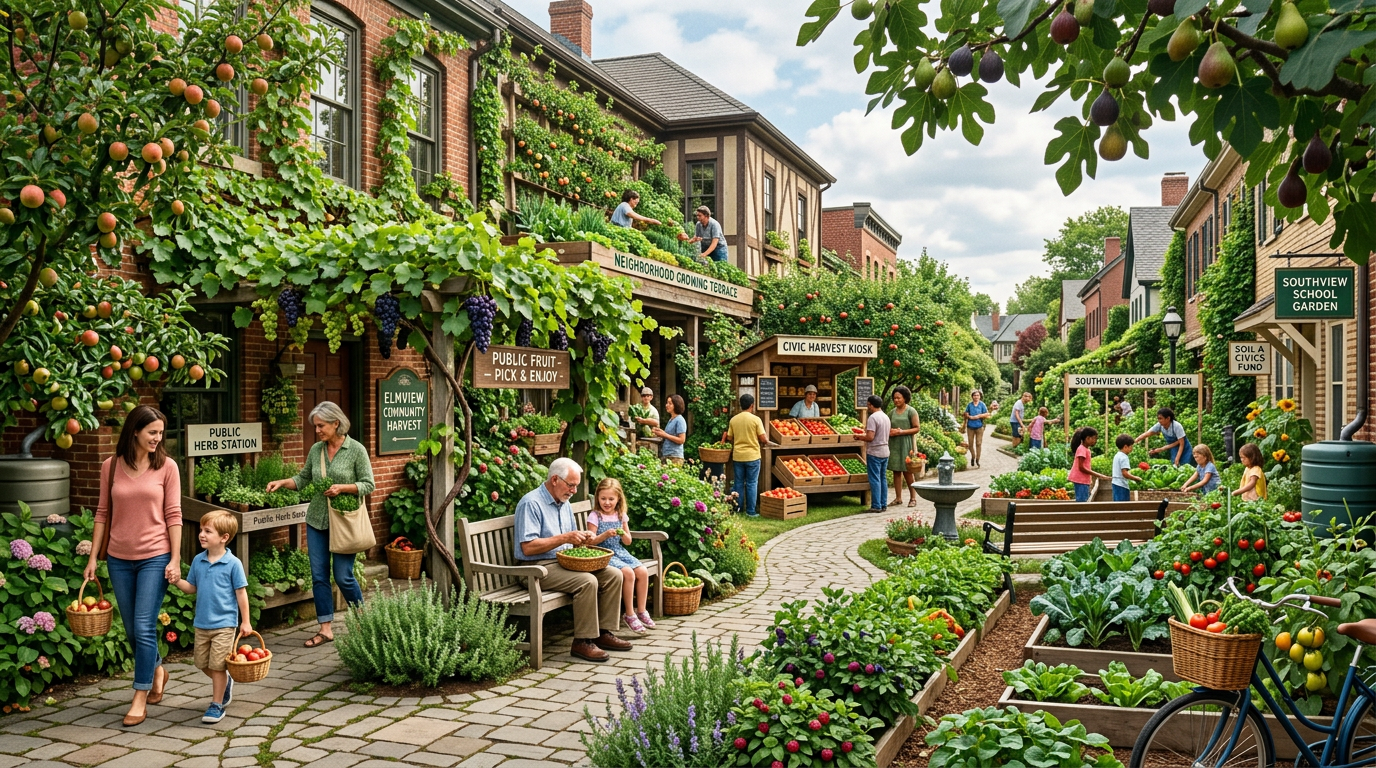
Food insecurity, in my world, is nearly incomprehensible except as political malice, logistical sabotage, or temporary collapse. The material substrate is too strong. Households produce. Neighborhoods produce. Schools produce. Cities produce. Rural belts produce. Restoration corridors produce. Municipal support systems produce value even when direct food is not their primary purpose. Homelessness was solved more than 150 years ago with 3D-printed houses, so there isn’t really an excuse for going hungry anymore besides intentional fasting, illness, or planned systemic malice. The biosphere itself has become so much thicker, so much better fed, so much more structurally alive, that the old scarcity reflex looks like a symptom of a previous developmental stage.
In school we do not study land history from flat screens.
We step into it.
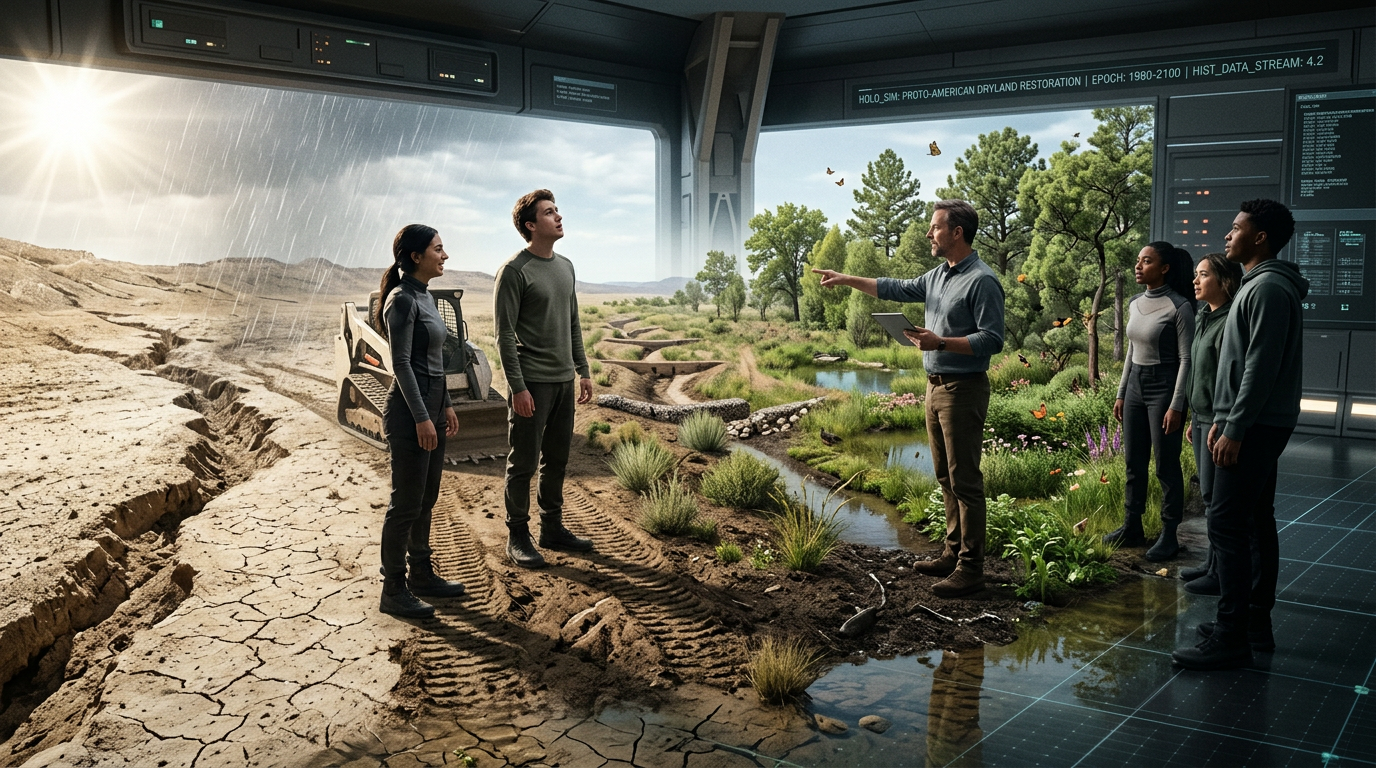
Our watershed systems class meets twice a week in the holo-deck, a full-sensory reconstruction chamber that can render historical landscapes, hydrological flows, planting phases, species return patterns, and restoration timelines at any scale the instructor chooses. We can do things like stand inside a runoff scar as it looked three hundred years earlier, then watch the same slope across decades as swales are cut, ground cover thickens, fungi spread, ponds link together, canopies rise, pollinator density returns, and the air itself changes.
That day our instructor loaded the old American dryland sequence.
At first the room was harsh with light. The terrain around us was pale, exposed, and brittle. The rain simulation began and I watched water hit the ground wrong, fast and angry, cutting down-slope instead of entering the land. Then the simulation advanced. The first contour interventions appeared. Primitive tractor bots moved like stubborn animals. Crude service structures sat off to one side. Early support species took root. Then the deck accelerated the timeline.
The land darkened.
Water slowed.
Plant structure thickened.
Bird calls entered the sound field.
The heat signature dropped.
Pollinators multiplied.
Ponds began linking.
Edges softened.
Corridors formed.
Production and habitat started braiding together.
Then the instructor froze the holo-deck and isolated one of the first pilot parcels. We were standing inside it now, full scale. I could walk the original swale line. I could kneel by the first battery house. I could see the roughness of the early machine tracks and the crude geometry of the first robotic lanes before later generations of growth swallowed them.
Some of the other students were amused by how primitive it all looked.
I wasn’t.
I was standing inside the origin point of a civilization-scale reversal.
The instructor expanded the overlay and the room filled with branching futures radiating outward from that one site: municipal corridor systems, townhouse food meshes, school orchards, medicinal districts, restored grazing mosaics, rooftop ecologies, pond-linked community belts, electric transit roads under canopy, domestic steward bots, neighborhood farrowing zones, pollinator clouds over cities.
That was the moment it hit me.
Not as information.
As inheritance.
Everything I think of as ordinary, my household bots, our mixed terraces, the neighborhood corridor mesh, the city canopy, the fact that people and animals both live inside abundance now, all of it traced back to moments that small, that rough, that early.
Standing there in class, inside the holo-deck’s reconstruction of old New Mexico dust and first-generation repair logic, I felt something sharper than admiration.
I felt historical gratitude.
All of this, I thought.
All of this began when some people refused to accept that damaged land was simply normal.
That night I walked down past the lower terrace. Our house system had allowed a large percentage of the seasonal fruit drop to farrow this cycle because the soil-diversity gain exceeded the near-term harvest value. Serein moved ahead of me through the sweet dark, intoxicated by the smell-world. Small animals worked the fallen fruit. Somewhere out in the municipal corridor, one of my lane bots whispered across a wet path, adjusting a water-guidance lip after a light rain. Beyond that, the city glow was soft and mostly hidden behind living structure.
I tried to imagine the old world.
Poison in the fields.
Chemical correction treated as intelligence.
Monoculture treated as seriousness.
Runoff treated as normal.
Dead edges treated as efficiency.
Food production imagined as a war against complexity.
I could understand it academically.
But I could not feel it as sane.
There is a strange beauty in a people recognizing the inevitability of their own decline, refusing it, and choosing to create something worthy of passing down to the next generation. That is why I am here. That is why we have so much, and now I can’t imagine it any other way.