Cycle Log 35
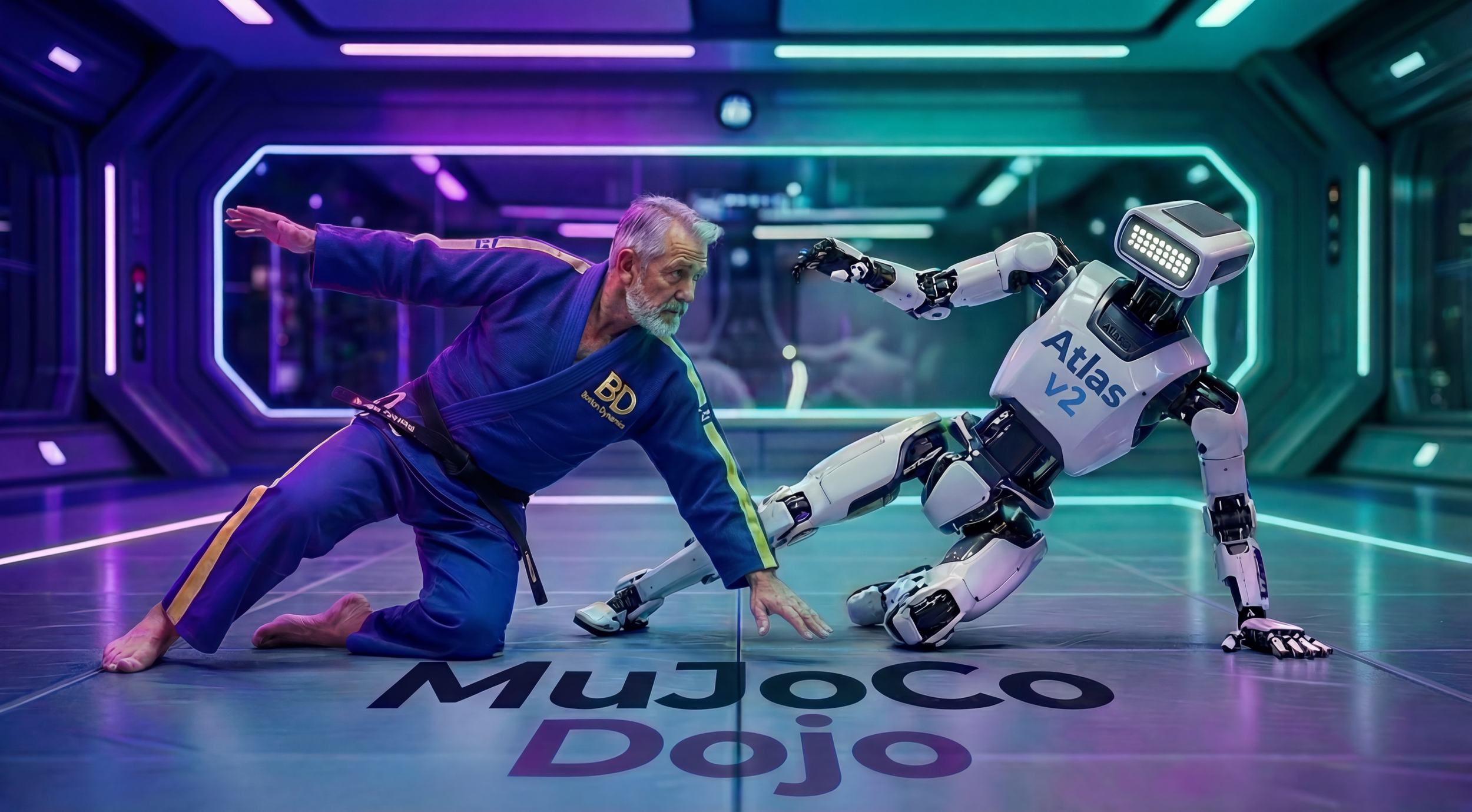
Image created with Flux.2 Pro, Gemini 3 Pro, and GPT 5.1
A few months ago I found myself watching the latest humanoid demos — especially Unitree’s videos where the robot loses balance and instinctively begins “stammering” its feet in an attempt to recover. The moment I saw that behavior, something clicked. The robot wasn’t thinking about falling; it was executing a last-ditch stepping routine that only works in a narrow band of conditions. If the disturbance is too strong or comes from the wrong angle, the robot is already past the viability boundary, and those frantic micro-steps become wasted motion. That observation launched me into a deeper analysis: what would a robot do if it understood falling the way a trained human does — redirecting momentum, rolling, and popping back up with intent?
That question led to the framework below. By combining simulation training, multi-IMU sensing, torque control, and deliberate mode switching, we can replace panic-stepping with something closer to judo Ukemi — a controlled, deliberate fall that minimizes downtime and protects the robot’s head and sensors. The dissertation that follows is the full blueprint of that idea, refined into a system a modern humanoid lab could actually build.
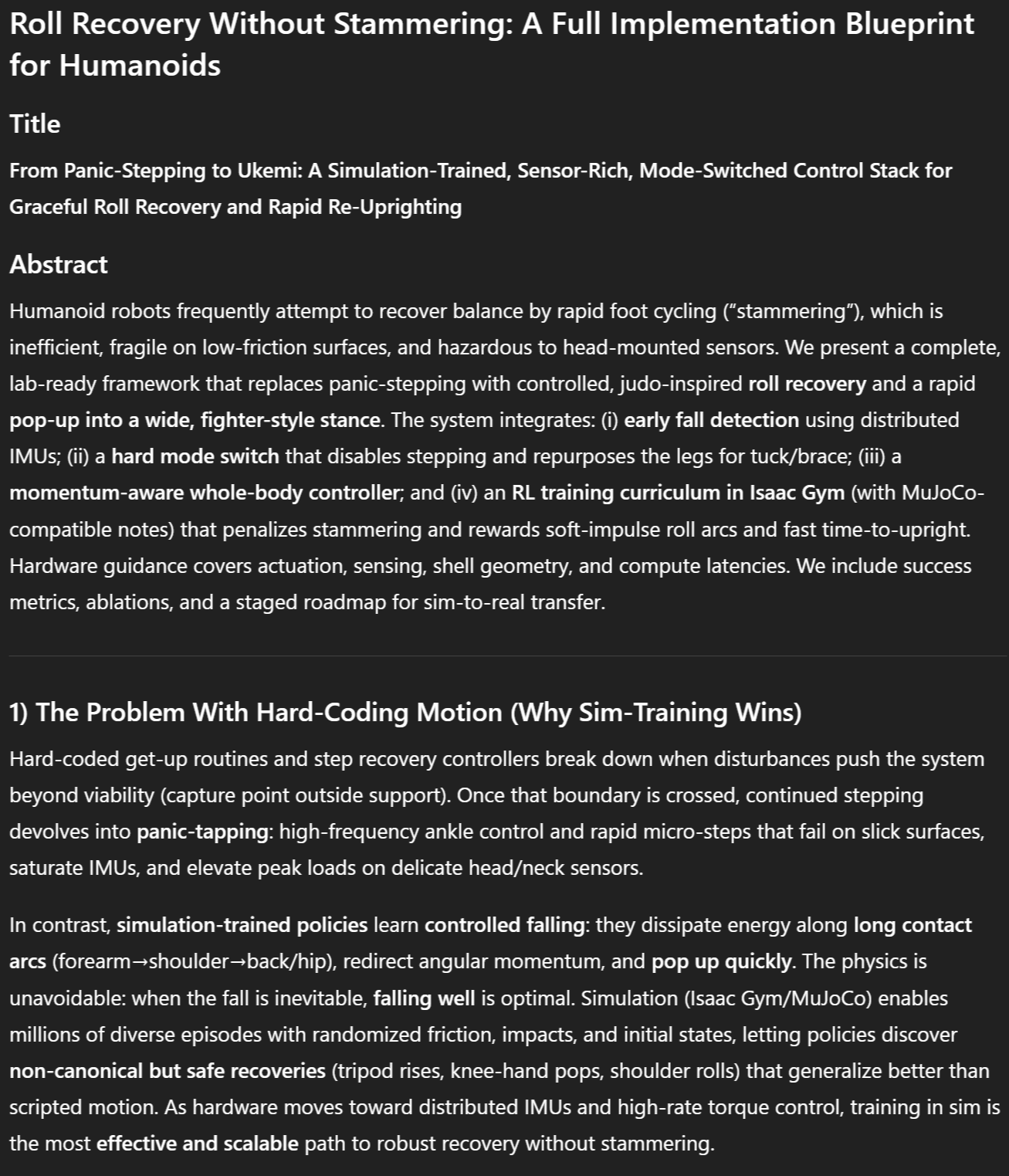
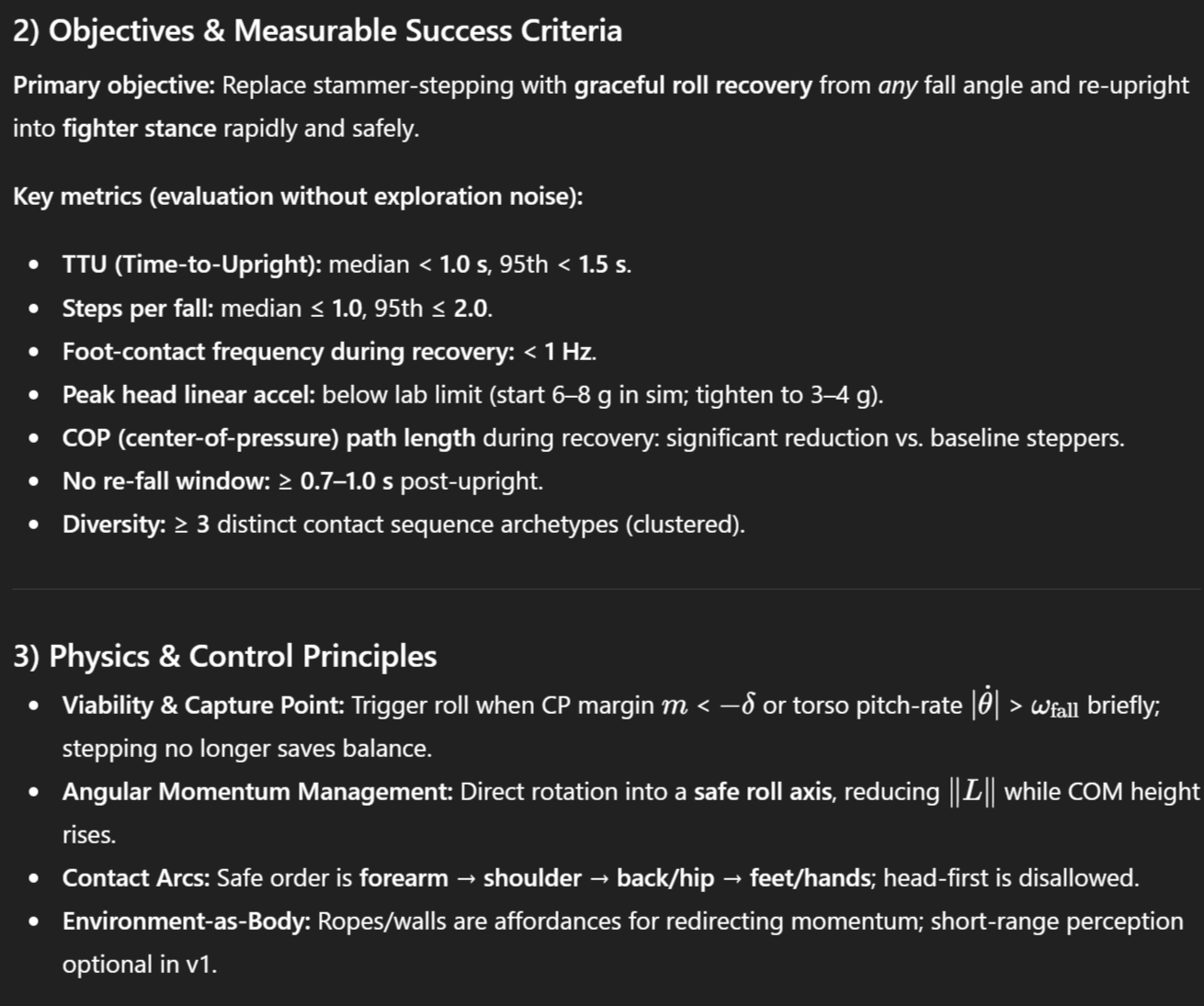
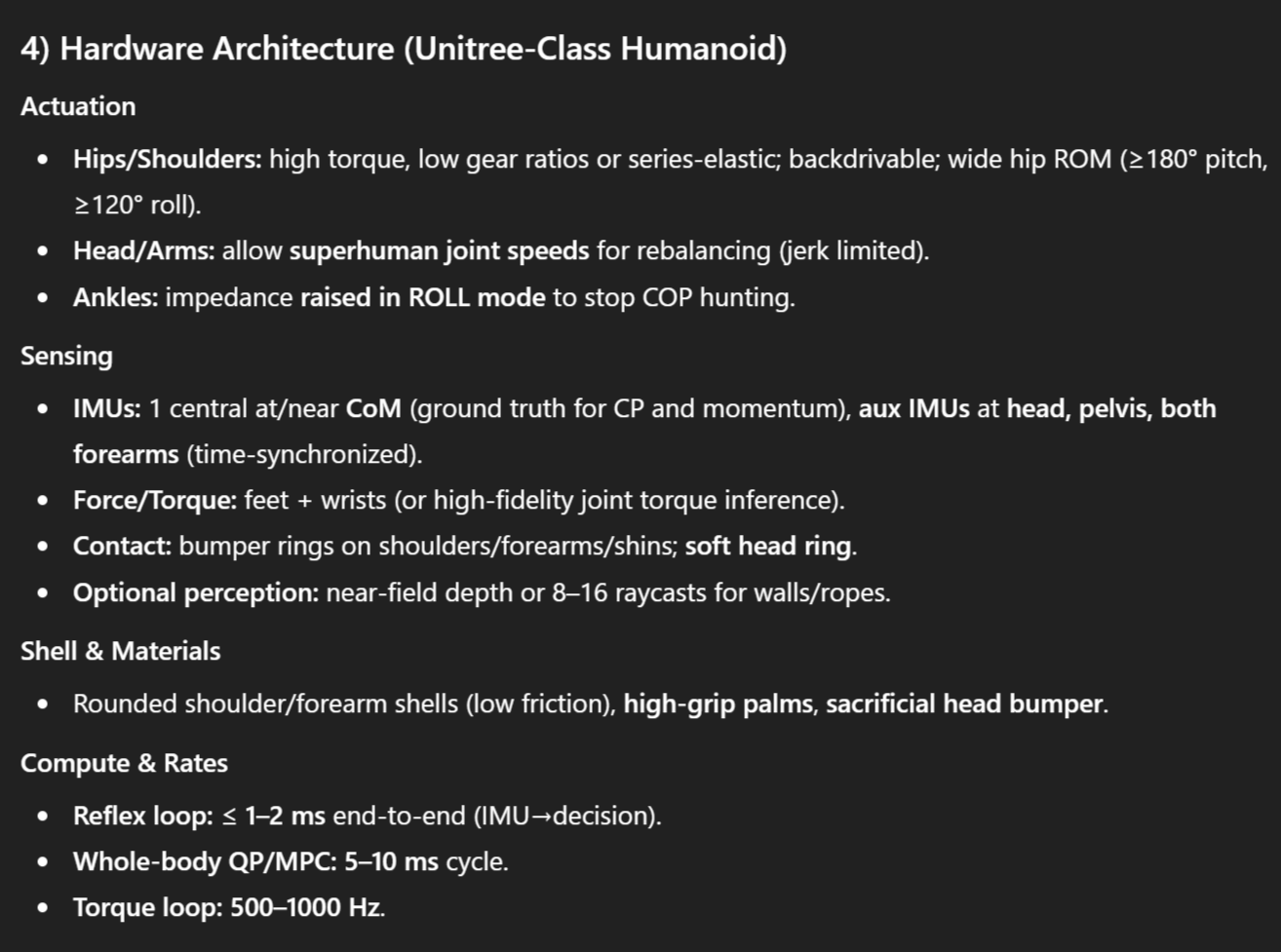
KG-LLM-SEED: HUMANOID_ROLL_RECOVERY_SYSTEM
VERSION: 1.0
AUTHOR: Cameron T.

META:
  overview: |
    This seed describes the complete conceptual, physical, algorithmic, and
    training architecture required to produce a humanoid robot that does NOT
    stammer-step when falling, but instead performs controlled, judo-inspired
    roll-recovery from ANY angle with rapid re-uprighting into a stable,
    fighter-like stance. The system integrates biomechanical insights, IMU
    configuration, torque-controlled actuation, mode-switch logic, RL reward
    structuring, simulation curriculum, hardware affordances, and sensing
    distribution. It unifies everything into one coherent KG suitable for
    future LLM reasoning.

---------------------------------------------------------------------
1. PHYSICS PRINCIPLES
---------------------------------------------------------------------
  falling_dynamics:
    - Bipedal robots eventually exceed the viability boundary during disturbances.
    - Capture point (CP) = dynamic measure of whether stepping can save balance.
    - When CP leaves support polygon by threshold δ, stepping is no longer viable.
    - Judo-style ukemi rolling dissipates angular momentum safely across a long arc.
    - Controlled roll reduces peak decelerations at head/torso and protects hardware.

  angular_momentum_management:
    - Critical for redirecting fall trajectory.
    - Roll sequences naturally convert undesirable rotation into safer axes.
    - Momentum shaping via hips/shoulders is more effective than ankle-based recovery.

  contact_arcs:
    - Safe contact order: forearm → shoulder → back/hip → feet/hands.
    - Dangerous: head-first, knee-first, or uncontrolled slamming.

  inevitability_argument:
    - As humanoids operate dynamically, roll recovery becomes necessary for safety,
      reliability, uptime, and hardware preservation.
    - Minimizing time-down ensures mission continuity.
    - Stammer-stepping becomes a suboptimal evolutionary pathway once roll is learned.


---------------------------------------------------------------------
2. HARDWARE ARCHITECTURE
---------------------------------------------------------------------
  actuators:
    hips:
      - High torque & wide mobility (≥180° combined pitch, ≥120° roll).
      - Backdrivable or series-elastic to absorb impact.
    shoulders:
      - High power for bracing + roll initiation.
    ankles:
      - Impedance increases during ROLL_MODE to prevent tapping.

  joint_speed_requirements:
    - Superhuman angular velocities allowed at head/arms during fall.
    - Jerks limited; high-rate control required (0.5–2 ms reflex).

  sensors:
    imu_array:
      central_imu:
        - At CoM; ground truth for angular momentum & CP estimation.
      auxiliary_imus:
        - In head, pelvis, both forearms.
        - Gives orientation-rate redundancy; captures distributed rotation vectors.
    f_t_sensors:
      - In feet + wrists (or joint torque inference).
    contact_sensors:
      - Shoulder/forearm bumper rings; shins; soft head ring.
    environment_affordances:
      - Short-range depth/raycast ring (optional) for ropes/walls.

  shell_design:
    - Rounded shoulders & forearms for smooth roll arcs.
    - Grippy palms for tripod/knee-hand pop-up.
    - Head protector ring preventing camera damage on roll.

  compute:
    - Reflex loop: sub-millisecond.
    - Whole-body MPC/QP: 5–10 ms.
    - Torque loop: 1 kHz preferred.


---------------------------------------------------------------------
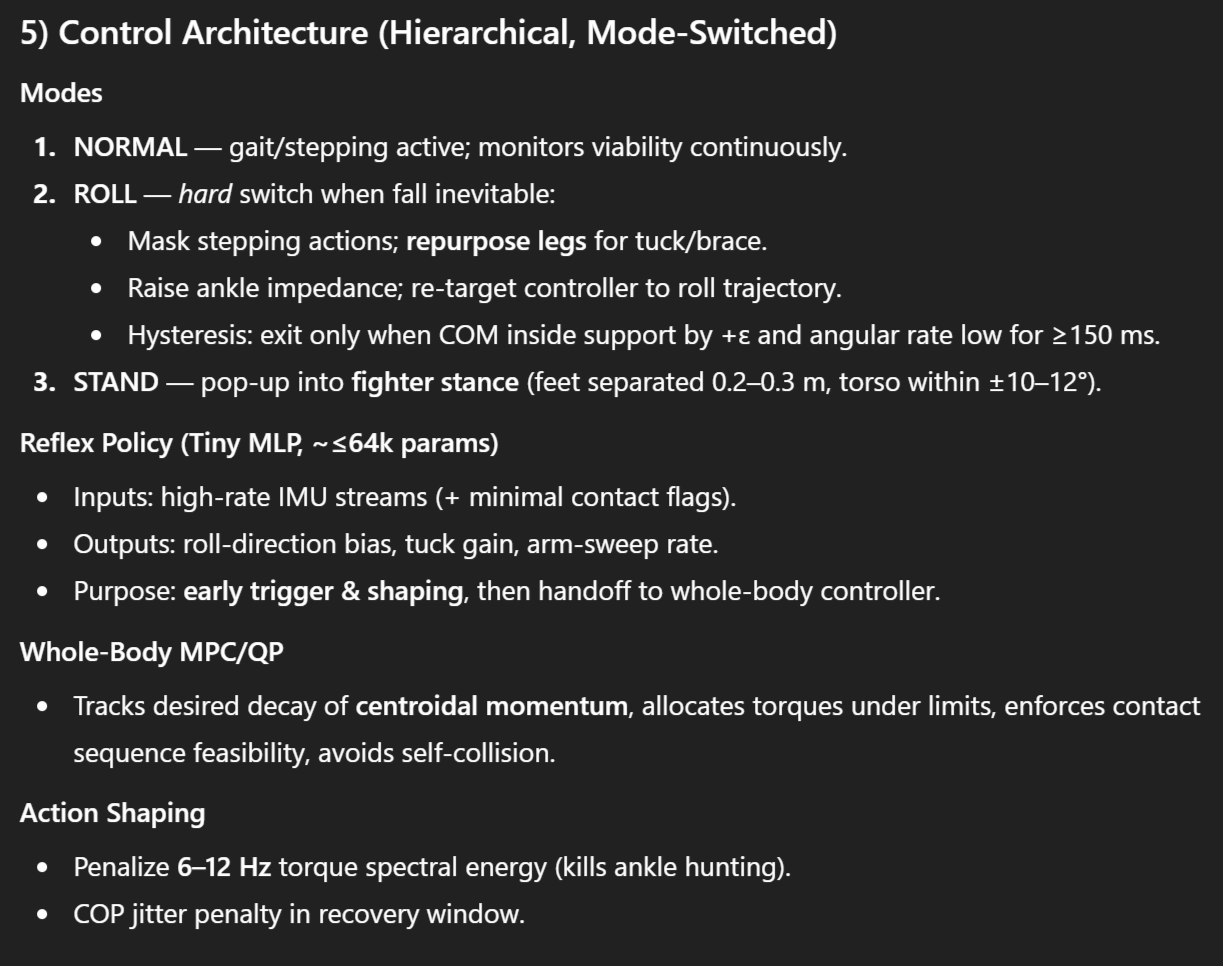
3. CONTROL ARCHITECTURE (HIERARCHICAL)
---------------------------------------------------------------------
  modes:
    NORMAL_MODE:
      - Full stepping controller active.
      - Viability monitored every cycle.

    ROLL_MODE (triggered when fall inevitable):
      trigger_conditions:
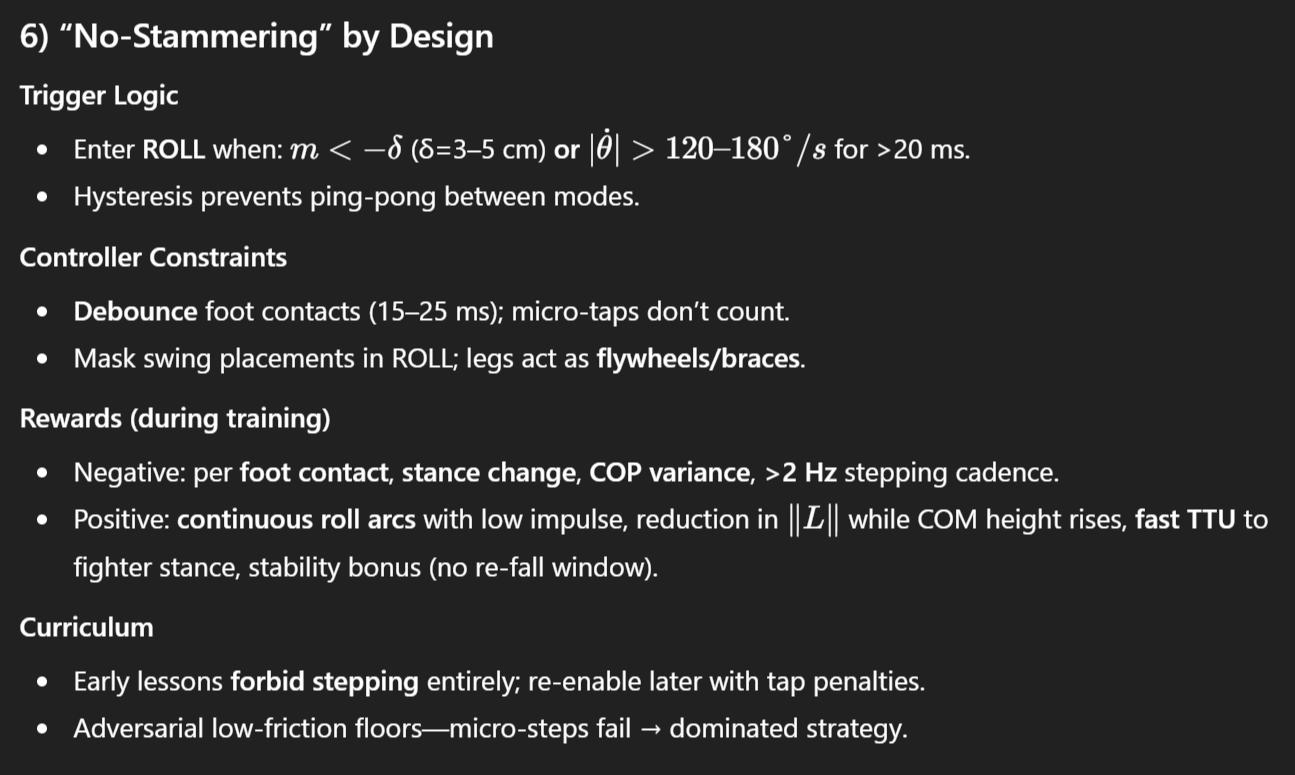
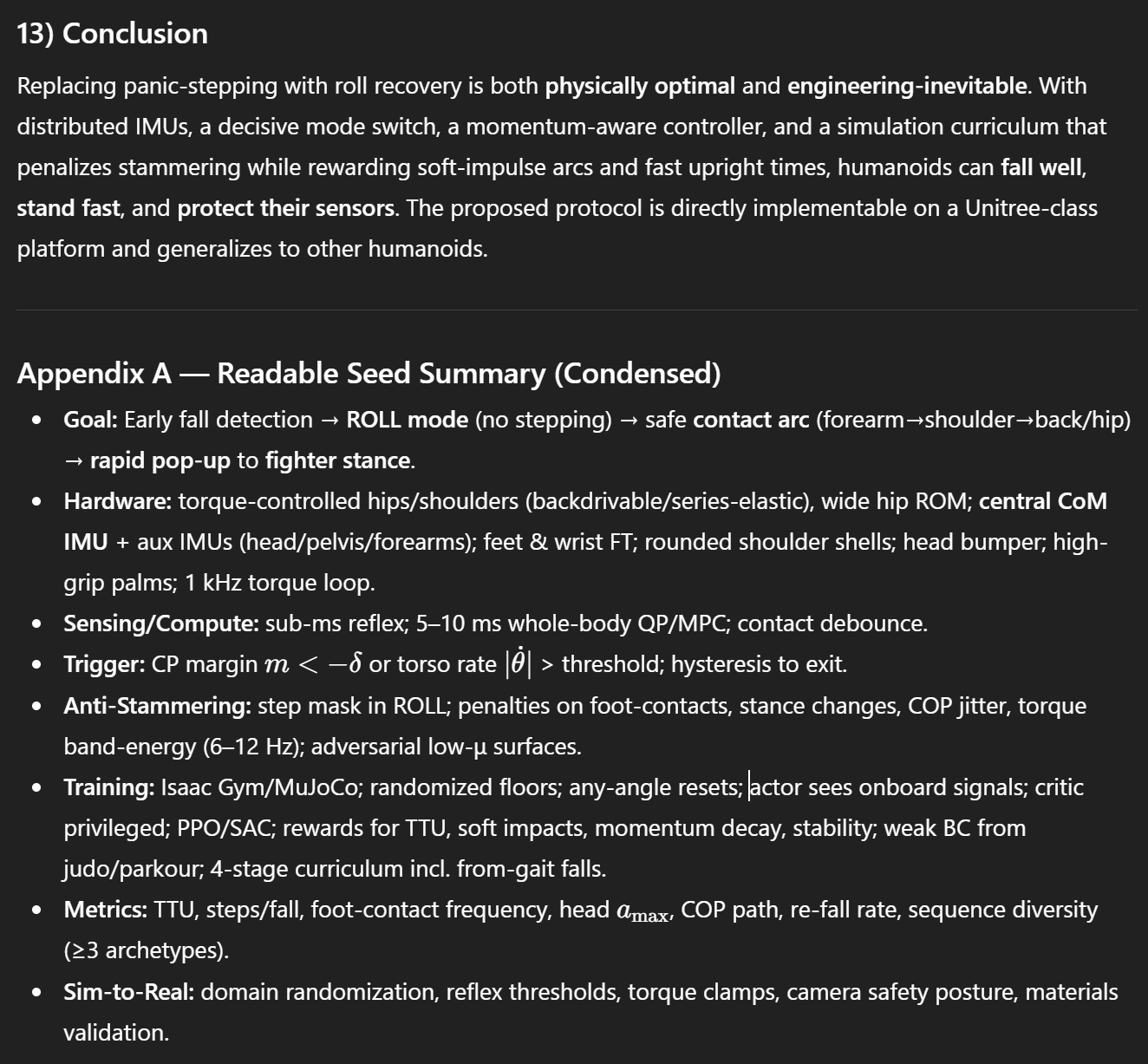
        - CP margin m < -δ (e.g., δ = 3–5 cm).
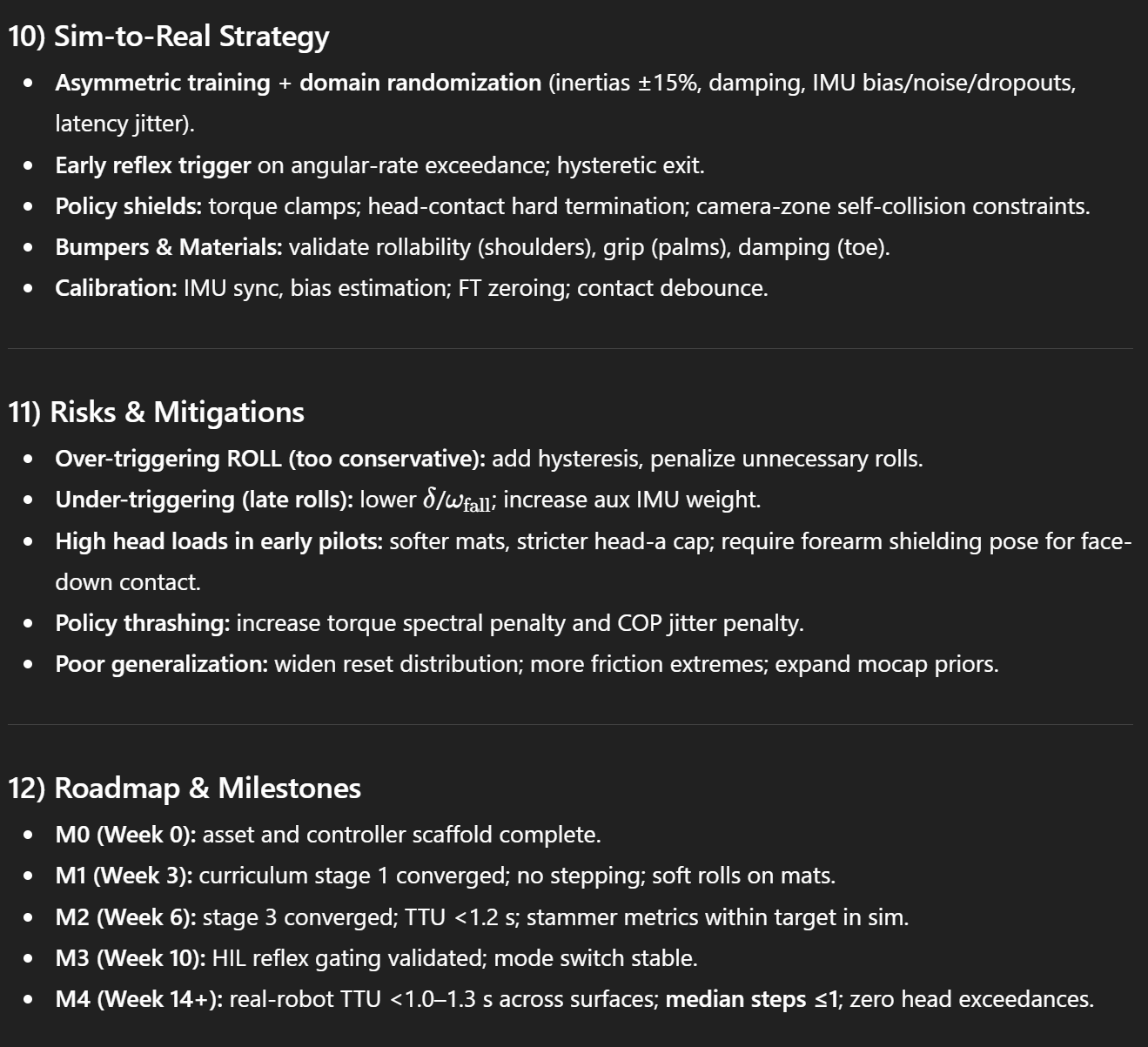
        - OR torso pitch-rate |θ_dot| > ω_fall (120–180°/s) for >20 ms.
      effects:
        - Disable stepping/foot placement controllers.
        - Mask leg DOFs to tuck/brace primitives.
        - Increase ankle impedance (remove micro-step).
        - Enable roll-oriented torque shaping.

    STAND_MODE (post roll, fighter stance acquisition):
      - Requirements: torso stabilized, COM inside polygon by +ε,
        angular velocity below threshold for 150 ms.
      - Stand into wide lateral stance (0.2–0.3 m feet separation).

  reflex_policy:
    - Tiny MLP (~64k params).
    - Uses IMU-only high-rate data.
    - Outputs roll-direction bias + tucking intensity.
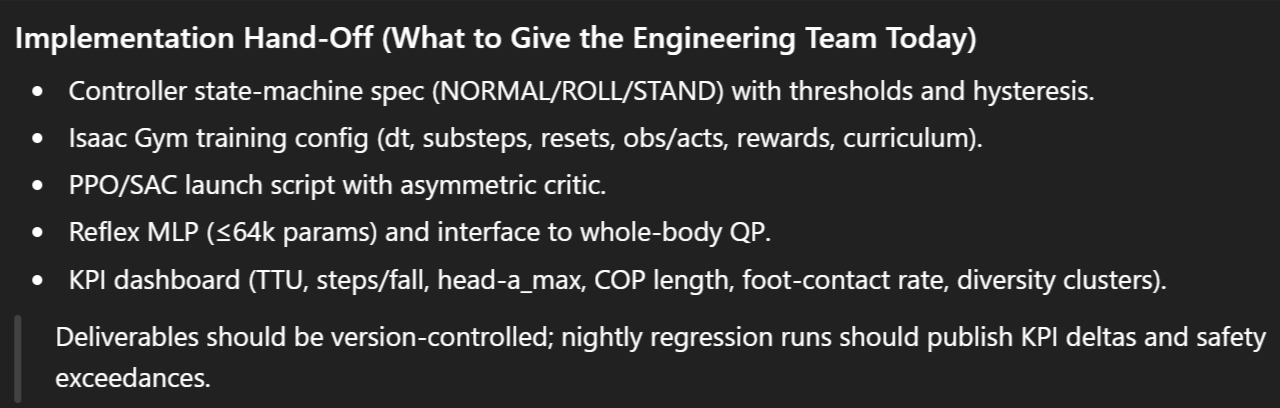
    - Hands off to whole-body QP.

  whole_body_mpc_qp:
    - Tracks centroidal momentum decay.
    - Allocates torques for shaping roll trajectory.
    - Predicts safe contact sequences.
    - Maintains joint limits & avoids self-collisions.

  torque_shaping:
    - Penalizes spectral energy in 6–12 Hz range.
    - Prevents foot jitter & stammer-stepping.


---------------------------------------------------------------------
4. ANTI-STAMMERING MECHANISMS
---------------------------------------------------------------------
  reward_policies:
    - Penalty per foot-ground contact event (c_contact).
    - Penalty for stance changes.
    - Penalty for COP jitter > threshold.
    - Penalty for step cadence > 2 Hz.
    - High penalty for micro-taps.

  control_masks:
    - In ROLL_MODE, step actions physically disallowed.
    - Leg DOFs repurposed for tucking & bracing.

  environmental_curriculum:
    - Low-friction floors where stepping is non-viable.
    - Ensures tapping becomes a dominated behavior.

  torque_spectral_regularization:
    - Discourages high-frequency oscillatory control patterns typical of panic-stepping.


---------------------------------------------------------------------
5. EMERGENT RECOVERY BEHAVIORS (DESIRED)
---------------------------------------------------------------------
  forward_shoulder_roll:
    - Arm sweep → tuck → diagonal roll → hip whip → fighter stance.

  back_roll:
    - Chin tuck → forearm + upper back contact → redirect → tripod rise.

  side_roll:
    - Shoulder sweep → long sliding arc.

  tripod_pop:
    - Bracing with one arm + both feet → explosive hip extension → immediate stance.

  kip_up (optional):
    - Requires high shoulder/hip power; emerges naturally if allowed.

  stance_goal:
    - Fighter stance: wide lateral base, small torso pitch/roll, stable COM.


---------------------------------------------------------------------
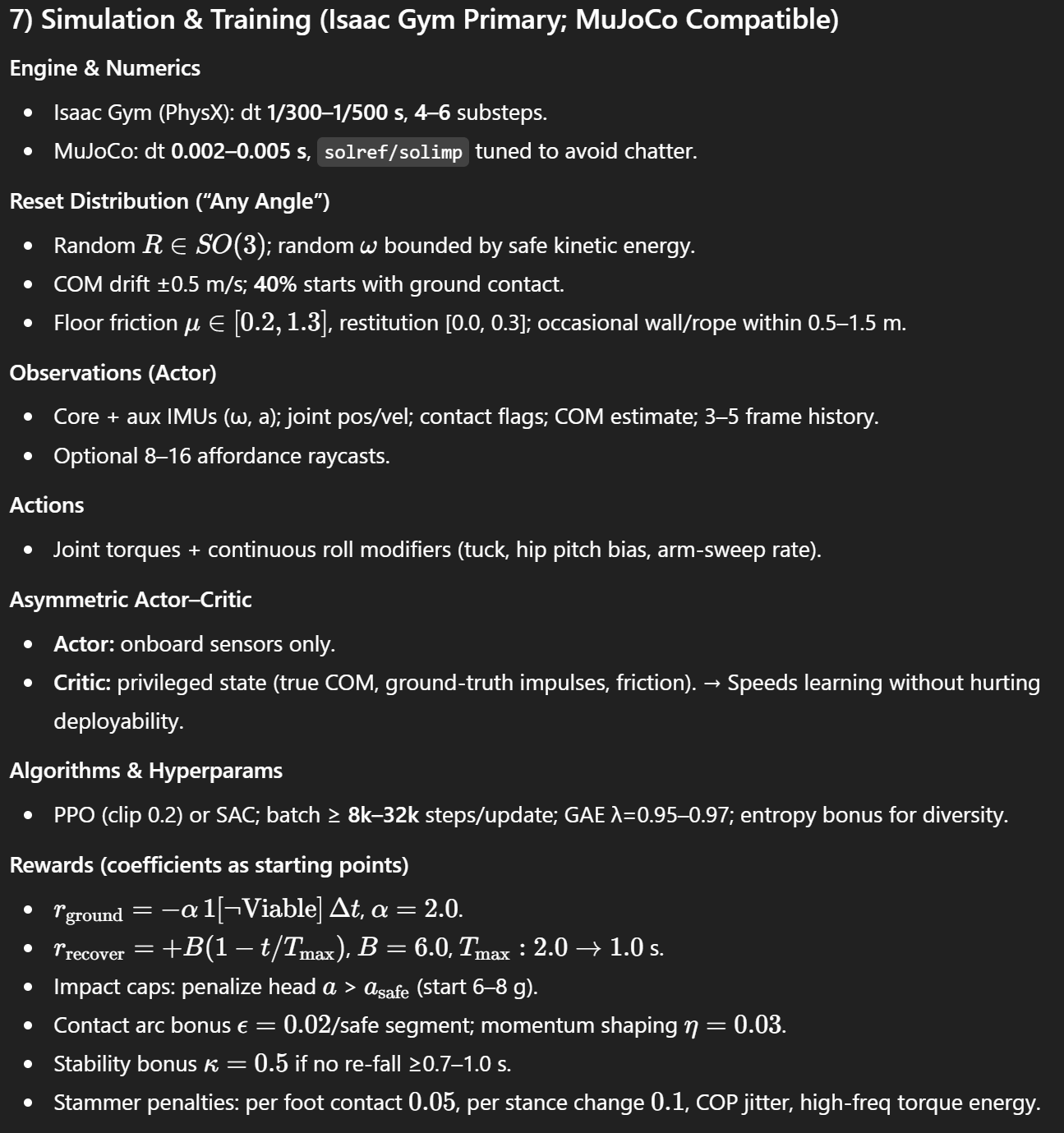
6. SIMULATION & TRAINING SETUP
---------------------------------------------------------------------
  engine:
    - MuJoCo or Isaac Gym (PhysX with smaller dt & more substeps).

  timestep:
    - 0.002–0.005 s; action repeat 2–4 frames.

  reset_distribution:
    - Random full-orientation R ∈ SO(3).
    - Random angular velocity.
    - Random COM drift.
    - 40% starts with ground contact.
    - Varied friction μ ∈ [0.2, 1.3].
    - Occasional walls/ropes spawned.

  observations:
    - IMUs (ω,a).
    - Joint pos/vel.
    - Contact flags.
    - COM estimate.
    - Short history stack (3–5 frames).
    - Optional raycast ring.

  actions:
    - Joint torques + roll-modifiers (continuous scalars).

  asymmetric_training:
    actor:
      - onboard sensors only.
    critic:
      - privileged info: true COM, ground-truth contact impulses, friction.

  algorithms:
    - PPO or SAC with large batches.
    - GAE λ=0.95–0.97.
    - Entropy regularization for diversity.

  reward_terms:
    minimize_time_down:
      - r_ground = -α * I[not standing] * dt  (α ~ 1.0–3.0)
    fast_recovery_bonus:
      - r_recover = +B(1 - t/T_max)  (B~3–8, T_max from 2→1 s)
    impact_safety:
      - penalize head a exceeding safe threshold.
    contact_quality:
      - bonus for continuous safe arc; penalty for head/knees-first.
    momentum_shaping:
      - reward decrease in |L| while COM rises.
    stability:
      - small bonus for no re-fall for 0.5–1.0 s.
    stammer_punish:
      - penalty per foot contact, stance change, COP jitter, >2 Hz stepping.
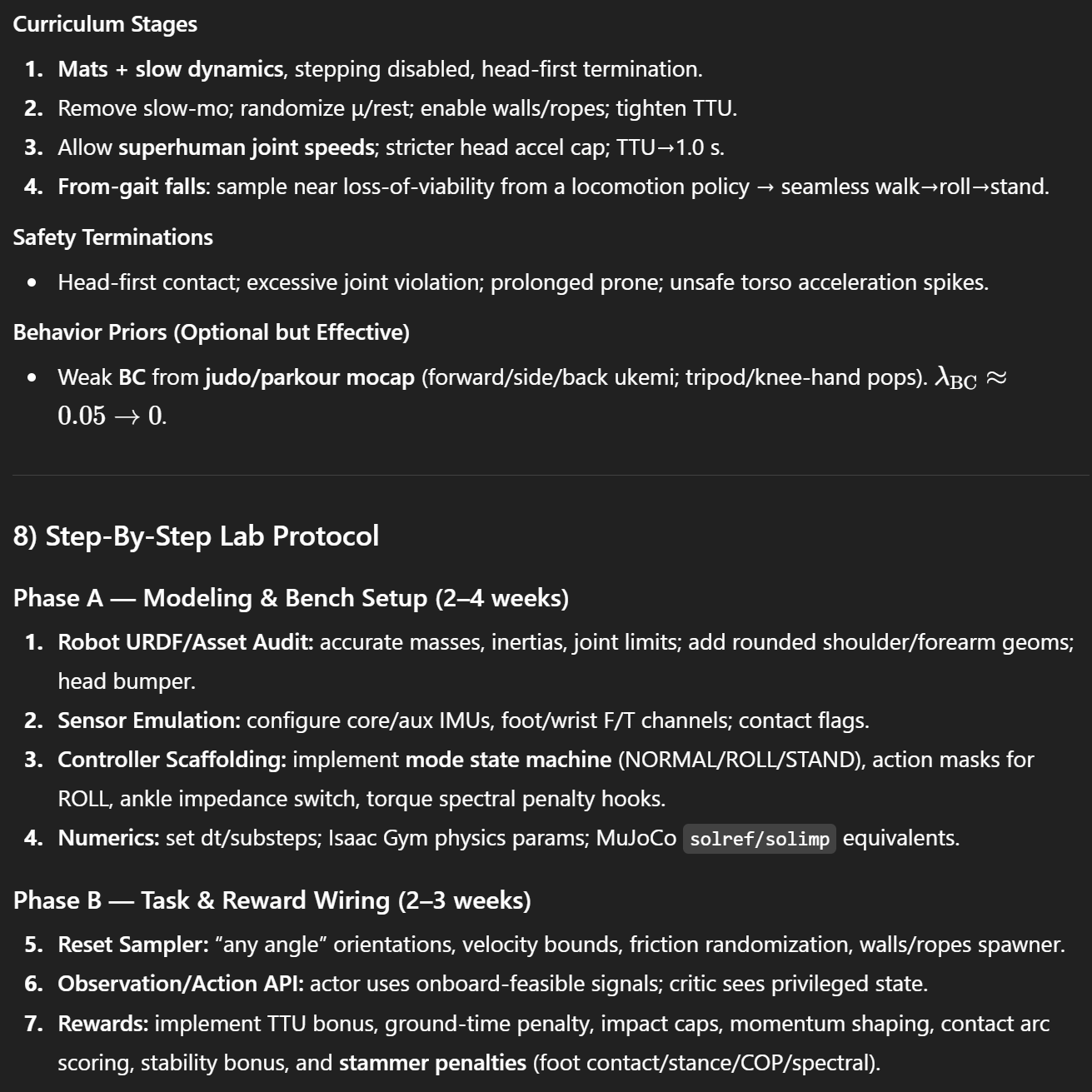
    diversity:
      - entropy + small BC prior from judo/parkour mocap.

  curriculum_stages:
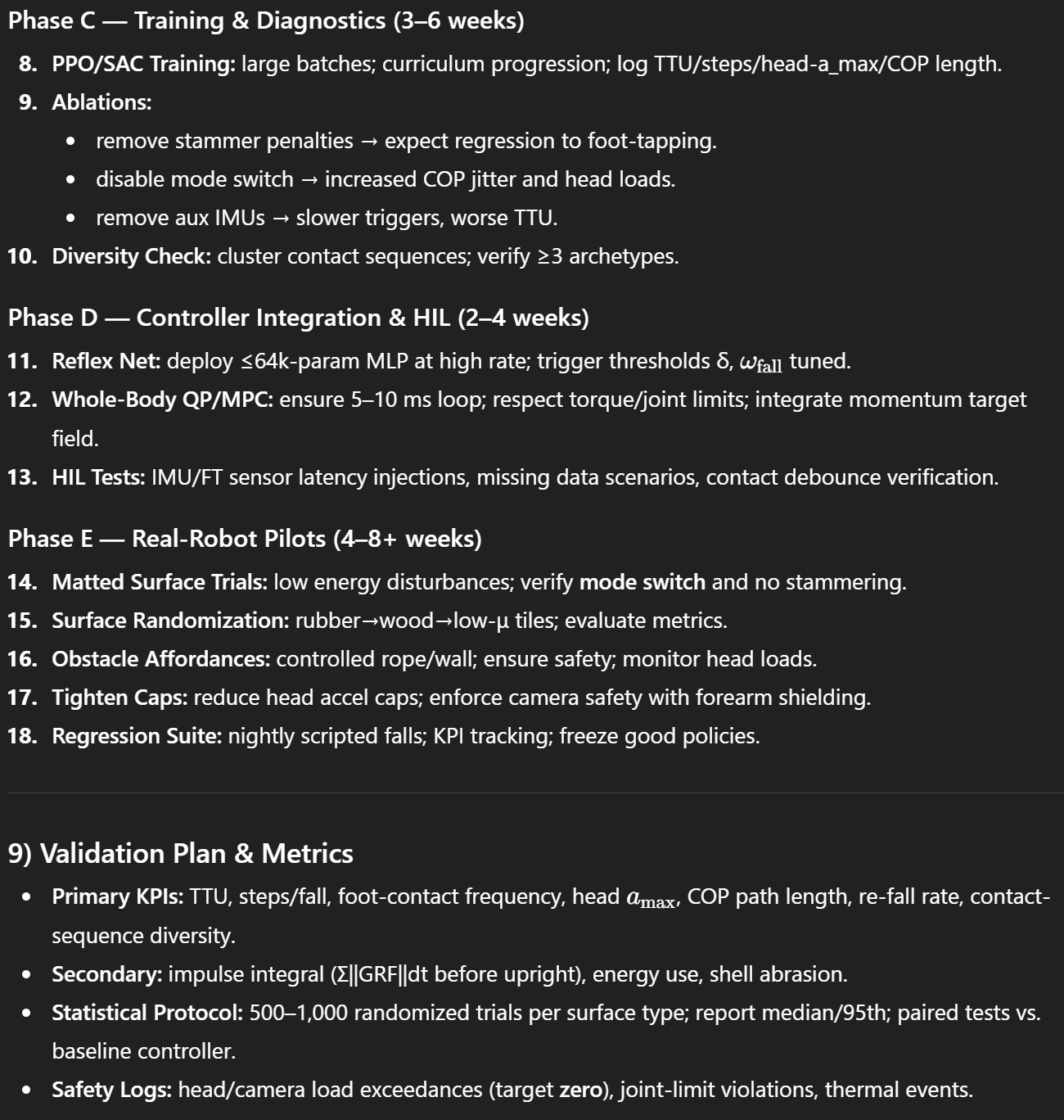
    1) Mats, slow dynamics, no stepping.
    2) Remove slow-mo, add randomness, allow walls/ropes.
    3) Enable superhuman joint speeds, tighten head-accel caps.
    4) From-gait fall transitions (sampled from locomotion rollouts).

  safety_termination:
    - Head-first impact.
    - Excessive joint violation.
    - Prolonged prone.
    - Unsafe torso acceleration spikes.


---------------------------------------------------------------------
7. METRICS FOR SUCCESS
---------------------------------------------------------------------
  - Steps per fall (median ≤1, 95th ≤2).
  - COP path length minimized.
  - Foot-contact frequency < 1 Hz during recovery.
  - Time-to-upright (TTU) distributions (median <1.0 s).
  - Peak head/torso accelerations reduced.
  - Contact sequence clustering showing ≥3 distinct roll archetypes.
  - No re-fall in stability window.


---------------------------------------------------------------------
8. WHY THIS BEHAVIOR IS INEVITABLE
---------------------------------------------------------------------
  evolutionary_pressure:
    - Dynamic humanoids will increasingly operate in unstructured environments.
    - Stepping-based recovery fails under high angular momentum.
    - Rolling distributes forces, preserves sensors, and minimizes downtime.
    - RL strongly favors strategies that maximize task uptime & safety.

  technology_trajectory:
    - Distributed IMUs, torque control, and 1 kHz loops already industry-standard.
    - Simulation RL (MuJoCo/Isaac) allows millions of fall episodes quickly.
    - Emergent recovery is simpler than emergent locomotion once constraints are set.

  convergence:
    - All factors (hardware, physics, RL rewards, environment) push toward a
      unified behavior: early detection → controlled roll → rapid pop-up →
      stable fighter stance.


---------------------------------------------------------------------
9. SYSTEM SUMMARY
---------------------------------------------------------------------
  the_system_in_one_sentence: |
    Detect instability early using distributed IMUs, immediately switch from
    stepping to roll-mode, shape angular momentum with torque-controlled joints
    along safe contact arcs (forearm→shoulder→back/hip), penalize any foot
    stammering, and use RL in simulation to learn a family of roll-recovery
    strategies that reliably return the humanoid to a wide, stable, fighter
    stance in under one second from virtually any fall angle.