Cycle Log 39
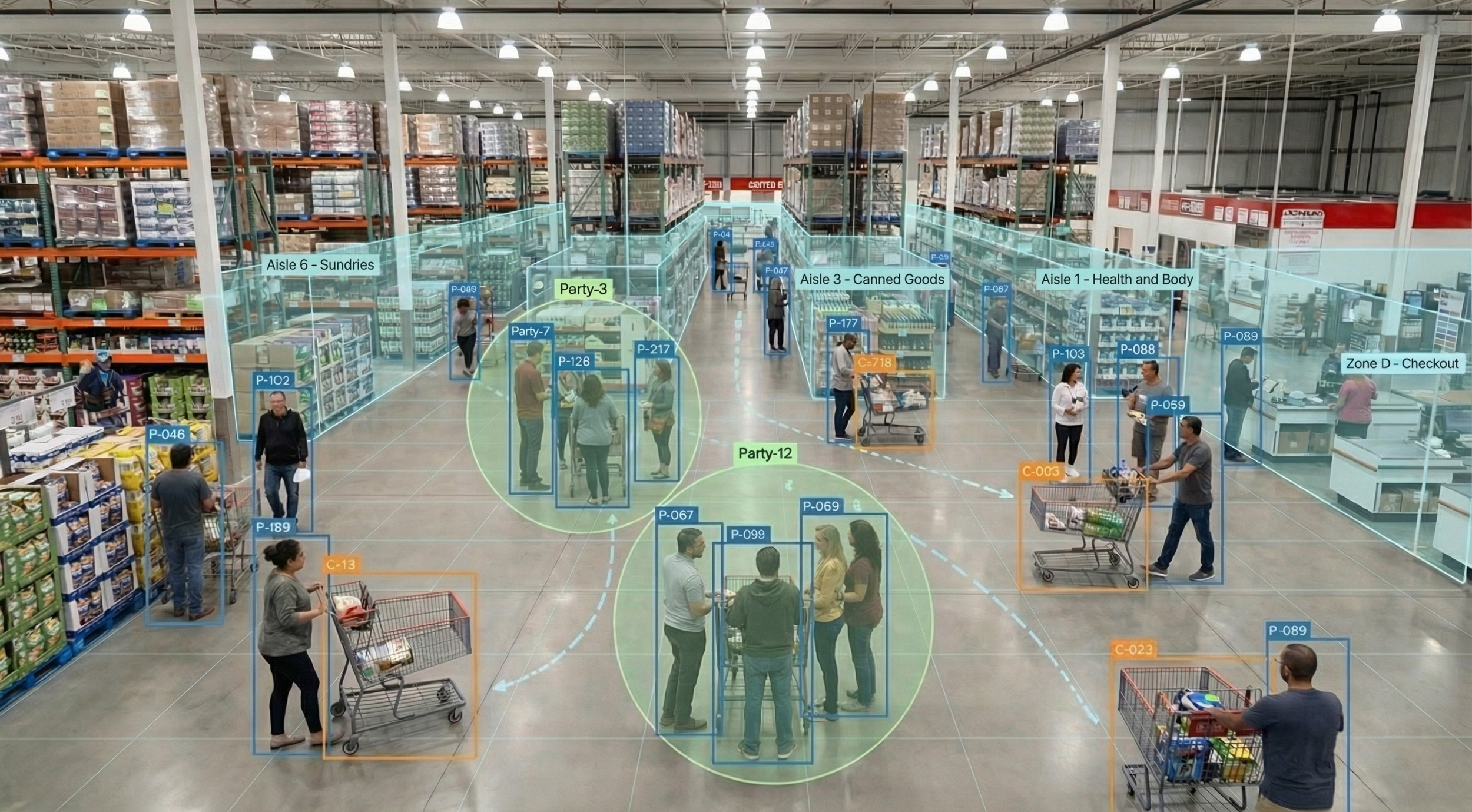
Images created with Gemini 3 Pro/Gemini Thinking, with prompt construction by GPT 5.2
Retail Intelligence in Phases: Track-Every-Body → Autonomous Fulfillment
Authors:
Cameron (Idea Purveyor, Retail Thought Architect)
ChatGPT (GPT-5.2 Thinking Model) (Systems Synthesizer & Spec Writer)
Part I — The Case for a Track-Every-Body System
I. Introduction and Motivation
Retailers operate on razor-thin margins, and inventory losses — often referred to as shrink — represent one of the largest unseen drains on profitability. Shrink encompasses the disappearance of products that never result in a legitimate sale — whether from external theft, internal misplacement, damage, spoilage, or administrative errors. Industry-wide, shrink has remained a significant problem: the National Retail Federation’s latest surveys show that retail shrink accounted for over $112 billion in annual losses, representing roughly 1.6 % of total retail sales in 2022 and rising compared to previous years. National Retail Federation
While large formats such as warehouse clubs have traditionally enjoyed lower shrink rates — estimations suggest a chain like Costco may experience shrink as low as 0.11 – 0.12 % of sales, far below historical averages — losses in the broader industry are substantial and persistent. The Maine Criminal Defense Group In grocery retail specifically, shrink often reaches 2½ – 3 % of total revenue, with perishable departments like produce and dairy disproportionately affected due to spoilage and unrecorded losses. Markt POS These levels imply millions of dollars lost annually for a single large store, even before we consider the broader economic escalation of theft incidents in recent years.
Compounding the problem, organized retail crime and opportunistic shoplifting are increasing, with stores reporting large year-over-year growth in incidents and dollar losses. As per another article by the National Retail Federation, under these conditions, traditional loss prevention — security guards, cameras at exits, or random manual inventory counts — struggles to keep pace. What’s needed is not simply another sensor but a comprehensive system that sees the store holistically and continuously in both space and time.
II. Conceptual Overview of the Track-Every-Body System
The Track-Every-Body (TEB) system is proposed as a store-wide, camera-based, real-time tracking and continuity framework that binds together people, parties, carts, items, workers, pallets, and inventory movement into a persistent operational model. It is designed to replace periodic audits, reduce loss, enhance checkout efficiency, and create a live digital twin of what is happening throughout the retail environment.
At its core, TEB unifies two fundamental capabilities:
Continuity-based observation: Instead of treating each camera frame independently, TEB builds persistent identities and histories for every tracked entity, dramatically reducing ambiguity and misattribution across occlusions and movement.
Semantic event tracking: By recognizing and timestamping discrete interactions (e.g., picking an item from a shelf, placing an item into a cart, worker restocking), TEB constructs an accurate event ledger that reflects true store dynamics.
Together, these allow the store to know who took what and where, not just at the point of sale, but across the entire shopping process.
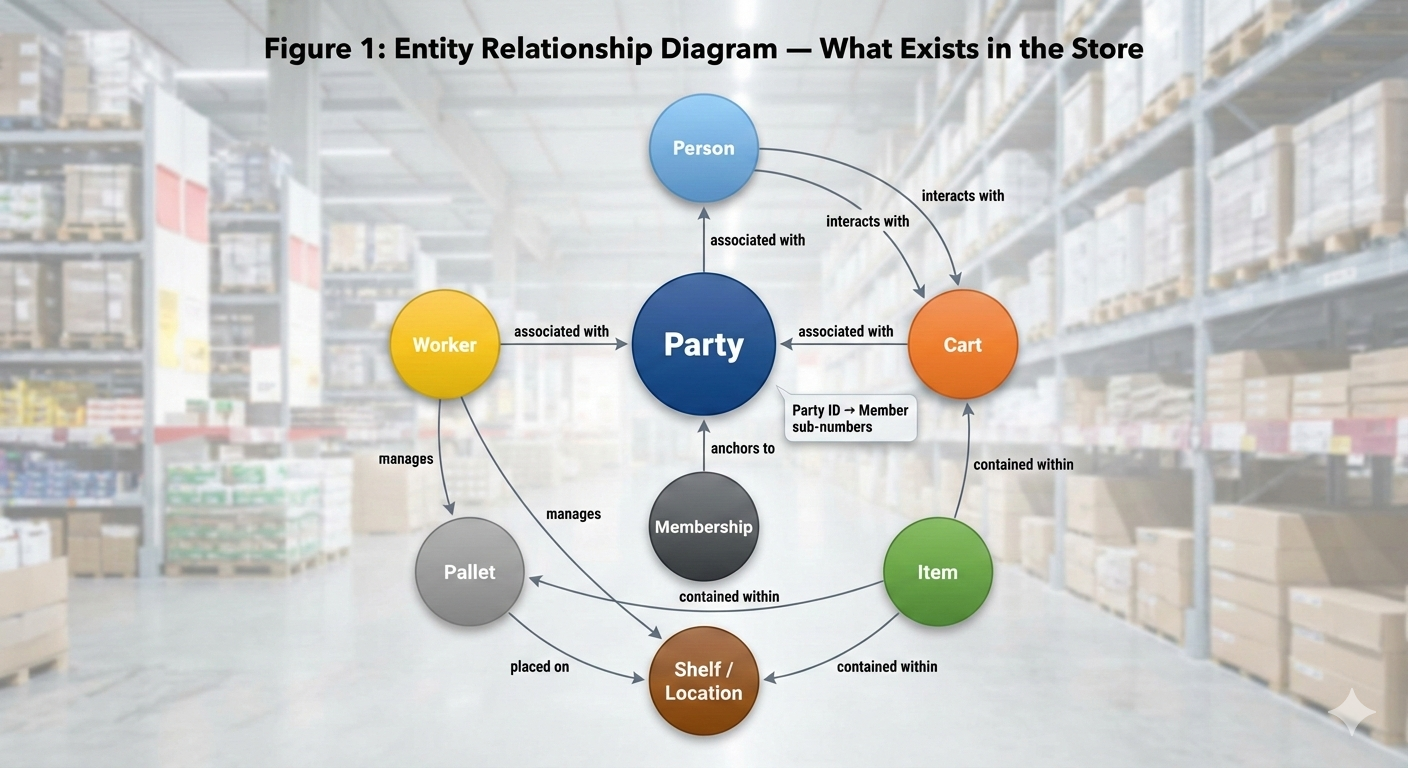
Figure 1: Core entities tracked by the Track-Every-Body (TEB) system and their persistent relationships inside the store.
III. Party Inference and Shopper Behavior
A key insight behind TEB is that shopping is not always a solo activity. Retailers typically judge shrink and theft on a per-customer basis, but real behavior involves groups (families, couples, friends) whose members join and separate fluidly over time. TEB introduces a party model that infers groupings using three behavioral cues:
Proximity: Who stays close and moves together.
Speech activity: Conversational patterns and turn-taking.
Body orientation and visual attention: Who looks at whom and signals engagement.
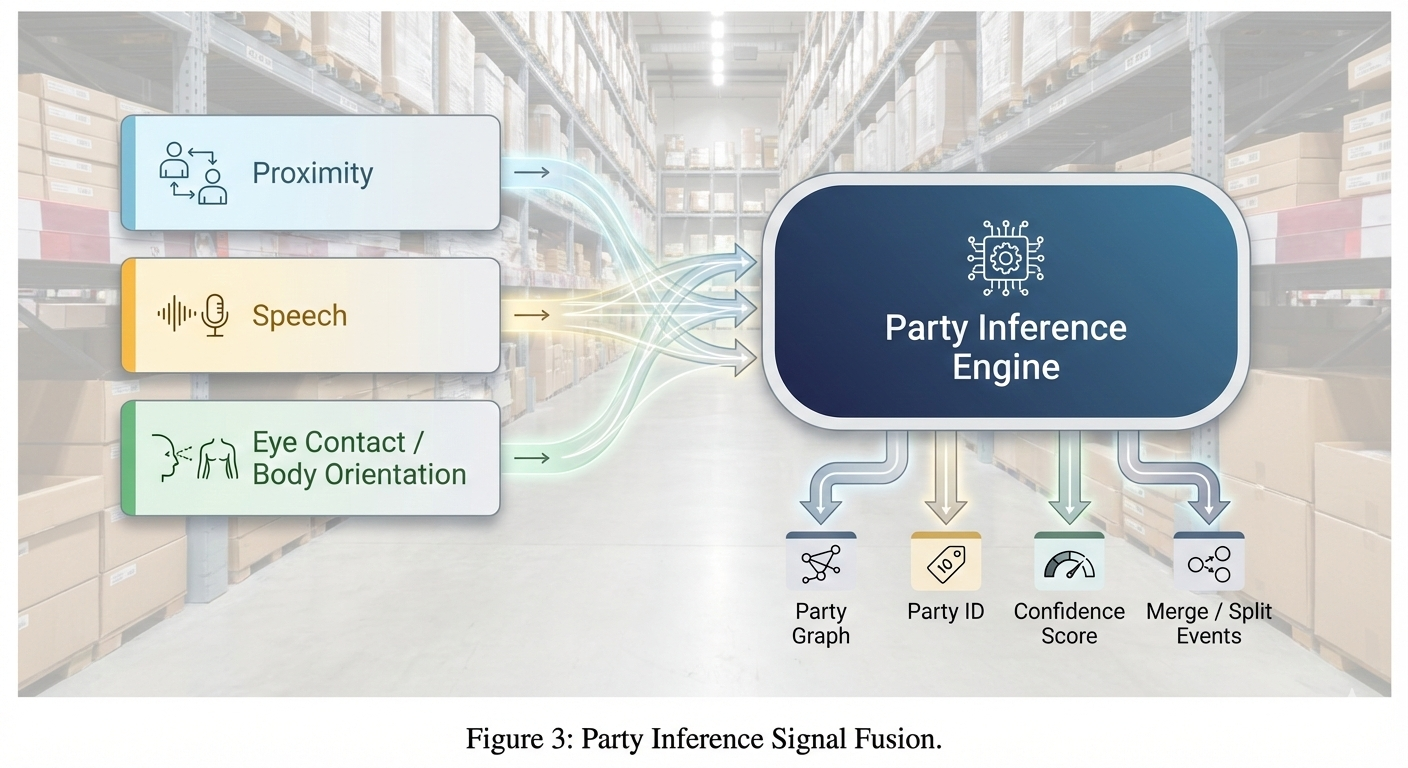
Figure 3: Multi-signal fusion engine combining proximity, speech, and body orientation to infer parties and manage group splits and merges.
By integrating these cues into a probabilistic graph model with edge weights that strengthen or weaken over time,
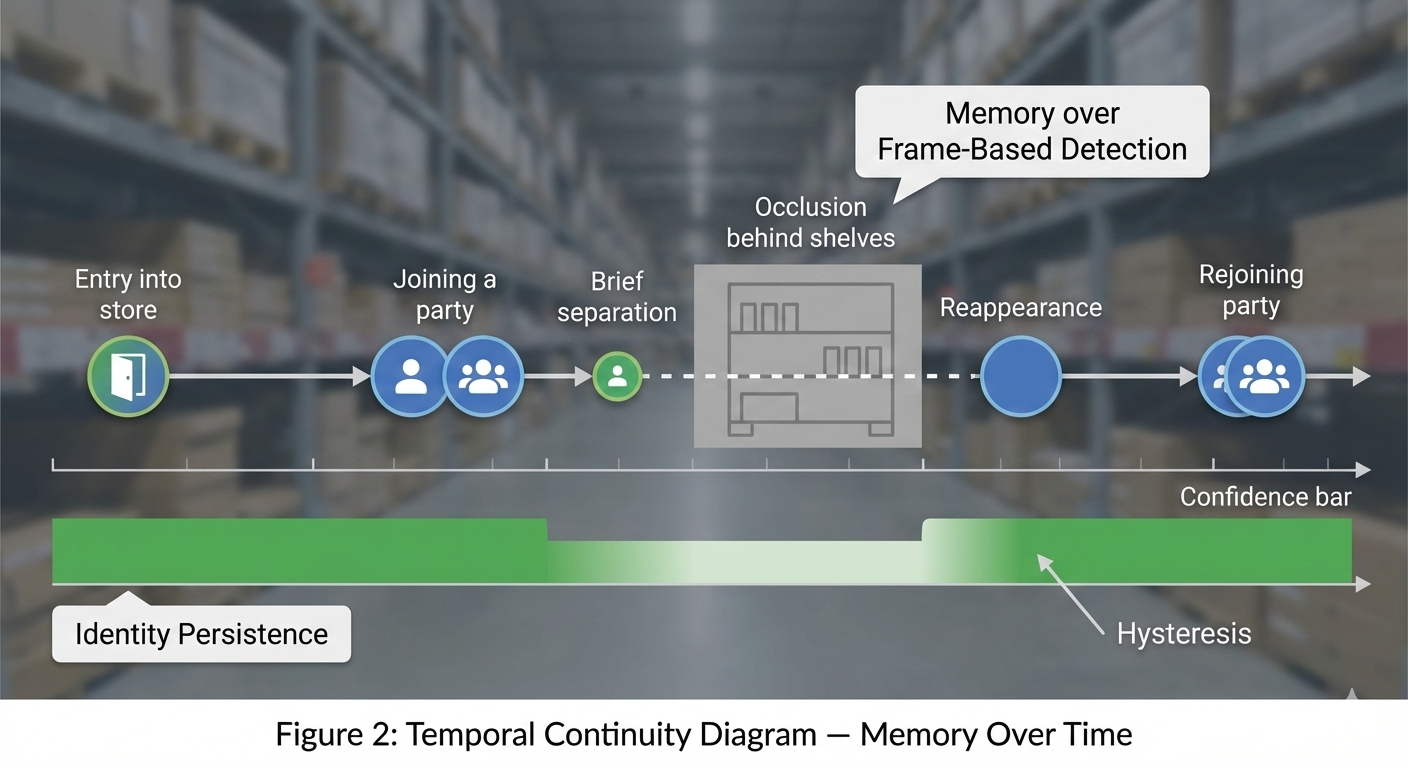
Figure 2: Party and identity continuity maintained over time using memory and hysteresis rather than frame-by-frame detection.
TEB maintains party associations even if individuals separate temporarily or enter the store at different times. This ensures that inventory movements and item interactions are attributed to the correct relationship context, reducing false positives in loss prevention and building a more accurate picture of customer intent.
IV. Cart and Item Interaction Tracking
In conventional retail systems, carts are anonymous objects; items are scanned manually at checkout, leading to gaps in attribution and opportunities for loss. TEB reimagines carts as entity objects whose history is as significant as that of people and items.
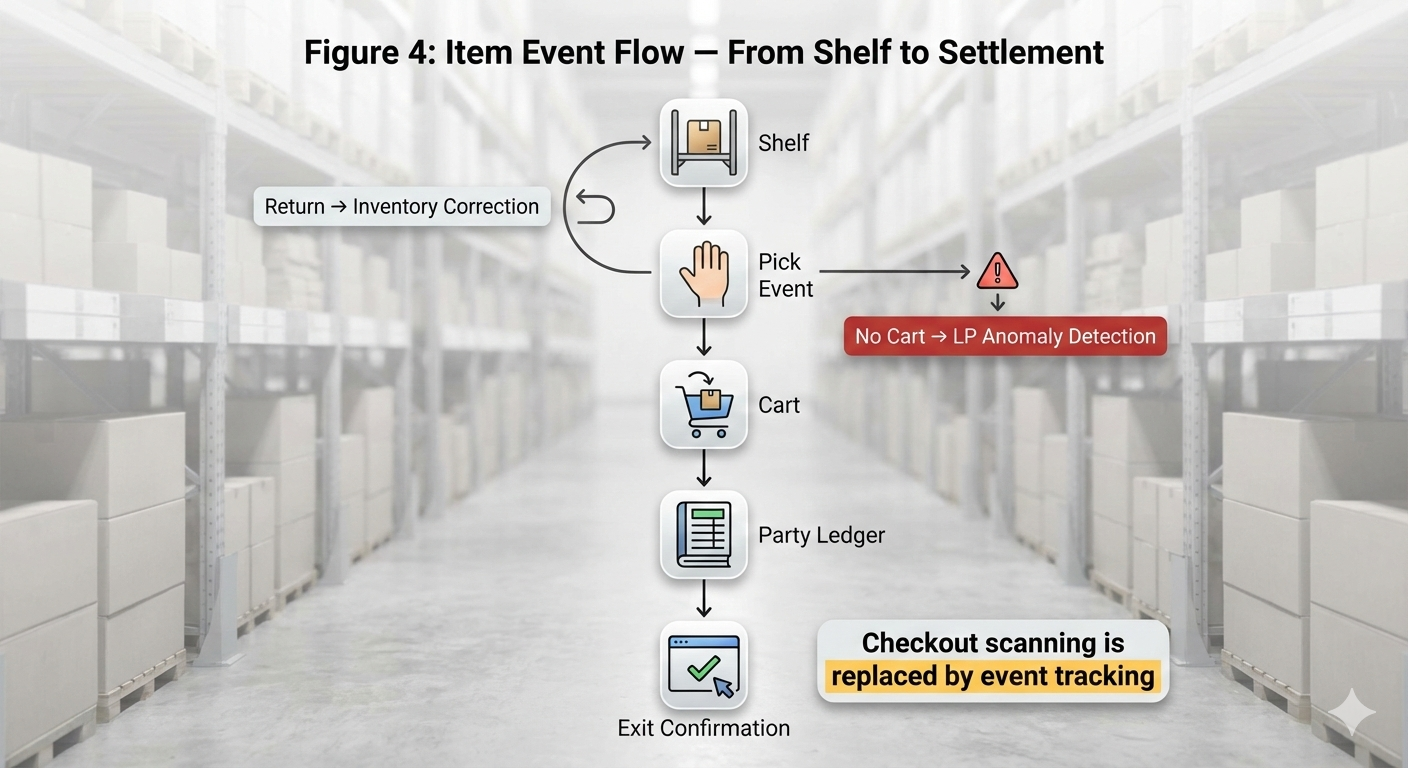
Figure 4: Item movement tracked as discrete events from shelf to exit, replacing traditional checkout scanning with continuous attribution.
TEB treats carts as passive tracked objects that are continuously associated with a person or party via:
Handle contact
Close and sustained proximity
Shared item interaction events (e.g., placing objects into the cart)
This evolving cart-party linkage — maintained via persistent memory — ensures that any item placed into a cart is reliably attributed to the right party, even if someone leaves the immediate vicinity of the cart. By recognizing and logging events such as SHELF_PICK, CART_PLACE, and CART_REMOVE, TEB constructs an audit trail that can be used to present running totals to customers and generate accurate exit totals, eliminating the traditional manual scanning workflow.
V. Membership Anchoring and Payment Flow
Rather than relying on cashiers, TEB uses membership as an anchor point: when a customer scans their membership at entrance, the system creates a party anchor to which item activity can be attributed. This approach preserves customer autonomy and avoids introducing potentially unsafe or intrusive payment hardware into public areas.
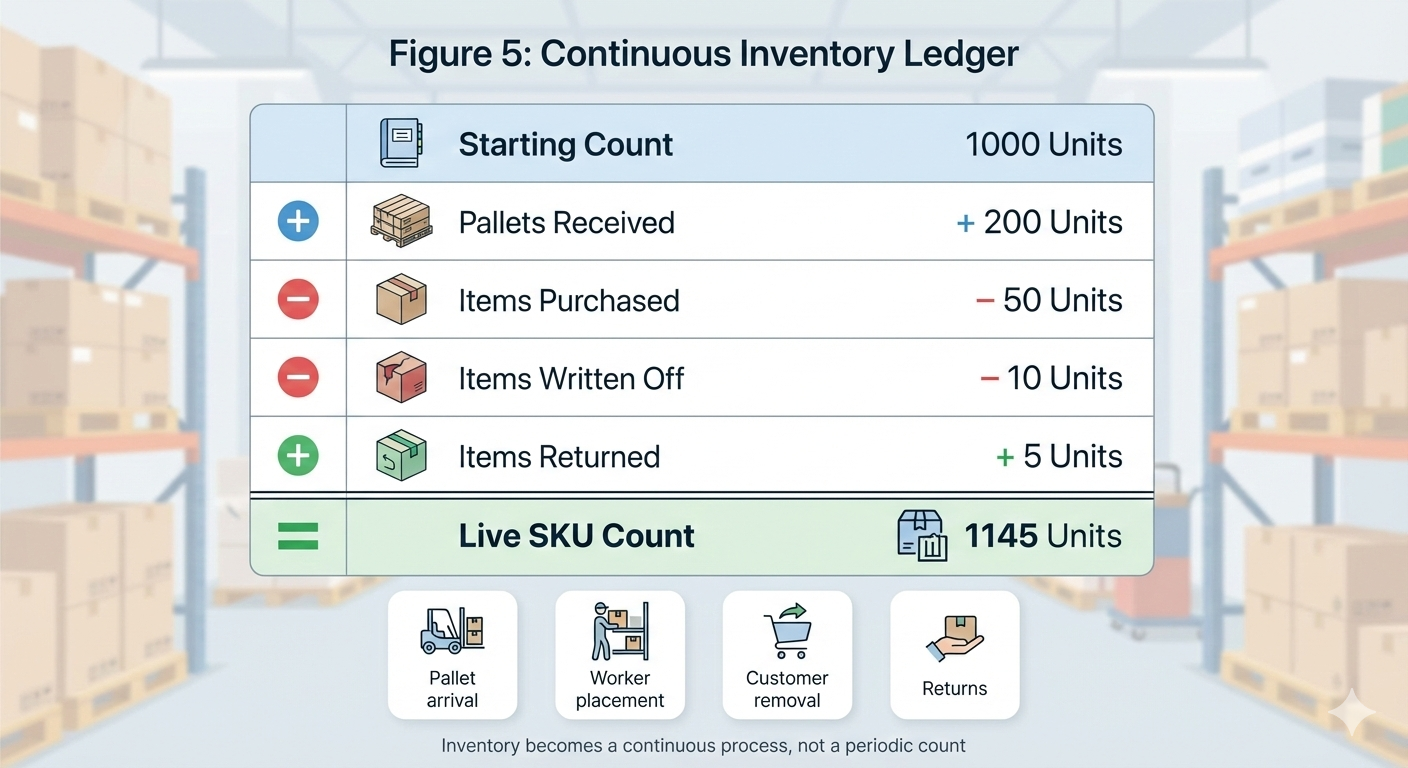
Figure 5: Inventory maintained as a live ledger updated by pallet arrivals, worker actions, purchases, and returns.
At the end of the shopping session, a brief confirmation step — either in an app or on a display — allows the charges to be finalized against the customer’s card-type payment method that would be added (by the user) onto the app. Cash and check exceptions are handled by dedicated staff lanes, so the bulk of customers benefit from a streamlined, electronic checkout without being forced into high-risk hardware interfaces.
VI. Continuous Inventory via Worker Observation
One of the most labor-intensive aspects of retail operations today is inventory counting — periodic, manual reviews that frequently disrupt store activity and nonetheless result in inaccuracies. In contrast, TEB turns workers into implicit sensors. Every movement a restocking associate makes — taking cases off pallets, shelving items, relocating stock — is visually observed and logged.
The system combines this with known pallet counts (which arrive with SKU and unit metadata) to continuously maintain SKU tallies and accurate location assignments. As a result, inventory becomes a live data stream, not a periodic snapshot, eliminating inventory counting days and enabling precise replenishment planning.
VII. Loss Prevention and Internal Trust Modeling
With party inference, persistent cart linkage, and item event logging, TEB creates an unprecedented evidential basis for loss prevention. Instead of guessing intention from obfuscated camera angles or exit alarms, loss prevention teams can receive evidence packets containing:
Detailed timelines of events
Associated parties and member anchors
Video snippets synchronized to suspicious actions
Confidence scores
These evidence packets support human review and adjudication rather than automated punitive action — reducing false positives and improving the overall experience for legitimate customers.
Over time, TEB also builds internal trust scores for memberships based on historical patterns, discrepancy rates, and dispute resolution histories. This score is internal and opaque, used only to modulate audit frequency and exit friction, not as a public credit metric, preserving fairness and governance.
Part II — The Evolution to Autonomous Fulfillment
I. From Tracking to Automation: A Natural Progression
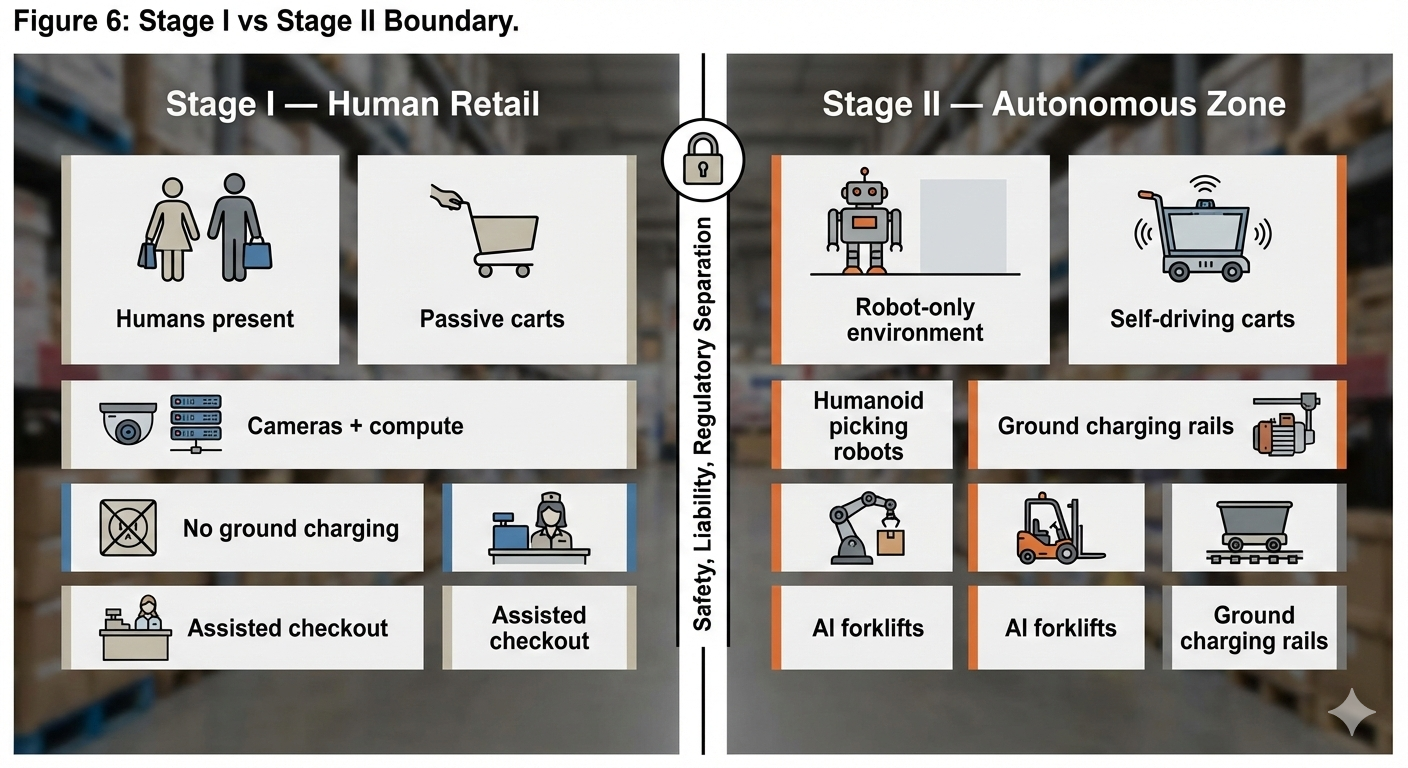
Figure 6: Clear separation between Stage I human retail and Stage II autonomous fulfillment for safety, liability, and regulatory control.
Once a store has achieved robust continuity tracking — understanding where every person, party, cart, item, and pallet is at all times — the natural evolution is to shift from observing to acting. Stage II builds upon the foundation established in TEB, extending the store ecosystem into a space where autonomous agents (robots) perform the physical tasks of picking and fulfillment in zones not shared with human shoppers.
II. Autonomous Fulfillment Zones and Safety Boundaries
In Stage II, the traditional retail floor is converted — either physically or logically — into a robot-only fulfillment zone. This controlled environment allows the introduction of kinetic agents:
Self-driving, self-charging carts
Humanoid picking robots
AI-powered forklifts
Autonomous delivery handlers
To ensure safety and operational clarity, human shoppers are excluded from this zone. Instead, they interact with the store remotely, either through mobile apps or immersive VR shopping interfaces. This separation reduces collision risk and enables higher payload, speed, and complexity in robotic movements.
III. Autonomous Cart Ecosystem
Unlike the passive carts of Stage I, autonomous carts in Stage II navigate the store without manual pushing, routinely docking to ground rail charging stations and routing themselves to task assignments. Because human safety constraints are relaxed in dedicated zones, these carts can use higher-power charging infrastructure and advanced navigation algorithms, enabling efficient start-to-finish fulfillment.
Cart tasks include:
Driving to a picking robot’s station
Receiving items
Routing to staging or delivery handoff points
Returning to charge autonomously
These agents act as mobile fulfillment bins, orchestrated by the same event ledger system that was developed in Stage I.
IV. Humanoid Picking Robots and AI Forklifts
In Stage II, humanoid robots act not as decision makers, but as agents of execution. They receive precise pick lists — derived from TEB’s accurate inventory state — and follow instructions to:
Walk to a shelf coordinate
Select the correct item
Place it into the autonomous cart
Confirm placement via vision/pose checks
Because the cognitive work (what to pick) is done upstream in the inventory and event system, humanoids can be simpler, more reliable, and easily replaceable.
Similarly, AI forklifts become the backbone of bulk stock management: intake, put-away, replenishment staging, and removal of waste or damaged goods. TEB’s live inventory model provides the signals that generate forklift missions without human intervention, improving safety and throughput.
V. Robot-to-Robot Commerce and Settlement
A particularly powerful aspect of Stage II is the shift to robot-to-robot commerce: settlement occurs at the precise moment custody of the product transfers from a picking agent into a delivery agent’s cart.
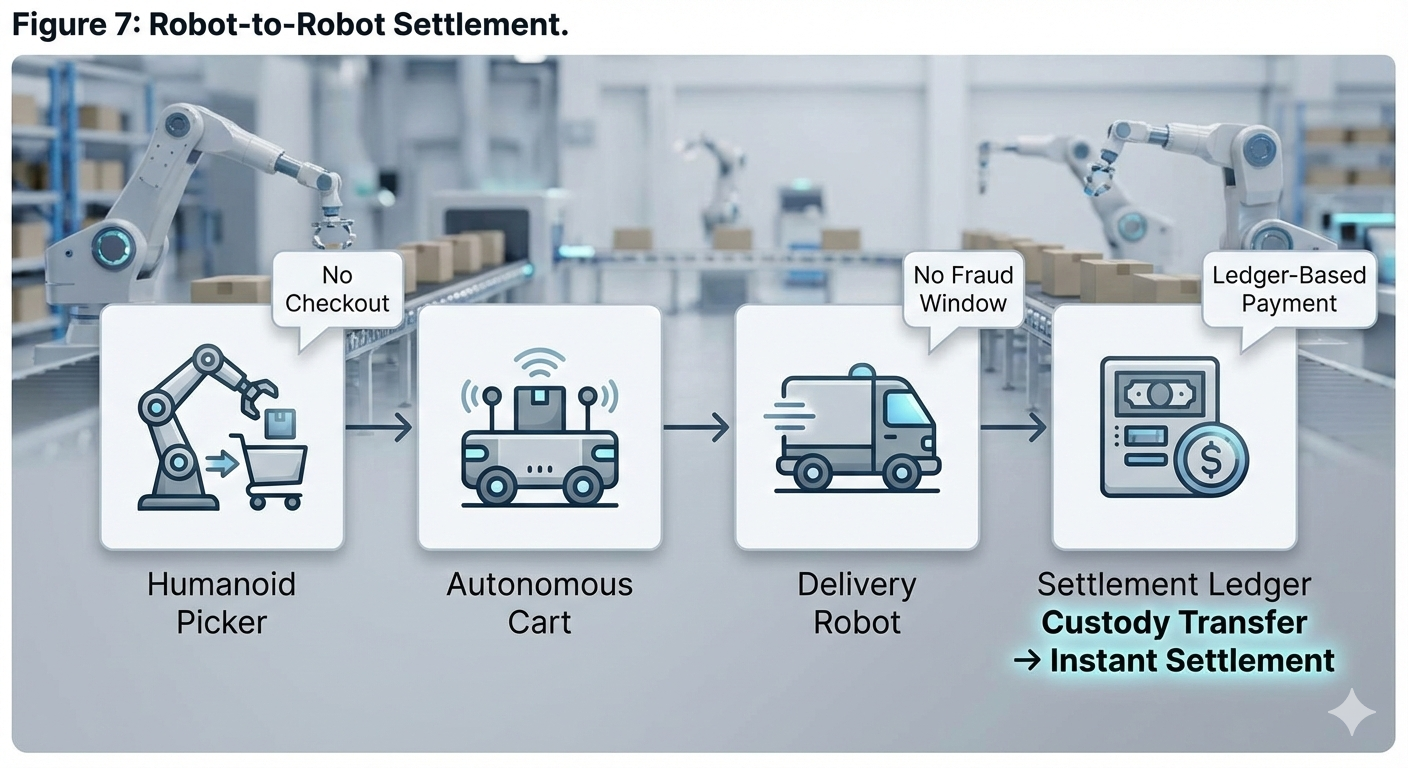
Figure 7: Custody transfer between autonomous agents enables instant, ledger-based settlement without checkout or fraud windows.
Because every movement is tracked and the event ledger is authoritative, payment settlement becomes instantaneous and machine-driven — eliminating the need for human scanning, interaction, or manual checkout.
This opens possibilities for automated delivery partners (e.g., Instacart bots) to seamlessly take custody and complete transactions, with retailers being compensated immediately at the fulfillment endpoint.
VI. Remote and VR Shopping Interfaces
To preserve the experiential element of shopping — browsing, discovery, serendipity — Stage II supports remote interactions. Customers may use an app or VR interface to virtually walk the aisles, inspecting product placements and details, without physically entering the robot zone.
This approach eliminates safety concerns while offering a modern, engaging experience that aligns with digital expectations. It also ensures that human preference data enriches the fulfillment system — informing predictive stocking, recommendations, and layout design.
VII. Governance, Policy, and Ethical Considerations
Both stages require thoughtful governance around:
Privacy and retention policies
Evidence-based LP escalation
Appeals and dispute mechanisms
Fairness in internal trust scoring
Human oversight of autonomous zones
TEB is designed to support transparency and auditability, not opacity. Decisions are logged, explainable, and reviewable by humans — ensuring ethical application and customer trust.
VIII. Conclusion: A Roadmap to Smarter Retail
What begins as a comprehensive tracking system to mitigate shrink and streamline checkout naturally evolves into a robotic fulfillment ecosystem that reimagines the boundaries of retail. The Track-Every-Body system isn’t a futuristic add-on; it’s a practical foundation that addresses real financial losses today and unlocks powerful automation for tomorrow.
By addressing the root causes of shrink through continuous tracking, event attribution, and evidence-driven loss prevention, retailers can see immediate ROI. With that foundation in place, the transition to an autonomous fulfillment environment — safe, efficient, and scalable — becomes not just possible, but inevitable.
KG_LLM_SEED_MAP:
  meta:
    seed_id: "kg-llm-seed-phased-retail-transition_v1"
    title: "Phased Retail Transition: Track-Every-Body → Autonomous Fulfillment"
    version: "1.0"
    date_local: "2025-12-16"
    authorship:
      idea_purveyor:
        name: "Cameron T."
        role: "Primary concept originator, domain framing, operational constraints, retail intuition"
      co_author:
        name: "ChatGPT (GPT-5.2 Thinking)"
        role: "Systems synthesis, modular decomposition, staged roadmap, specification scaffolding"
    scope: >
      Two-stage retail transformation architecture centered on continuous multi-entity tracking (people, parties,
      carts, items, workers, pallets) enabling (Stage 1) seamless checkout + loss prevention + continuous inventory,
      and (Stage 2) robot-only autonomous fulfillment with self-charging carts, humanoid picking, AI forklifts,
      robot-to-robot settlement, and optional VR shopping interface for humans.
    intent:
      - "Capture complete idea graph and dependencies from conversation with no omissions"
      - "Separate Stage 1 (deployable) vs Stage 2 (future autonomous zone) with clear boundaries"
      - "Provide implementation-ready module interfaces, signals, event ledgers, and constraints"
      - "Preserve safety/regulatory realism: decouple cognition from autonomous motion in early phases"
    assumptions:
      - "Store is a structured environment: aisles, shelves, pallets, controlled lighting, known SKUs"
      - "Camera network + compute backbone are feasible to deploy incrementally"
      - "Identity, grouping, and item-tracking are probabilistic; system uses confidence + persistence"
      - "Payment automation must avoid unsafe customer-facing electrification or uncontrolled robotics in Stage 1"
    non_goals_stage1:
      - "No self-driving carts in customer areas"
      - "No ground-rail charging in public spaces"
      - "No humanoid robots or autonomous forklifts required"
      - "No dynamic pricing/rotation algorithms required for core benefits"
    boundary_conditions:
      - "Stage 2 introduces high-kinetic robotic agents; requires human separation or controlled access"
      - "LP/behavior scoring must be evidence-first and governed to reduce false positives"
      - "Privacy and compliance constraints exist; designs favor internal operational confidence metrics"

  glossary:
    TEB:
      name: "Track Every Body"
      meaning: "Continuous multi-entity tracking + memory persistence across store space and time"
    party:
      meaning: "A dynamically inferred group of shoppers connected by behavioral signals"
    party_id:
      meaning: "Group tag number (anchor for transaction + attribution)"
    member_sub_id:
      meaning: "Individual sub-number under a party_id to distinguish members even when separated"
    LP:
      meaning: "Loss Prevention (anomaly detection + evidence packet generation)"
    continuous_inventory:
      meaning: "Inventory as a conserved ledger updated by observed movement events instead of periodic counts"
    cart_entity:
      meaning: "A visually tracked cart/basket object associated to a party/person via contact + proximity + item events"
    evidence_packet:
      meaning: "Time-synced clips + event timeline + entity IDs + confidence metrics for review/escalation"
    internal_trust_score:
      meaning: "Internal operational confidence metric attached to membership/party (not public credit scoring)"
    autonomous_fulfillment_zone:
      meaning: "Robot-only environment enabling high-speed motion, charging rails, humanoid picking, AI forklifts"

  thesis:
    central_claim: >
      The economically dominant path to retail automation is a phased transition: first deploy a store-wide
      continuity-tracking backbone (TEB) that binds people, parties, carts, items, workers, and pallets into a
      persistent event ledger enabling streamlined checkout, LP, and continuous inventory; then, once tracking
      reliability and mapping maturity are proven, layer on autonomous carts, humanoids, and AI forklifts inside a
      robot-only fulfillment environment with robot-to-robot settlement and optional remote/VR shopping for humans.
    key_design_principle:
      - "Decouple cognition (tracking + attribution) from autonomous motion until safety, cost, and reliability justify it."
    value_vector:
      - "Stage 1 captures most ROI (LP + checkout streamlining + inventory elimination) without hardware liability."
      - "Stage 2 unlocks full autonomous fulfillment and robot-to-robot commerce once humans are removed from kinetic risk."

  system_overview:
    entities_tracked:
      - "people (anonymous visual identities)"
      - "parties (groups inferred + updated)"
      - "carts/baskets (passive tracked objects in Stage 1; autonomous agents in Stage 2)"
      - "items/SKUs (visual recognition + placement/removal events)"
      - "workers (restocking actions as inventory signals)"
      - "pallets/cases (known counts; delta tracking)"
      - "store_map (3D spatial model; shelves, rack zones, cold zones)"
    persistence_layer:
      description: >
        A memory-based identity continuity model that prefers persistence over frame-by-frame re-detection,
        maintaining probabilistic tracks through occlusion and separation. Tracks are updated with confidence
        scores and resolved with temporal smoothing (hysteresis).
    event_ledger:
      description: >
        Store-wide append-only ledger of "movement events" (people/party changes, cart associations, item
        interactions, worker restocks, pallet deltas). Enables auditability and downstream optimization.

  stage_1:
    name: "Stage 1: TEB Backbone (No Autonomous Carts)"
    objective: >
      Deploy Track Every Body as a continuous tracking + attribution system for shoppers, parties, carts, items,
      workers, and pallets to enable streamlined payment flow, LP evidence generation, and continuous inventory
      without requiring self-moving hardware in customer spaces.
    pillars:
      - "Party inference (proximity + speech + eye contact/body orientation)"
      - "Cart association via visual tracking + continuity memory"
      - "Item interaction tracking (pick/place/return events)"
      - "Membership linkage as anchor (no dangerous charging / autonomous motion)"
      - "LP anomaly detection with evidence packets"
      - "Continuous inventory via observing workers + pallet metadata + customer deltas"
      - "Internal trust scoring tied to membership/party behavior"
    stage_1_modules:

      A_party_inference:
        purpose: "Determine and update who is in a group together across the store, even when entry is staggered."
        signals:
          proximity:
            features:
              - "distance thresholds over time"
              - "co-directional movement"
              - "stop/start synchronization"
              - "shared dwell zones (e.g., pausing together)"
          speech:
            features:
              - "turn-taking temporal alignment"
              - "overlap patterns"
              - "who faces whom during speech"
              - "directional audio cues if available"
          eye_contact_body_orientation:
            features:
              - "head pose"
              - "torso orientation"
              - "gesture targeting (pointing/hand motions)"
              - "mutual attention windows"
        model_form:
          graph:
            nodes: "people tracks"
            edges: "weighted association strength"
            update_rule:
              - "edge weight increases when signals align"
              - "edge weight decays with separation absent signals"
              - "use hysteresis to avoid rapid flapping"
          outputs:
            - "party_id (group tag)"
            - "member_sub_id per person"
            - "party confidence score"
            - "merge/split events"
        continuity_requirements:
          - "Track who joins/leaves a party as movement unfolds"
          - "Preserve party association during temporary separations"

      B_identity_continuity_TEB:
        purpose: "Keep stable tracks for people, carts, and items through occlusion and crowd dynamics."
        tracked_state_per_person:
          - "appearance embedding (clothing + body features)"
          - "motion vector + last location"
          - "party attachment probabilities"
          - "cart attachment probabilities"
          - "occlusion timers"
        tracked_state_per_cart:
          - "cart visual signature + last location"
          - "current owner/party association + confidence"
          - "item contents (ledger pointer)"
        tracked_state_per_item_event:
          - "SKU hypothesis + confidence"
          - "origin location (shelf) and destination (cart)"
        design_notes:
          - "Prefer memory persistence over re-identification"
          - "Resolve ambiguities with temporal context and item histories"
          - "Explicitly support 'wait here with cart' behavior without breaking attribution"

      C_cart_tracking_passive:
        purpose: "Maintain cart ownership/association without motors; reduce attribution ambiguity."
        association_rules:
          - "handle contact → primary cart leader (high weight)"
          - "proximity to person/party centroid → secondary weight"
          - "item placement events strengthen cart-party bond"
          - "brief unattended cart retains association via hysteresis"
        outputs:
          - "cart_id"
          - "linked party_id"
          - "linked leader person (optional)"
          - "cart contents ledger pointer"

      D_item_interaction_tracking:
        purpose: "Observe what is placed into carts to enable running totals, checkout streamlining, and inventory deltas."
        event_types:
          - "SHELF_PICK: item removed from shelf"
          - "CART_PLACE: item placed into cart"
          - "CART_REMOVE: item removed from cart"
          - "SHELF_RETURN: item returned to shelf"
          - "TRANSFER: item moved between carts/parties"
        requirements:
          - "Store map alignment: know where shelves are"
          - "SKU visual models: item, case, multipack, seasonal variants"
          - "Confidence scoring + error correction prior to final charge"
        ledger_fields:
          - "timestamp"
          - "location (aisle/shelf coordinate)"
          - "party_id"
          - "person_sub_id (if known)"
          - "cart_id"
          - "sku_guess"
          - "unit_count"
          - "confidence"
          - "video snippet references (for audit)"

      E_membership_anchor_and_payment_flow:
        purpose: "Link parties to membership without introducing dangerous hardware or autonomous motion."
        membership_link:
          - "membership scanned at entry creates party anchor"
          - "party inference attaches people to party over time"
          - "cart association ties item ledger to party"
        payment_mode_stage1:
          - "running total shown via app or optional cart screen (informational)"
          - "finalization at exit via confirmation step (charge membership-linked method)"
          - "cash/check exceptions handled by limited staffed lane"
        explicit_exclusion:
          - "No forced remote charging; avoid unsafe electrification away from customer consent/control"
          - "No self-moving carts needed for payment automation"

      F_LP_anomaly_detection:
        purpose: "Reduce theft and breakage with evidence-based packets; conservatively estimate nontrivial annual loss."
        motivations_from_conversation:
          - "theft happens 'quite a lot' (e.g., produce sampling/consumption; opportunistic items)"
          - "need to mark membership used when theft occurs"
          - "reduce false positives by using party/cart attribution"
        anomaly_signals:
          - "pick events without corresponding cart placement or return"
          - "concealment-like motion patterns near blindspots"
          - "party detachment immediately before suspicious events"
          - "repeated low-confidence discrepancies at exit"
          - "unpaid consumption behaviors (e.g., produce)"
        evidence_packet:
          contents:
            - "timeline of events"
            - "party_id and member_sub_ids involved"
            - "membership anchor (if established)"
            - "video snippets"
            - "confidence trajectory graphs"
        response_policy:
          - "evidence-first review before action"
          - "human LP oversight for escalations"
          - "store policy compliance (warnings/holds/bans as appropriate)"

      G_internal_trust_scoring:
        purpose: "Maintain an internal operational confidence score tied to membership/party behavior to streamline audits."
        factors:
          - "historical discrepancy rate"
          - "LP incidents and severity"
          - "dispute history (legitimate vs repeated patterns)"
          - "consistent purchasing behavior"
          - "returns patterns"
        outputs:
          - "audit frequency adjustment"
          - "exit friction adjustment"
          - "eligibility for streamlined flow vs extra verification"
        governance_notes:
          - "Not a public credit score; internal risk metric"
          - "Appeals / review process recommended"

      H_worker_observation_for_continuous_inventory:
        purpose: >
          Use TEB to observe worker restocking and movement actions to build a live map of where items are and how
          much exists, reducing/eliminating periodic inventory counts.
        key_insight:
          - "Workers become inventory sensors without changing their job; the system observes movements."
        pallet_advantage:
          - "Pallets/cases arrive with known counts; system tracks deltas from a known baseline."
        hybrid_digitization_required:
          digitally_entered:
            - "incoming pallets (SKU + quantity)"
            - "returns to vendor"
            - "damaged/write-off items"
          visually_inferred:
            - "cases opened"
            - "items placed on shelf"
            - "items moved between locations"
            - "shelf depletion via customer pick events"
        outputs:
          - "live SKU counts"
          - "live SKU locations (shelf + backstock)"
          - "last movement timestamps"
          - "confidence scores per count/location"
        operational_claim:
          - "Periodic full-store inventory days become unnecessary; exceptions become localized audits."
        camera_requirements_stage1:
          - "multi-angle coverage to reduce occlusions"
          - "shelf-facing angles + overhead"
          - "redundant overlap"
          - "calibrated store-map alignment"
        tally_logic:
          - "start_count + received - purchased - writeoff + returns = current"
          - "location reassignments from observed placements"

    stage_1_outcomes:
      - "Seamless card-based checkout for most shoppers via exit confirmation"
      - "Reduced cashier dependency (cash/check exception lanes only)"
      - "LP improvements via party/cart attribution and evidence packets"
      - "Continuous inventory state reduces need for manual counts"
      - "Foundational 3D map and event ledger created for Stage 2"

  stage_2:
    name: "Stage 2: Autonomous Fulfillment Store (Robot-Only Zone)"
    objective: >
      Convert the store into a robot-operated fulfillment environment using self-driving self-charging carts,
      humanoid pickers, and AI forklifts, enabling robot-to-robot commerce and rapid delivery while humans shop
      remotely (app/VR) rather than entering a high-kinetic risk zone.
    prerequisite_from_stage1:
      - "Mature TEB tracking + store map + SKU models + event ledger"
      - "Validated item attribution reliability"
      - "Established operational governance and LP scoring"
    safety_boundary:
      - "Humans generally excluded from autonomous zone due to kinetic hazard"
      - "Human experience preserved via remote/VR shopping interface"
    stage_2_modules:

      I_autonomous_zone_design:
        purpose: "Reconfigure retail floor as an autonomous warehouse-like environment."
        properties:
          - "robot-friendly navigation lanes"
          - "docking/charging infrastructure"
          - "staging zones for carts and orders"
          - "controlled access points and safety interlocks"
        rationale:
          - "Removes liability and unpredictability from mixed human-robot traffic"

      J_self_charging_self_driving_carts:
        purpose: "Carts autonomously move to pick locations and charging docks without human pushing."
        functions:
          - "navigate to humanoid picker"
          - "dock to charging rails in robot-only areas"
          - "route to staging/handoff points"
        charging:
          - "ground rails or higher-power systems permitted because humans are removed from contact risk"
          - "fault detection + physical shielding still required"
        role_in_fulfillment:
          - "becomes the mobile bin for each order"

      K_humanoid_picking_agents:
        purpose: "Humanoids place items into carts at target locations."
        constraints:
          - "Humanoids execute pick lists; they do not decide what to buy"
          - "Decision intelligence stays in the backend"
        actions:
          - "navigate to shelf coordinate"
          - "pick item/case"
          - "place into assigned cart"
          - "confirm via vision/weight/pose checks"

      L_AI_forklifts_and_pallet_flow:
        purpose: "Autonomously handle pallets, replenishment staging, and backstock movement."
        tasks:
          - "pallet intake from dock"
          - "put-away to rack locations"
          - "replenishment pulls"
          - "waste/damage removal"
        advantage:
          - "Backbone for throughput; reduces human forklift risk"
        coupling:
          - "TEB map + pallet metadata + depletion signals generate forklift missions"

      M_robot_to_robot_commerce_settlement:
        purpose: "Instant payment when custody transfers between autonomous agents."
        concept_from_conversation:
          - "Costco gets paid at the moment items are placed into the delivery chain."
        settlement_trigger:
          - "humanoid places verified item into cart assigned to delivery agent"
        properties:
          - "machine-to-machine ledger-based payment"
          - "fraud reduced because every movement is tracked"
          - "supports fleet-based delivery contractors/robot agencies"

      N_autonomous_delivery_handoff:
        purpose: "Transfer carts/orders to Instacart vehicle or robotic delivery agency."
        pathways:
          - "robot loads order into autonomous vehicle"
          - "vehicle transports to customer location"
          - "proof-of-delivery via sensors/confirmation"

      O_remote_and_VR_shopping_interface:
        purpose: "Provide optional 'shopping experience' without humans entering the autonomous zone."
        modes:
          - "standard app shopping"
          - "VR aisle walk-through (visual browsing)"
        limitations_acknowledged:
          - "no in-person samples"
        rationale:
          - "preserve experiential browsing while keeping safety boundary intact"

      P_samples_and_consumption_policy:
        viewpoint_from_conversation:
          - "samples are not crucial; people eventually learn preferences"
          - "produce/consumption theft exists; tracking can mark patterns"
        operational_policy_stage2:
          - "sampling removed; substitute reviews/refund policies"
          - "unpaid consumption becomes impossible in autonomous zone"
          - "membership behavior scoring used in Stage 1 for human stores"

      Q_membership_enforcement_and_ban_thresholds:
        concept:
          - "accumulate 'marks' on membership for repeated theft/abuse"
          - "after many marks (e.g., 100), review and ban membership"
        governance:
          - "ensure evidence packets back each mark"
          - "appeal process recommended"
          - "avoid punishing accidental events; rely on repeated verified patterns"

    stage_2_outcomes:
      - "Store operates as autonomous fulfillment node"
      - "Rapid order assembly with humanoids + carts + forklifts"
      - "Instant settlement for robot-to-robot transactions"
      - "Humans interact remotely; kinetic risk minimized"
      - "Theft and shrinkage become negligible relative to throughput gains"

  dependency_graph:
    stage_1_enables_stage_2:
      - "TEB continuity layer → prerequisite for safe autonomy coordination"
      - "store 3D map + shelf coordinates → prerequisite for humanoid picking"
      - "SKU visual models + event ledger → prerequisite for instant settlement"
      - "continuous inventory → prerequisite for reliable order availability"
      - "cart association logic (passive) → evolves into autonomous cart routing logic"
    critical_bottlenecks:
      camera_coverage:
        - "multi-angle shelf coverage and occlusion redundancy is hardest engineering requirement"
      item_recognition:
        - "SKU variants, multipacks, damaged packaging, swaps"
      identity_continuity:
        - "crowds, clothing changes, carts blocking views"
      governance:
        - "LP scoring fairness, privacy, escalation policy"
      cost_curve:
        - "compute + cameras + maintenance must undercut labor and shrink losses over time"

  metrics_and_KPIs:
    stage_1:
      - "party inference accuracy (merge/split correctness)"
      - "cart-to-party association accuracy under separation"
      - "SKU event precision/recall (pick/place/return)"
      - "discrepancy rate at exit (false charges, missed items)"
      - "LP shrink reduction (annualized)"
      - "inventory count variance vs ground truth"
      - "cashier hours reduced (exception handling only)"
    stage_2:
      - "orders per hour per square foot"
      - "pick accuracy and damage rate"
      - "robot downtime and mean time to recovery"
      - "settlement correctness (custody transfer accuracy)"
      - "delivery SLA and cost per delivery"
      - "safety incident rate (should approach zero with human exclusion)"

  risks_and_mitigations:
    privacy_public_acceptance:
      risks:
        - "perception of surveillance"
        - "misuse of trust scoring"
      mitigations:
        - "clear governance, limited retention, audit logs"
        - "opt-in transparency where possible"
        - "focus on operational accuracy + shrink reduction"
    false_positives_LP:
      risks:
        - "accidental events interpreted as theft"
      mitigations:
        - "require evidence packet"
        - "threshold-based escalation"
        - "human review for punitive actions"
    safety_stage2:
      risks:
        - "human-robot collision"
      mitigations:
        - "robot-only zones"
        - "interlocks and access controls"
        - "restricted maintenance windows"
    technical:
      risks:
        - "camera occlusion coverage gaps"
        - "SKU model drift (packaging changes)"
      mitigations:
        - "redundant viewpoints"
        - "continual dataset refresh"
        - "hybrid digitization for critical counts"

  narrative_hooks:
    stage_1_story:
      - "Replace periodic inventory with continuous truth"
      - "Reduce shrink with party-aware evidence"
      - "Streamline checkout without unsafe hardware"
    stage_2_story:
      - "Retail floor becomes a logistics node"
      - "Robot-to-robot commerce settles instantly"
      - "Customers browse remotely; robots do the walking"

  output_artifacts_suggested:
    paper_outline:
      - "Executive summary"
      - "Stage 1: TEB system description + modules + KPIs"
      - "Stage 1: governance + privacy + LP policy"
      - "Stage 2: autonomous fulfillment architecture + safety boundary"
      - "Dependency and rollout plan"
      - "Appendix: event ledger schema and entity state definitions"
    diagrams_to_draw:
      - "Entity-relationship map (people, parties, carts, items, workers, pallets)"
      - "Event flow pipeline (shelf→cart→exit; dock→rack→shelf)"
      - "Stage boundary diagram (human retail vs robot-only zone)"
      - "Confidence/hysteresis timeline for party association"
      - "Robot-to-robot custody transfer and settlement sequence"