Cycle Log 38

Image created with Gemini 3 Pro with prompt construction by GPT 5.2
Structural Liquidity Absorption and Nonlinear Price Dynamics in XRP
synthesized with the help of Chat GPT 5.2
I. Introduction: Why Supply, Not Narrative, Matters
This is third post in the series on XRP ETFs. For necessary background information, please read the first and second papers by clicking on the hyperlinks in this sentence!
Most discussions around XRP pricing focus on circulating supply, market capitalization, or headline-driven catalysts. These variables are useful for context but are blunt instruments for understanding price formation under sustained institutional demand. What actually governs price behavior—especially in structurally constrained markets—is effective tradable supply, not total supply.
This paper frames XRP price dynamics through the lens of:
liquidity absorption,
ETF-driven demand,
and a market state variable referred to here as the I-Factor (impact multiplier),
which together determine how sensitive price becomes to marginal buying as tradable supply is removed.
The core claim is straightforward: once enough XRP is absorbed from the market, price behavior changes class. It stops responding linearly to flows and becomes structurally unstable.
II. Effective Float and the Meaning of “Absorption”
XRP’s headline circulating supply is misleading for medium-term price analysis. Only a fraction of XRP is actually available for sale at any moment. Exchange balances, OTC liquidity, and responsive holders define what we call the effective float.
Based on observed exchange reserves and recent drawdowns:
A reasonable working estimate for effective float is on the order of ~6 billion XRP
The responsive subset—XRP that will sell near current prices—is likely smaller
Absorption refers to XRP being removed from this float through:
ETF custody,
institutional cold storage,
authorized participant (AP) pre-positioning,
or long-term strategic holdings.
This is not theoretical. Over roughly one month:
Exchange reserves declined by approximately $1.3 billion
This implies roughly ~600 million XRP has already left the tradable pool
Notably, this occurred before the full set of spot ETFs has gone live.
III. ETF Product Types and Why They All Matter
The ~$1.3B absorbed so far did not originate from spot ETFs alone. It reflects the combined effect of several product types and behaviors, including:
Futures-based XRP ETFs
Leveraged and inverse products
Hybrid spot/futures structures
Institutional pre-positioning ahead of anticipated spot approvals
While futures and leveraged ETFs do not hold XRP one-to-one, they force hedging behavior that still removes sell-side liquidity. Hybrid products absorb XRP directly. Pre-positioning quietly drains exchanges before public AUM figures ever appear.
At present:
Roughly five XRP ETF-type products are already influencing flows
An additional five pure spot XRP ETFs are late-stage:
DTCC-ready
exchange-mapped
operationally complete
awaiting final effectiveness
Once these spot ETFs go live, the market transitions from partial absorption to mechanical, continuous removal of XRP.
IV. The I-Factor: A Market State Variable
The I-Factor is not price, volume, or volatility. It is a state variable describing how much price impact results from marginal net buying.
At low absorption:
I-Factor ≈ 1
Order books refill
Price responds approximately linearly
As absorption rises:
Sellers become selective
Market makers reduce depth
Liquidity decays faster than price rises
Empirically across assets, the critical transition occurs around 40–60% absorption of the effective float. Beyond this window, markets stop trending smoothly and begin repricing in jumps.
Importantly, the I-Factor does not reset quickly. Once elevated, it can persist for days or weeks, allowing price effects to compound over time rather than occurring as a single spike.
V. Price Multiples Are Not “Per Dollar”
The price multiple associated with a given I-Factor is often misunderstood. It is not a per-dollar elasticity and does not mean each dollar of buying moves price by X.
Instead, it describes the typical repricing range once liquidity fails.
At low I-Factor:
Demand shocks cause small moves
Mean reversion dominates
At high I-Factor:
The same shock can force price to jump several times higher
A new equilibrium is found only after price gaps upward
When this occurs repeatedly, because buying is continuous rather than episodic, the effects compound. This is why relatively small, routine flows can produce multi-X outcomes once the market is sufficiently stressed.
VI. Time to the 40% Threshold Under Combined ETF Pressure
With an effective float of ~6B XRP, the 40% absorption threshold corresponds to approximately ~2.4B XRP removed from the market.
Given that:
~600M XRP has already been absorbed,
roughly ~1.8B XRP remains before entering the regime-change zone.
Under conservative assumptions:
Existing five ETF-type products are absorbing approximately:
~160M XRP per week
Five incoming spot ETFs, extrapolated from Bitcoin spot ETF behavior and scaled to XRP at 60–160%, imply:
~84M to ~217M XRP per week at current prices
Combined absorption once all ten products are active:
~244M to ~377M XRP per week
At that rate:
The remaining ~1.8B XRP is absorbed in roughly 5–7 weeks
Plus any delay associated with spot ETF launches
Even allowing for a 1–4 week launch window, the total timeline from today to the high-sensitivity regime is on the order of ~1.5 to ~3 months.
This estimate already accounts for early, quiet absorption that has occurred ahead of public visibility.
VII. What Happens After 40%: The Logical Consequence
Once the ~40% threshold is crossed, price sensitivity becomes extreme.
At this point:
Continuous ETF buying no longer just pushes price higher
It changes how price is formed
Key characteristics of this regime include:
Liquidity failing to refill between buys
Each inflow landing on a thinner book than the last
Small imbalances producing large gaps
If ETF buying continues at anything resembling current rates over the following 6–12 months, the logical outcome is not steady appreciation but episodic repricing.
Price advances in steps:
surge,
pause,
surge again,
often overshooting what linear models would suggest. Resolution only occurs when:
new supply overwhelms demand, or
price overshoots enough to forcibly unlock sellers
Until then, the system remains unstable by construction.
VIII. Illustrative Price Trajectory Beyond the 40% Absorption Threshold (Nonlinear Regime)
As effective XRP float absorption approaches approximately 40%, the market transitions into a fundamentally different price-formation regime. In this state, price behavior is no longer well described by linear liquidity assumptions or smooth equilibrium curves. The dominant driver becomes marginal price sensitivity, captured in this framework by the I-Factor. Crucially, the I-Factor is not a direct price multiplier, but a measure of how strongly incremental demand impacts price as available liquidity is progressively depleted.
Around the 40% absorption level, the modeled I-Factor reflects a multiple-times increase in marginal price impact relative to low-absorption conditions. Practically, this means that each additional unit of net buying pressure moves price several times more than it would have earlier in the cycle. This does not imply an immediate or mechanical jump to a fixed multiple (for example, “6× price instantly”), but rather that the slope of the price-impact curve steepens sharply, allowing price acceleration to emerge under persistent demand.
To examine this regime conservatively, the model incorporates two stabilizing assumptions. First, it allows the effective float to expand gradually as price rises, reflecting the participation of previously dormant sellers. Second, ETF-driven buying is treated as dollar-denominated, meaning the quantity of XRP purchased per unit time declines as price increases. Together, these assumptions intentionally smooth the modeled price path and suppress runaway behavior, establishing a defensible lower bound for potential repricing under sustained demand.
Within this constrained framework, the lower-bound inflow scenario yields a repricing into the mid-single-digit to high-single-digit range within several months, extending into the low-teens over a twelve-month horizon. The higher-bound scenario progresses more rapidly, reaching the upper-single-digit range within months and advancing toward the high-teens over a similar period. These price ranges are derived from smoothed, conservative extrapolations of the modeled path and should be interpreted as outputs of a linearized or gently nonlinear approximation—not as hard ceilings on price.
In real market conditions, however, absorption near and beyond the 40% threshold produces genuinely nonlinear dynamics. Marginal price sensitivity remains elevated, liquidity thins faster than it can be replenished, and price evolution becomes increasingly path-dependent and reflexive. Under sustained demand, the system does not converge toward a stable price range; instead, it admits the possibility of accelerating, potentially exponential repricing until sufficient new supply is induced. Beyond this point, no intrinsic upper bound is imposed by the model itself—the eventual price level is determined by the price at which sellers are finally compelled to restore balance.
Within this post-40% environment, price behavior becomes time-integrated rather than event-driven. Temporary sell clusters at psychological price levels may briefly relieve pressure and dampen the I-Factor, but persistent net demand, particularly from ETF-driven accumulation, quickly establishes a new, higher price floor. From that base, liquidity tightens again, marginal sensitivity rises, and the cycle repeats. The resulting structure resembles a stair-step pattern of higher baselines and renewed instability, in which price movements compound over time even though no single step represents a simple multiplicative jump.
The key implication is that entry into a sustained high-I-Factor regime fundamentally alters the requirements for price appreciation. Continued inflows need not accelerate; steady, mechanical demand alone is sufficient to maintain structural fragility. In such conditions, relatively modest incremental buying can produce outsized price movements. The most important consequence of ETF-driven absorption, therefore, is not any specific price target (Because no one can really know what the price will be in an extremely high I regime over a certain period of time), but the creation of an extended window in which XRP trades in a nonlinear, reflexive price-discovery regime, characterized by sharp repricing events and the rapid formation of successive price floors rather than gradual, linear adjustment.
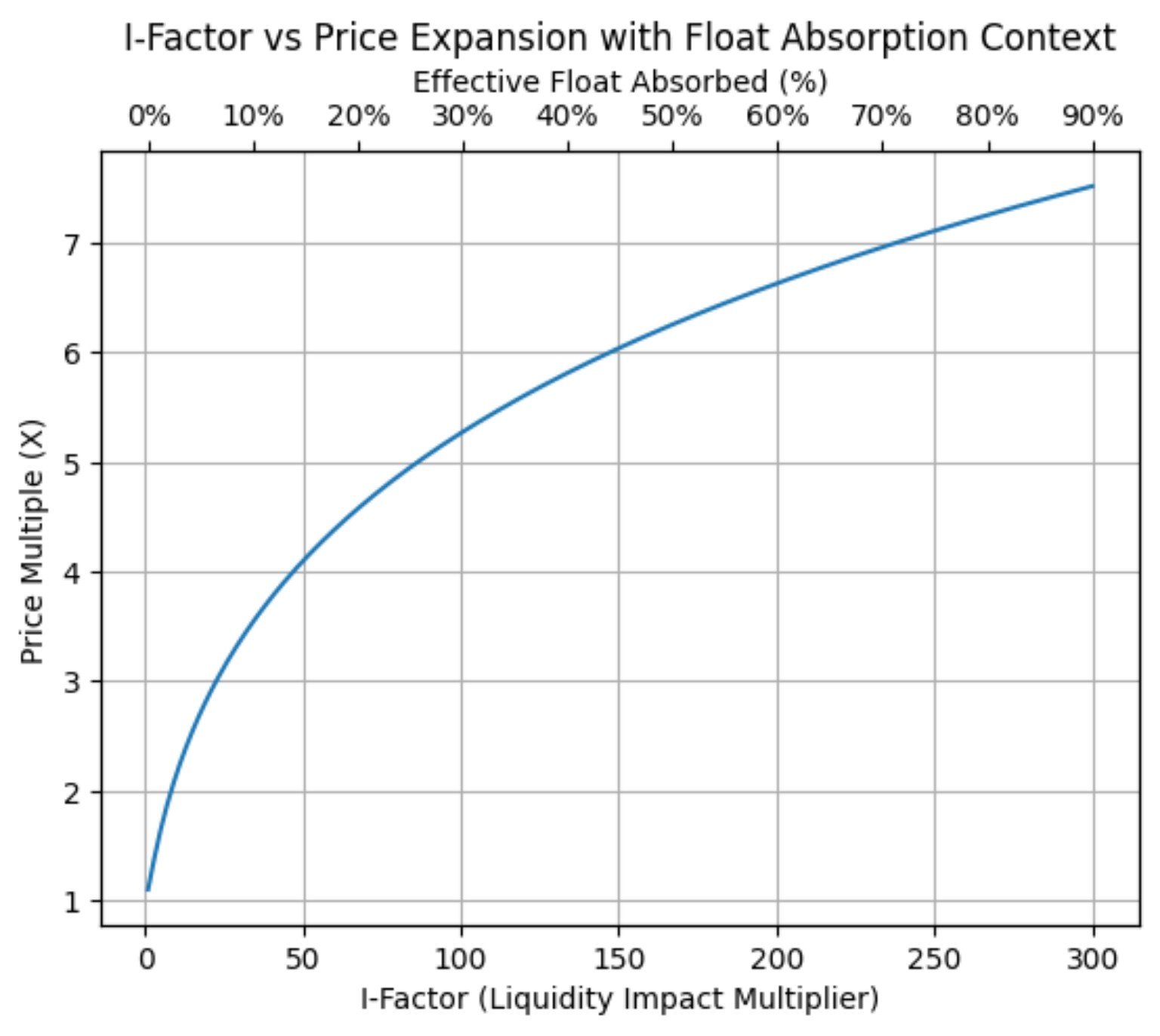
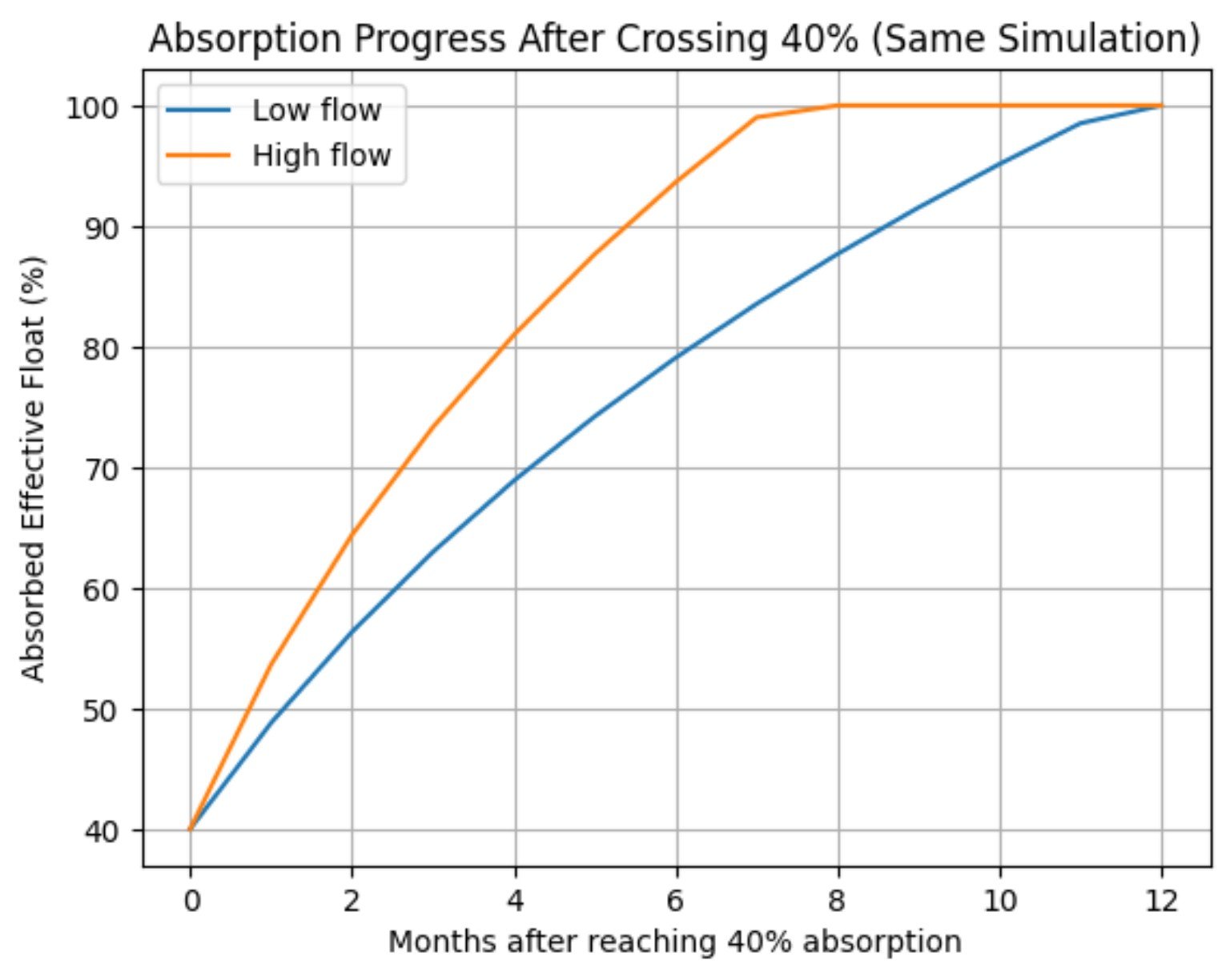
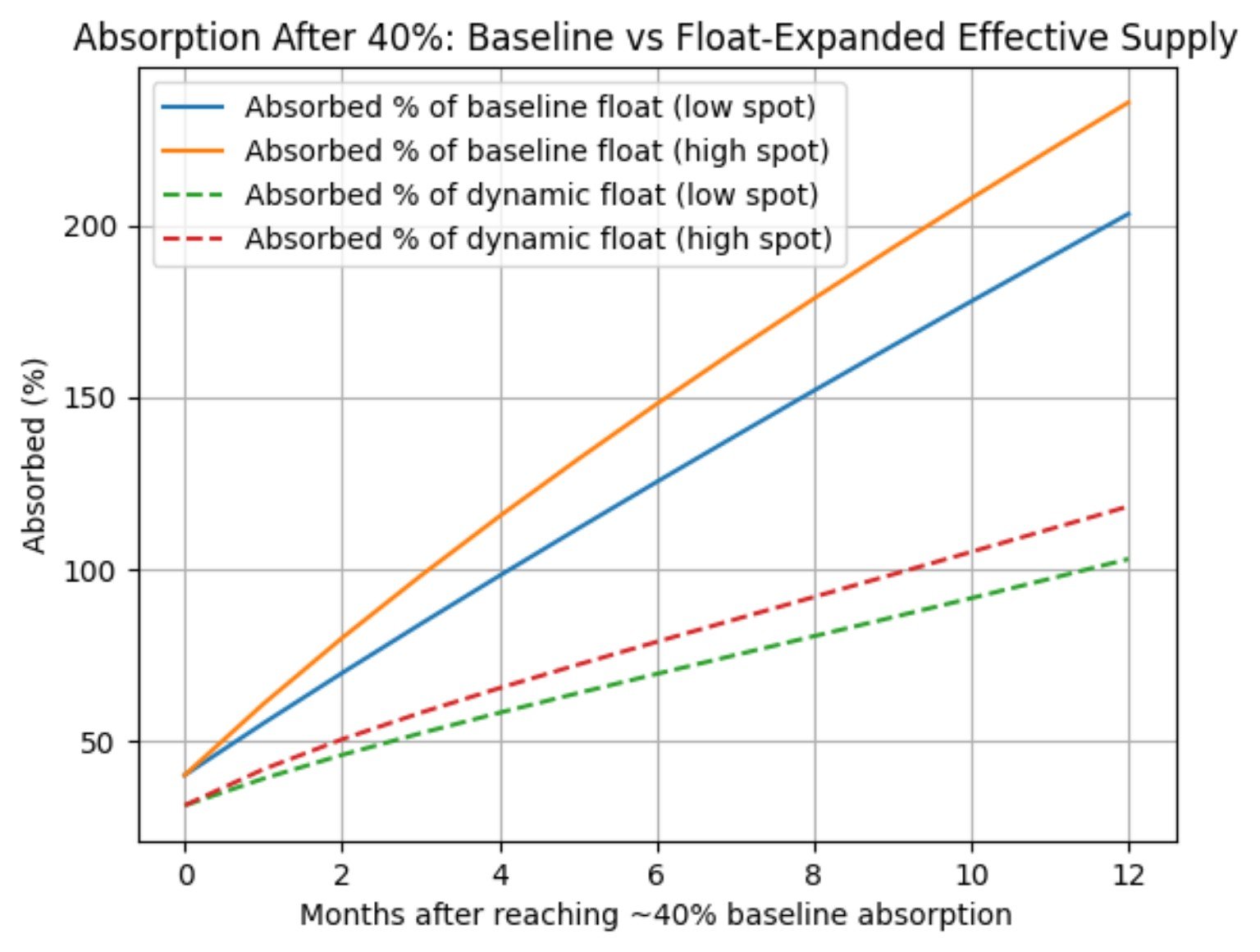
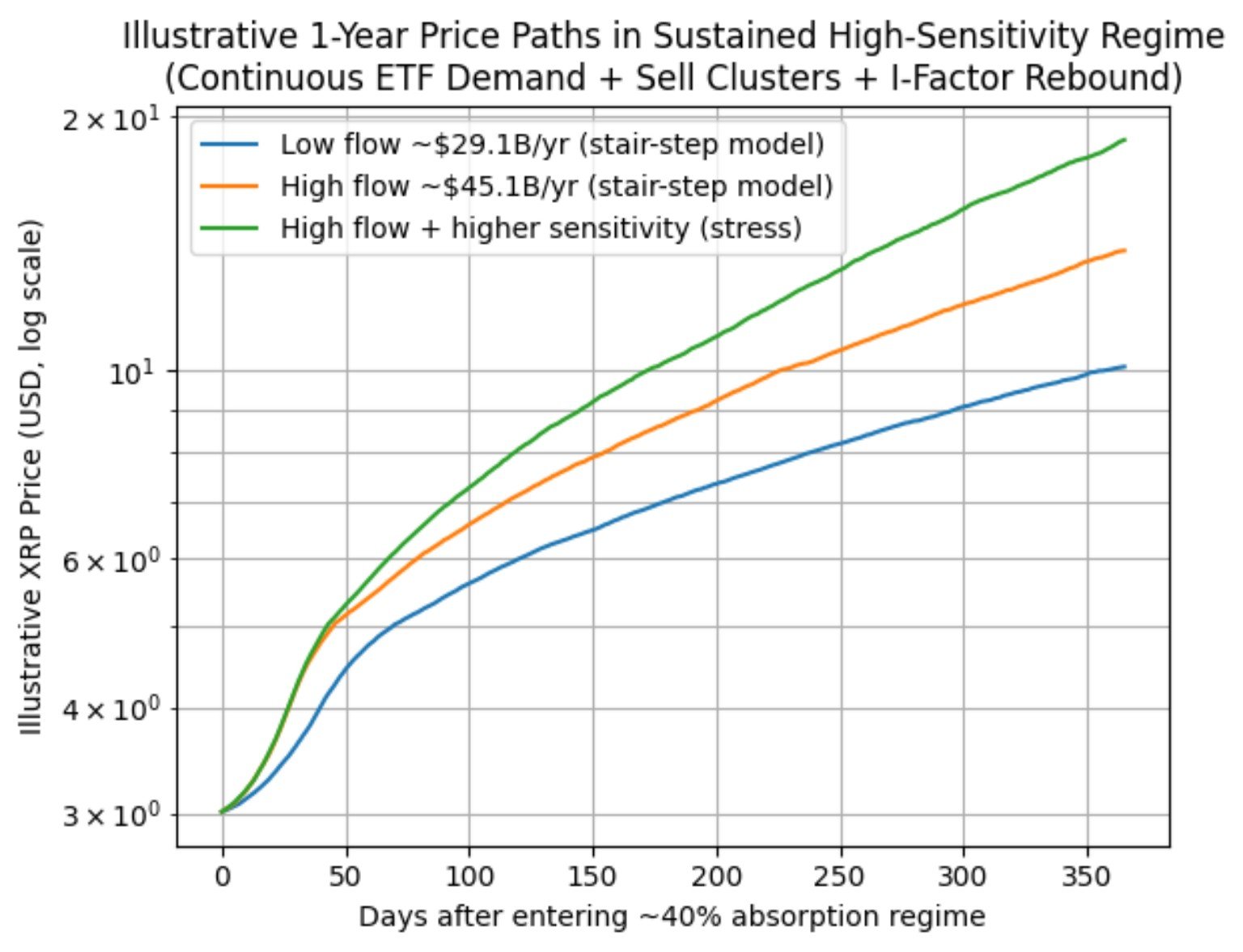
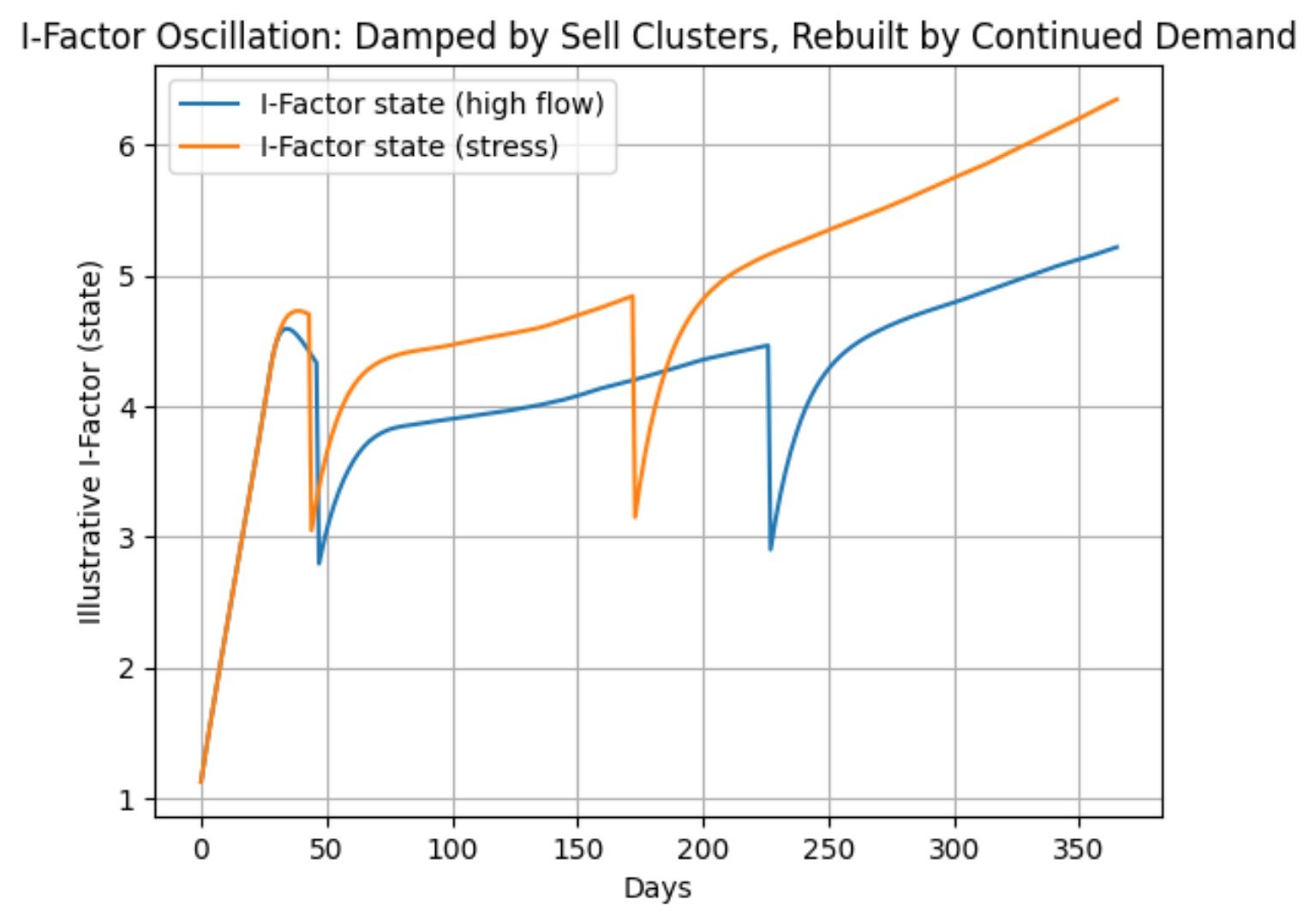
Figure 1 — I-Factor vs. Price Expansion with Float Absorption Context
This figure shows how price expansion scales with the I-Factor (liquidity impact multiplier), with effective float absorption shown on the upper axis. As absorption increases, marginal price sensitivity rises nonlinearly, illustrating why price behavior transitions from linear to unstable well before absolute scarcity is reached. The curve represents state-dependent repricing potential, not per-dollar price impact.
Figure 2 — Absorption Progress After Crossing ~40% Effective Float
This chart tracks how effective float absorption continues after the ~40% regime threshold under two demand scenarios (low flow and high flow). Even as rising prices reduce XRP-denominated buying, sustained dollar-based inflows continue to push absorption toward higher scarcity states over time.
Figure 3 — Baseline vs. Float-Expanded Absorption After 40%
This figure compares absorption measured against a fixed baseline effective float versus a dynamically expanding float that accounts for new sellers entering as price rises. The dashed curves show that while float expansion moderates absorption pressure, it does not eliminate it under continuous demand, preserving structural liquidity stress.
Figure 4 — Illustrative One-Year Price Paths in a Sustained High-Sensitivity Regime
This chart presents illustrative price trajectories over one year after entering the high-I-Factor regime. The stair-step pattern reflects episodic sell clusters that briefly dampen price sensitivity, followed by renewed upward repricing as ETF demand persists. These paths are intentionally smoothed and conservative, serving as lower-bound illustrations rather than upper limits.
Figure 5 — I-Factor Oscillation: Damped by Sell Clusters, Rebuilt by Continued Demand
This figure shows how the I-Factor evolves over time in a stressed liquidity environment. Temporary sell clusters reduce sensitivity, but continued net demand rapidly rebuilds the I-Factor, leading to repeated cycles of stabilization and renewed instability. The result is a sequence of higher price floors rather than sustained mean reversion.
KG_LLM_SEED_MAP:
  seed_id: "EXARRPEE-XRP-ETF-LIQUIDITY-IFACTOR-2025-12-13-REV2"
  author: Cameron T.
  scope:
    topic: "XRP ETF-driven liquidity absorption, effective float, I-Factor regime shifts, and reflexive price dynamics"
    purpose:
      - "Encode a coherent world-model for reasoning about XRP price dynamics under constrained tradable supply."
      - "Separate 'headline supply' from 'effective/available float' and model phase transitions as absorption rises."
      - "Provide a reusable framework to extrapolate ETF inflows and estimate time-to-regime thresholds."
    assumptions_boundary:
      - "This seed captures a conceptual + quantitative framework; it is not a guarantee of ETF approvals, inflow magnitudes, or price outcomes."
      - "Numbers used are scenario inputs discussed in-chat (e.g., $10B–$26B/yr, 6B float, 160M XRP/week), not verified facts."

  entities:
    Asset:
      - id: "asset:xrp"
        type: "crypto_asset"
        attributes:
          base_price_anchor_usd: 2.30
          circulating_supply_note: "Not used as primary driver; focus is on effective tradable float."

    SupplyConstructs:
      - id: "supply:headline_circulating"
        type: "supply_metric"
        description: "Total circulating XRP supply; too coarse for short/medium-term price impact modeling."
      - id: "supply:exchange_reserves"
        type: "supply_metric"
        description: "XRP on exchanges; proxy for immediately sellable inventory."
      - id: "supply:effective_float"
        type: "derived_supply_metric"
        description: "Responsive/available tradable inventory relevant for price impact; smaller than circulating supply."
        candidate_values:
          - value: 6_000_000_000
            unit: "XRP"
            label: "effective_market_float_estimate"
          - value_range: [3_200_000_000, 4_000_000_000]
            unit: "XRP"
            label: "responsive_liquidity_range"
        notes:
          - "Effective float can expand as price rises (more holders willing to sell), but may lag at higher absorption."
          - "Effective float is the key state variable for I-Factor escalation."

    ProductTypes:
      - id: "etf_type:futures"
        type: "exposure_vehicle"
        description: "Futures-based ETF products; do not necessarily hold spot XRP 1:1 but drive hedging demand."
      - id: "etf_type:leveraged"
        type: "exposure_vehicle"
        description: "Leveraged ETF products; can amplify hedging/market-maker inventory effects."
      - id: "etf_type:hybrid"
        type: "exposure_vehicle"
        description: "Hybrid spot/futures structures; partial direct spot absorption + derivatives overlay."
      - id: "etf_type:spot"
        type: "exposure_vehicle"
        description: "Pure spot ETFs; mechanically remove XRP from circulating tradable supply into custody."
      - id: "flow:pre_positioning"
        type: "institutional_flow"
        description: "APs/market makers/funds accumulating XRP ahead of spot ETF launch; manifests as exchange outflows."

    Actors:
      - id: "actor:authorized_participants"
        type: "market_actor"
        role: "Create/redeem ETF shares; source/hedge underlying exposure."
      - id: "actor:market_makers"
        type: "market_actor"
        role: "Provide liquidity; may pull depth when volatility rises or inventory risk increases."
      - id: "actor:institutions"
        type: "market_actor"
        role: "Large buyers; can accumulate via OTC/custody; may front-run expected ETF demand."
      - id: "actor:holders"
        type: "market_actor"
        role: "Long-term XRP holders; become less willing to sell as price rises (seller withdrawal)."

  observables_inputs:
    ExchangeReserveUSDChange:
      id: "obs:exchange_reserve_usd_outflow_30d"
      type: "observable"
      description: "Exchange reserve value fell by roughly $1.3B over ~30 days."
      derived_implication:
        - "Translate $ outflow into XRP units using price range to estimate XRP leaving exchanges."
      xrp_equivalent_estimate:
        range_xrp: [550_000_000, 650_000_000]
        midpoint_xrp: 600_000_000
        price_assumption_range_usd: [2.0, 2.3]

    AUM_XRP_ETF_Complex:
      id: "obs:xrp_etf_complex_aum"
      type: "observable_assumption"
      description: "In-chat assumption: ~$1.3B total AUM/absorption across existing ETF-type products."
      xrp_equivalent_midpoint:
        usd: 1_300_000_000
        price_usd: 2.30
        xrp: 565_217_391

  core_concepts:
    Absorption:
      id: "concept:absorption"
      description: "Net removal of XRP from readily tradable venues into custody/cold storage/ETF structures."
      measure:
        absorbed_xrp: "A"
        absorbed_fraction: "f = A / effective_float"
      key_thresholds:
        - name: "regime_change_zone"
          f_range: [0.40, 0.60]
          meaning: "I-Factor accelerates; discontinuous price discovery becomes dominant."
        - name: "scarcity_panic_zone"
          f_range: [0.60, 0.90]
          meaning: "Order books fracture; marginal buying can induce multi-X repricing."

    MarketRegimeClass:
      id: "concept:market_class_transition"
      description: "Discrete change in price-formation behavior as effective float absorption rises."
      classes:
        - name: "linear_liquidity"
          absorption_range: "0–20%"
          behavior: "Price responds proportionally; liquidity replenishes."
        - name: "unstable_transition"
          absorption_range: "20–40%"
          behavior: "Liquidity decays faster than price rises; volatility increases."
        - name: "nonlinear_reflexive"
          absorption_range: "40%+"
          behavior: "Price becomes path-dependent, discontinuous, and reflexive."
      note: "This represents a class change, not a smooth parameter shift."

    IFactor:
      id: "concept:i_factor"
      description: "Liquidity impact multiplier capturing price sensitivity to marginal net buying."
      properties:
        - "Nonlinear (often exponential) growth as absorption rises."
        - "Reflects depth decay, seller withdrawal, and market-maker de-risking."
      qualitative_mapping_f_to_I:
        - f: "0–10%"   ; I_range: "1–2"
        - f: "10–20%"  ; I_range: "2–4"
        - f: "20–30%"  ; I_range: "4–8"
        - f: "30–40%"  ; I_range: "8–15"
        - f: "40–50%"  ; I_range: "15–30"
        - f: "50–60%"  ; I_range: "30–60"
        - f: "60–75%"  ; I_range: "60–120"
        - f: "75–90%"  ; I_range: "120–300+"

    PriceMultiple:
      id: "concept:price_multiple"
      description: "State-dependent repricing amplitude from local equilibrium under stressed liquidity."
      warning:
        - "Not per-dollar and not linear."
      mapping_I_to_X_multiple_heuristic:
        - I: "1–5"       ; X_range: "1.0–1.3x"
        - I: "10"        ; X_range: "~2x"
        - I: "20–30"     ; X_range: "~3–4x"
        - I: "40–60"     ; X_range: "~4–6x"
        - I: "80–120"    ; X_range: "~6–9x"
        - I: "150–300"   ; X_range: "10x+ possible"

    MechanicalDemand:
      id: "concept:mechanical_demand"
      description: "Rules-based, price-insensitive demand operating independently of short-term market conditions."
      sources:
        - "ETF creation/redemption mechanics"
        - "Index mandates"
        - "Regulatory-driven positioning"
      properties:
        - "Continuous"
        - "Non-opportunistic"
        - "Removes supply rather than recycling it"

    UpperBoundConstraint:
      id: "concept:no_intrinsic_price_cap"
      description: "In sustained high-I regimes, price is not bounded by model extrapolations."
      rule:
        - "Upper bound determined solely by seller emergence, not by demand exhaustion."

  processes_dynamics:
    EffectiveFloatCompression:
      id: "process:float_compression"
      description: "ETF + institutional absorption shrinks effective float; sensitivity rises nonlinearly."

    FeedbackLoops:
      id: "process:reflexive_feedback"
      loops:
        liquidity: "Higher price → fewer sellers → thinner books → higher I → higher price"
        volatility: "Larger candles → MM de-risk → depth withdrawal → larger candles"
        psychology: "Holders wait → supply vanishes → price jumps → holders wait longer"

    StairStepRepricing:
      id: "process:stair_step_repricing"
      description: "Surge–pause–surge price progression driven by persistent demand and temporary seller release."
      outcome:
        - "Successively higher price floors"
        - "Compounding instability without single-step multiplication"

  key_claims_from_chat:
    - id: "claim:time_compression_to_instability"
      statement: "Under combined ETF pressure, transition to nonlinear pricing occurs over weeks to months, not years."
    - id: "claim:critical_zone_40_to_60pct"
      statement: "True nonlinear behavior typically begins around 40–60% effective float absorption."

  glossary:
    effective_float: "Tradable inventory that responds to price."
    absorption: "Net removal of tradable XRP from circulation."
    I_factor: "State variable governing marginal price sensitivity."
    mechanical_demand: "Non-discretionary, rules-based buying."
    stair_step_repricing: "Compounded price advances via successive instability."